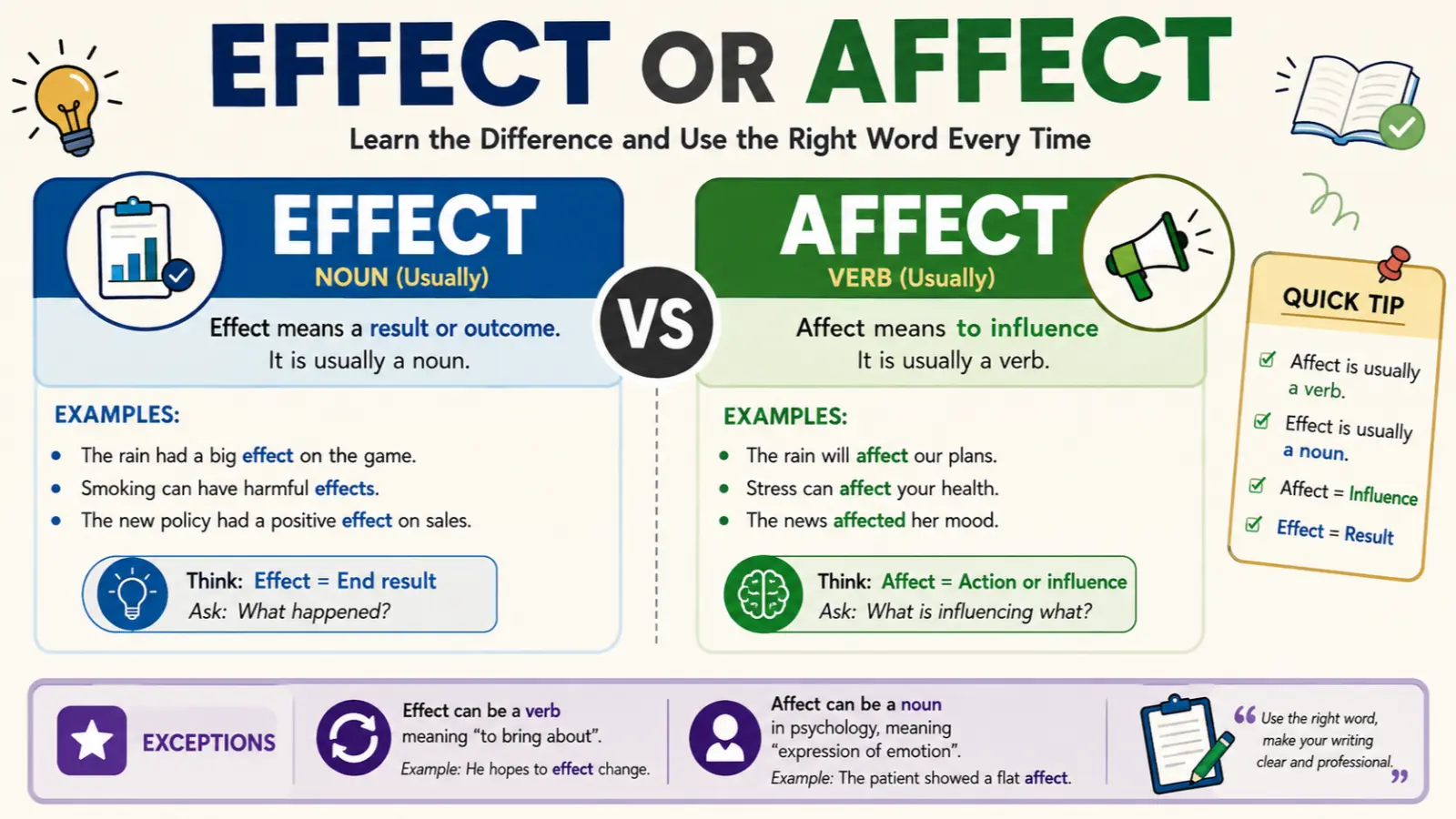
Effect or affect is a common English word choice problem. The two words look and sound similar, but they usually play different roles in a sentence. The easiest way to remember the difference is simple: affect is usually a verb, while effect is usually a noun.
Effect or Affect is a common English word confusion that can make writing tricky. Although both words are related to change or influence, they have different meanings and grammatical roles. Affect is usually a verb, while effect is usually a noun.
Understanding the difference between effect and affect can help you write more clearly and confidently. In this guide, you will learn their meanings, simple examples, and easy ways to remember which word to use.
However, English has a few exceptions. In some situations, effect can work as a verb, and affect can work as a noun. This guide explains their meanings, grammar rules, sentence structure, common mistakes, and everyday usage in simple English.
Effect or Affect Category
Effect vs affect is mainly a grammar comparison and similar word usage topic. Both words are correct, but they serve different grammatical purposes in most sentences.
The basic rule is:
- Affect usually means to influence something.
- Effect usually means a result or outcome.
- Effect can also mean to cause something to happen.
- Affect can rarely be used as a noun in psychology.
What Does Affect Mean?
Affect is usually a verb. It means to influence a person, thing, situation, or result.
For example:
Lack of sleep can affect your mood.
Here, affect means “influence.”
More examples include:
- Loud noise can affect your concentration.
- The weather affected our travel plans.
- Stress can affect your health.
- The new policy may affect employees.
- Music can affect your emotions.
A simple question can help you identify affect:
Is something influencing something else?
If the answer is yes, affect is usually the right choice.
What Does Effect Mean?
Effect is usually a noun. It means the result or consequence of an action.
For example:
Lack of sleep had an effect on my mood.
Here, effect means “result.”
More examples include:
- The medicine had a strong effect.
- The storm caused serious effects.
- The new rule had an unexpected effect.
- Exercise can have positive effects.
- The decision had a lasting effect on the company.
A useful question is:
What was the result?
If you are talking about a result, effect is usually correct.
The Main Grammar Difference
The most useful distinction is based on the part of speech.
| Word | Usual role | Basic meaning | Example |
|---|---|---|---|
| Affect | Verb | Influence | Stress can affect sleep. |
| Effect | Noun | Result | Stress can have an effect on sleep. |
Compare these two sentences:
The heat affected my energy.
Here, affected is a verb because the heat influenced my energy.
The heat had an effect on my energy.
Here, effect is a noun because it describes the result.
This simple pattern solves most effect or affect questions.
Affect as a Verb
Affect commonly describes an influence.
The basic sentence structure is:
Subject + affect + object
Examples:
- The noise affected my work.
- The news affected her mood.
- The delay affected our schedule.
- The price increase affected customers.
- The accident affected traffic.
Notice that affect comes directly after the subject in these examples.
Affect in Different Tenses
Affect changes like other regular verbs.
Present:
The weather affects my plans.
Past:
The weather affected my plans.
Future:
The weather will affect my plans.
Present perfect:
The weather has affected my plans.
The meaning remains connected to influence.
Effect as a Noun
Effect usually describes a result.
Common sentence patterns include:
Subject + have + an effect + on + object
Examples:
- Exercise has a positive effect on health.
- The news had a major effect on her.
- The change had little effect on sales.
- Sleep has an important effect on concentration.
Another common structure is:
Cause + effect
For example:
Heavy rain caused flooding.
The flooding is the effect of the heavy rain.

Effect as a Verb
There is an important exception to the basic rule.
Effect can also be a verb. As a verb, it means to bring about or make something happen.
For example:
The new manager hopes to effect positive changes.
This means the manager hopes to bring about positive changes.
Another example is:
The company wants to effect a major transformation.
Here, effect does not mean influence. It means cause the transformation to happen.
This use is more formal and less common in everyday conversation.

Affect as a Noun
Affect can also be a noun, but this use is mainly found in psychology and related professional fields.
In this context, affect refers to the visible expression of emotion.
For example:
The patient showed a flat affect.
This meaning is different from the common verb affect.
For everyday writing, you will usually encounter affect as a verb and effect as a noun.
Effect or Affect in Everyday Sentences
Here are some quick comparisons.
Affect:
The loud music affected my concentration.
Effect:
The loud music had an effect on my concentration.
Affect:
The new schedule affected everyone.
Effect:
The new schedule had an effect on everyone.
Affect:
Lack of sleep affects your memory.
Effect:
Lack of sleep can have a negative effect on memory.
The meaning is closely related, but the grammar changes.

Common Mistakes With Effect and Affect
Many mistakes happen because both words are connected to change and influence.
Mistake 1: Using Effect as the Regular Verb
Incorrect:
The noise effected my concentration.
Correct:
The noise affected my concentration.
The regular meaning here is influenced, so use affected.
Mistake 2: Using Affect for a Result
Incorrect:
The effect of the medicine was immediate.
This sentence is actually correct.
A common mistake would be:
The affect of the medicine was immediate.
Correct:
The effect of the medicine was immediate.
The sentence talks about a result, so effect is the right word.
Mistake 3: Confusing Effect With Effected
Consider:
The new rule affected employees.
Here, affected means influenced.
Now consider:
The new rule effected major changes.
Here, effected means brought about.
The second sentence is more formal.
A Simple Memory Trick
Use this quick trick:
Affect = Action
Both words begin with A.
Think:
Affect = Action on something.
Effect = End result
Think:
Effect = End result.
This is not a rule for every rare use, but it works well for everyday English.
Another useful trick is:
Affect changes. Effect is the result.
For most ordinary sentences, this will help you choose the correct word quickly.
Effect or Affect in Professional Writing
Both words are common in professional writing.
Use affect when describing how one factor influences another.
Examples:
- Market conditions may affect revenue.
- Employee morale can affect productivity.
- Policy changes may affect customers.
- Interest rates can affect borrowing costs.
Use effect when discussing outcomes.
Examples:
- The policy had a significant effect on revenue.
- The changes produced positive effects.
- The new system had little effect on productivity.
- The decision had a long-term effect on the business.
Clear word choice makes professional writing easier to understand.
Formal and Informal Usage
The everyday meanings of affect and effect work in both formal and informal writing.
For example:
Informal:
The rain affected our plans.
Formal:
The severe weather significantly affected the planned operations.
Likewise:
Informal:
The change had a big effect.
Formal:
The change had a significant effect on overall performance.
The words themselves do not require a formal setting. The surrounding sentence determines the tone.
Effect vs Affect in Real Conversations
These examples show how the words appear naturally in everyday speech.
Person A: Did the bad weather affect your trip?
Person B: Yes. It had a big effect on our plans.
Person A: Does coffee affect your sleep?
Person B: Yes. It has a noticeable effect on me.
Person A: Did the news affect you?
Person B: Yes. The news had a strong effect on my mood.
These examples show how both words can appear in the same conversation.
How to Choose the Right Word
When you are unsure, follow these steps.
Ask If It Means Influence
If the word means influence, use affect.
The heat affected the plants.
Ask If It Means Result
If the word means result, use effect.
The heat had an effect on the plants.
Look at the Grammar
If you need a verb after the subject, affect is often correct.
Stress can affect performance.
If you need a noun after words such as the, an, or an adjective, effect is often correct.
Stress can have a negative effect on performance.
Check for the Rare Exceptions
Remember that effect can be a verb meaning “bring about.”
Also, affect can be a noun in psychology.
These exceptions are less common in everyday writing.
Effect or Affect Quick Comparison
| Feature | Affect | Effect |
|---|---|---|
| Most common role | Verb | Noun |
| Common meaning | Influence | Result |
| Example | Stress affects sleep. | Stress has an effect on sleep. |
| Common question | What does it influence? | What is the result? |
| Less common role | Noun | Verb |
| Special use | Emotional expression | Bring about change |
Which One Should You Use?
Choose affect when you mean influence.
The noise affected my work.
Choose effect when you mean result.
The noise had an effect on my work.
Use effect as a verb when you mean bring about.
The new policy effected major changes.
Use affect as a noun only in specialized contexts.
The patient displayed a flat affect.
Frequently Asked Questions
Is affect a verb or a noun?
Affect is usually a verb. It normally means to influence something.
Is effect a verb or a noun?
Effect is usually a noun. It normally means a result or consequence.
Is affect always a verb?
No. Affect can be a noun in psychology, where it describes the outward expression of emotion.
Is effect always a noun?
No. Effect can be a verb meaning to bring about or cause something to happen.
What is the easiest way to remember affect and effect?
Remember Affect = Action or influence and Effect = End result.
Which is correct: affect or effect my life?
The usual choice is affect.
Social media can affect my life.
Here, the word means influence.
Which is correct: affect or effect on health?
Use effect after the phrase have an.
Exercise has a positive effect on health.
Can affect and effect be used in the same sentence?
Yes.
Stress can affect your sleep and have a negative effect on your health.
Both words are correct because they perform different grammatical jobs.
Conclusion
The difference between effect or affect becomes easier when you focus on meaning and grammar. Affect usually works as a verb and means to influence. Effect usually works as a noun and means a result.
Remember the simple pattern: affect influences, while effect is usually the result. Once you learn this basic rule, you can correctly use both words in everyday, academic, and professional writing.:::

Olivia Bennett is a grammar expert and language content writer at GrammarWize.com. She specializes in English grammar, word usage, spelling differences, and writing improvement. Through clear explanations and practical examples, Olivia helps students, professionals, and language learners communicate more effectively. Her goal is to make English grammar simple, accessible, and easy to apply in everyday writing.