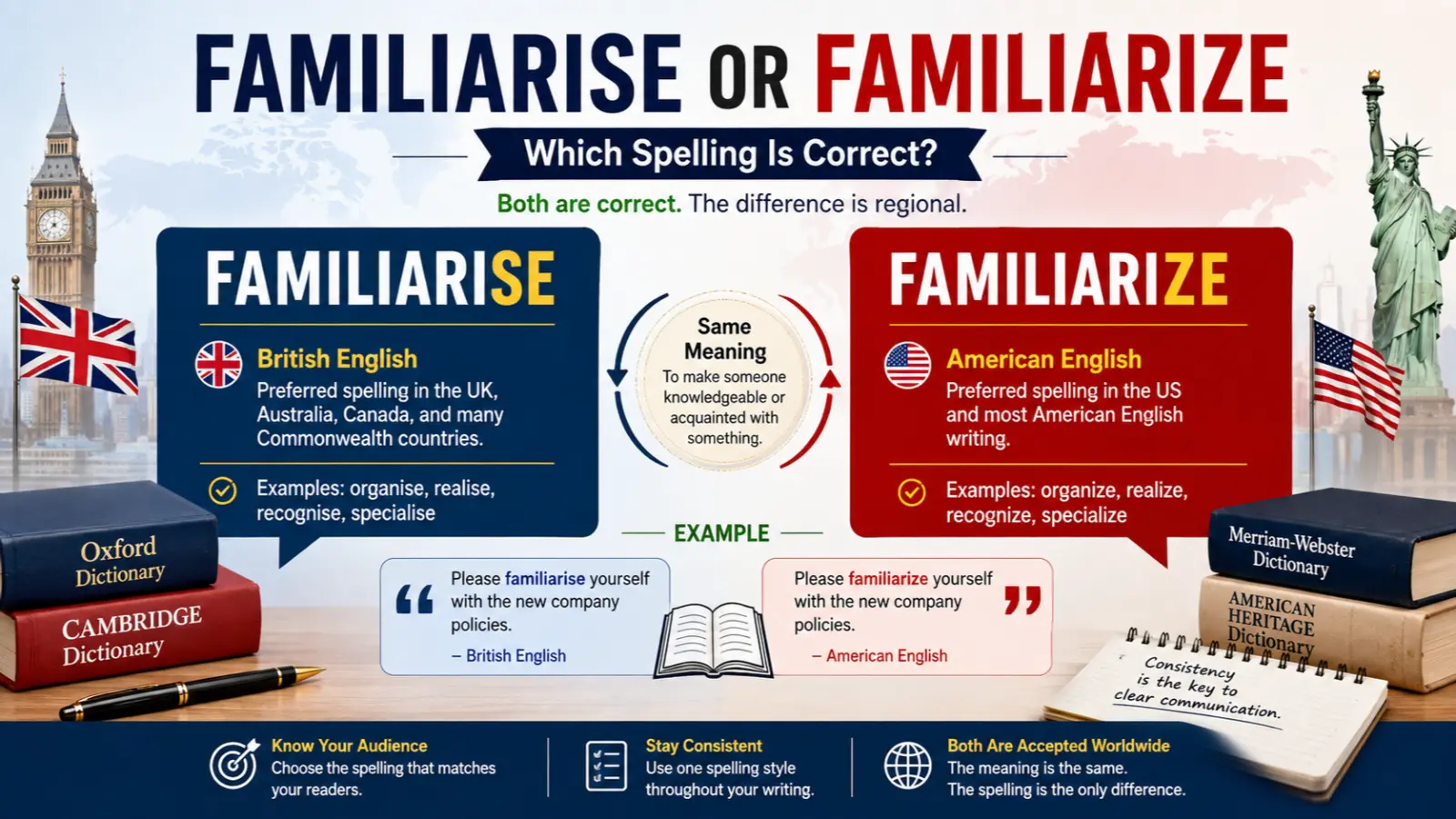
Familiarise or Familiarize is a common spelling question that confuses many English learners and writers. Both words have the same meaning and are used to describe the process of becoming familiar with something. The only real difference is the type of English you are using.
In this guide, you’ll quickly learn which spelling is correct for British and American English, why the difference exists, and how to use each word with clear examples. By the end of this article, you’ll know exactly when to use familiarise or familiarize with confidence.
Understanding the Difference Between Familiarise and Familiarize
The words familiarise and familiarize both mean to make someone knowledgeable about something or to help someone become accustomed to a situation.
The only difference is spelling preference. British English usually uses familiarise, while American English generally uses familiarize.
Examples:
The teacher helped students familiarise themselves with the new software. (British English)
The teacher helped students familiarize themselves with the new software. (American English)
Both sentences are grammatically correct.
Familiarise in British English
Familiarise is the standard spelling in British English. It follows the common British preference of using -ise endings in many verbs.
Common examples include:
organise
realise
recognise
familiarise
specialise
British dictionaries such as the Oxford English Dictionary and Cambridge Dictionary commonly list familiarise as the British spelling.
Example:
Employees must familiarise themselves with company policies before starting work.
Familiarize in American English
Familiarize is the standard American English spelling. American English often prefers the -ize ending for words derived from Greek roots and related verb forms.
Examples:
organize
realize
recognize
familiarize
specialize
American dictionaries such as Merriam Webster Dictionary recommend familiarize as the standard spelling.
Example:
New employees should familiarize themselves with workplace rules.
Why Do Familiarise and Familiarize Have Different Spellings?
The difference developed because British and American English followed different spelling traditions over time.
The -ize ending has historical roots in Greek and Latin influenced English. British publishers later adopted -ise as a common alternative for many words, while American English largely kept the -ize form.
The spelling split became stronger during the 18th and 19th centuries as British and American dictionaries created separate spelling standards.
Dictionary Recommendations for Familiarise and Familiarize
Major dictionaries recognize both forms.
British dictionaries usually prefer familiarise.
American dictionaries usually prefer familiarize.
International dictionaries often list both spellings and identify regional preferences.
Neither spelling is incorrect.
Style Guide Recommendations
British Publishing Standards
British publishers, universities, and organizations commonly follow -ise spellings.
Examples:
familiarise
organise
analyse
American Publishing Standards
American style guides usually recommend -ize spellings.
Examples:
familiarize
organize
analyze
Writers should follow the spelling system used by their target audience.
Academic Writing Usage
In academic writing, consistency matters more than choosing one spelling.
A British academic paper should normally use:
familiarise
organise
recognise
An American academic paper should normally use:
familiarize
organize
recognize
Mixing both styles in the same document can look inconsistent.
Business Writing and Professional Communication
Companies should choose the spelling style based on their audience.
Use familiarise for:
UK clients
British organizations
Commonwealth audiences
Use familiarize for:
US companies
American customers
International teams following American standards
Example:
British business email:
Please familiarise yourself with the updated company guidelines.
American business email:
Please familiarize yourself with the updated company guidelines.
International Communication
For global communication, both spellings are understood worldwide.
However, businesses, websites, and professional documents should maintain one consistent English style.
A company targeting the United States should generally use familiarize.
A company targeting the United Kingdom should generally use familiarise.
Current Usage Trends
American English has increased the popularity of -ize spellings worldwide because of global technology, software, and digital content.
However, familiarise remains widely used in British English publications, education, and government communication.
Online platforms often display both versions depending on the user’s language settings.
Real World Examples
British English:
Students should familiarise themselves with the examination rules.
American English:
Students should familiarize themselves with the examination rules.
British English:
Please familiarise new employees with the safety procedures.
American English:
Please familiarize new employees with the safety procedures.
Common Mistakes With Familiarise and Familiarize
Using Both Spellings in One Document
Incorrect style:
The team will familiarize employees and familiarise customers.
Better:
Choose one spelling style and use it consistently.
Assuming One Spelling Is Wrong
Both spellings are correct. The difference is regional, not grammatical.
Frequently Asked Questions
Is familiarise or familiarize correct?
Both spellings are correct. Familiarise is British English, while familiarize is American English.
Do familiarise and familiarize have different meanings?
No. They have the same meaning and pronunciation.
Which spelling should I use in the US?
Use familiarize in American English writing.
Which spelling should I use in the UK?
Use familiarise in British English writing.
Is familiarize accepted in British English?
Yes, but familiarise is more common in British English.
Which spelling is better for international websites?
Choose the spelling style that matches your main audience and keep it consistent.
Conclusion
Familiarise and familiarize are both correct spellings of the same word. The difference comes from British and American English preferences.
Use familiarise for British English audiences and familiarize for American English audiences. For academic, business, and online writing, consistency is the most important rule.
Olivia Bennett is a grammar expert and language content writer at GrammarWize.com. She specializes in English grammar, word usage, spelling differences, and writing improvement. Through clear explanations and practical examples, Olivia helps students, professionals, and language learners communicate more effectively. Her goal is to make English grammar simple, accessible, and easy to apply in everyday writing.