Opened or openned is a common spelling question because many English verbs double the final consonant before adding -ed, while others do not. If you have ever paused before typing this word, you are not alone.
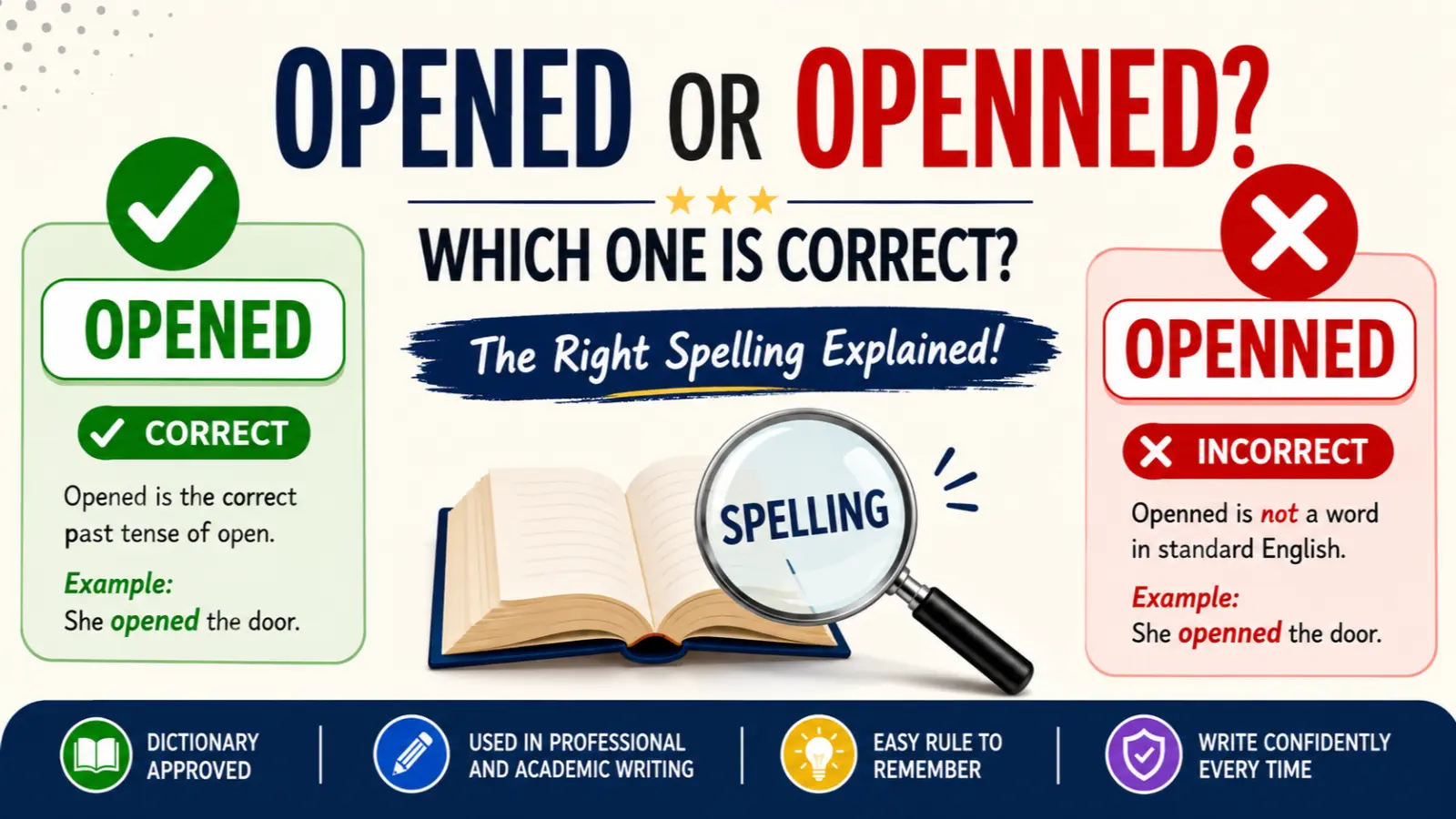
Opened or Openned is a common spelling question that confuses many English learners and writers. The correct spelling is opened because the verb open simply adds -ed to form its past tense and past participle. Openned is a misspelling and is not accepted in standard English.
If you are unsure which spelling to use, this guide will explain the difference with simple rules, clear examples, and common mistakes to avoid. By the end, you will know when to use opened correctly and write with more confidence in everyday, academic, and professional English.
This guide explains which spelling is correct, why the confusion happens, what dictionaries recommend, and how to remember the right form every time.
Quick Answer
✅ Opened is the correct spelling.
❌Use “opened” because “openned” is not accepted in standard English dictionaries.
The past tense and past participle of open is always opened.
Example:
- She opened the door.
- The store opened at 9 a.m.
Is This a Spelling Comparison?
Yes.
This keyword belongs to the Spelling Comparison category.
Use “opened” as the correct spelling because “openned” is a common misspelling.
What Does “Opened” Mean?

Opened is the past tense and past participle of the verb open.
It means:
- To make something no longer closed.
- To begin an event, business, conversation, or activity.
- To become available.
Examples:
- He opened the window.
- The museum opened last summer.
- She opened her laptop and started working.
Does “Openned” Mean Anything?

No.
Openned is not a recognized English word.
It appears because some writers mistakenly think the letter n should be doubled before adding -ed.
Standard dictionaries do not include openned as a correct spelling.
Opened vs Openned Comparison Table
| Feature | Opened | Openned |
|---|---|---|
| Correct spelling | ✅ Yes | ❌ No |
| Dictionary accepted | ✅ Yes | ❌ No |
| Past tense of open | ✅ Yes | ❌ No |
| Used in professional writing | ✅ Always | ❌ Never |
| Suitable for academic writing | ✅ Yes | ❌ No |
Why Is “Opened” Correct?
The verb open ends with the pattern:
- vowel + consonant + silent e
When adding -ed, English grammar simply drops the final e and adds -ed.
Open → Opened
The final n is not doubled because open does not follow the consonant-doubling rule.
Why Does the Confusion Exist?
Many English verbs double their final consonant before adding -ed, such as:
- stop → stopped
- plan → planned
- permit → permitted
Because of these patterns, some learners assume open should become openned.
However, open has two syllables, and the stress falls on the first syllable:
O-pen
Since the last syllable is not stressed, the n is not doubled.
Dictionary Recommendation
Major English dictionaries consistently recognize only:
- open (verb)
- opened (past tense and past participle)
- opening
- opens
They do not list openned as a correct spelling.
This makes opened the only acceptable choice in formal, academic, business, and everyday writing.
Origin of the Word
The word open comes from Old English open, meaning “not closed” or “accessible.”
Over centuries, its spelling has remained remarkably stable.
English has always formed the regular past tense as “opened,” following standard verb rules.
Real-Life Examples

Everyday Conversation
- She opened the package carefully.
- I opened the window because it was hot.
- They opened a new restaurant nearby.
Business Writing
- The company opened a new office in Texas.
- Registration opened on Monday.
- The manager opened the meeting with a welcome speech.
Academic Writing
- Researchers opened the experiment with a control group.
- The discussion opened with an overview of previous studies.
Common Mistakes
Incorrect
- I openned the file.
- The shop openned yesterday.
- She openned her notebook.
Correct
- I opened the file.
- The shop opened yesterday.
- She opened her notebook.
Memory Trick
Remember this simple rule:
Open already ends with one “n.”
Just add -ed.
Open → Opened
Think:
One N is enough to open the door.
Professional Writing Recommendation
Always use opened.
Avoid openned in:
- School assignments
- Business emails
- Reports
- Articles
- Resumes
- Professional documents
- Website content
Using the correct spelling improves credibility and makes your writing look polished.
Frequently Asked Questions
Is “openned” ever correct?
No. Standard English considers it a spelling mistake. ✅
Why isn’t the “n” doubled?
Because open does not meet the rule for doubling the final consonant. The stress is on the first syllable, not the last.
Is “opened” used in British and American English?
Yes. Both British and American English use opened.
Why do spell checkers flag “openned”?
Because it is not a recognized English word.
Can I use “openned” in informal writing?
No. Even in casual writing, opened is the correct spelling.
Conclusion
The correct spelling is opened, while openned is simply a common misspelling. The confusion comes from English verbs that double their final consonant before adding -ed, but open does not follow that pattern. Dictionaries, grammar guides, and professional writers consistently use opened. If you remember that open keeps its single n, you will choose the correct spelling every time.

Olivia Bennett is a grammar expert and language content writer at GrammarWize.com. She specializes in English grammar, word usage, spelling differences, and writing improvement. Through clear explanations and practical examples, Olivia helps students, professionals, and language learners communicate more effectively. Her goal is to make English grammar simple, accessible, and easy to apply in everyday writing.