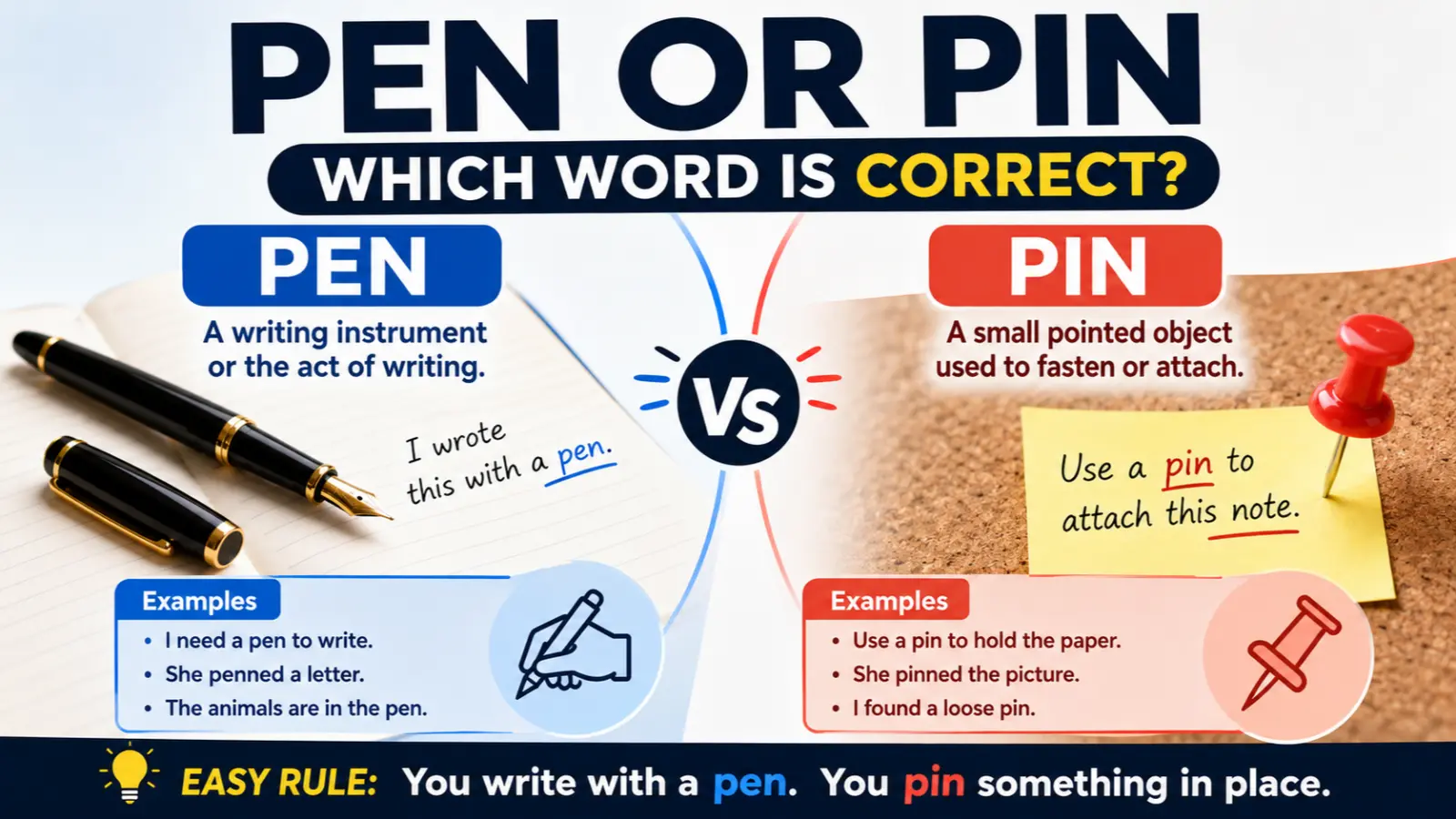
Pen or pin can be confusing because both words are correctly spelled, but they refer to very different things. The correct choice depends on the meaning you want to express.
Pen or Pin are two common English words that sound different and have completely different meanings. “Pen” usually refers to a writing tool or an enclosure for animals, while “pin” can mean a small sharp object used to hold things together.
Understanding the difference between Pen or Pin can help you avoid spelling and vocabulary mistakes. In this guide, you will learn their meanings, pronunciations, examples, and simple ways to remember which word to use.
A pen is commonly a writing tool, while a pin is usually a small pointed object used to fasten, hold, or attach something. Learning this simple difference can help you avoid mistakes in everyday and professional writing.
Quick Answer
Both pen and pin are correct English words.
- Pen usually means a writing instrument.
- Pin usually means a small pointed fastener or object.
- Pen can also mean an enclosed area for animals or the act of writing.
- Pin can also mean to attach, secure, or hold something in place.
So, pen is not a misspelling of pin, and pin is not a misspelling of pen. They have different meanings and uses.
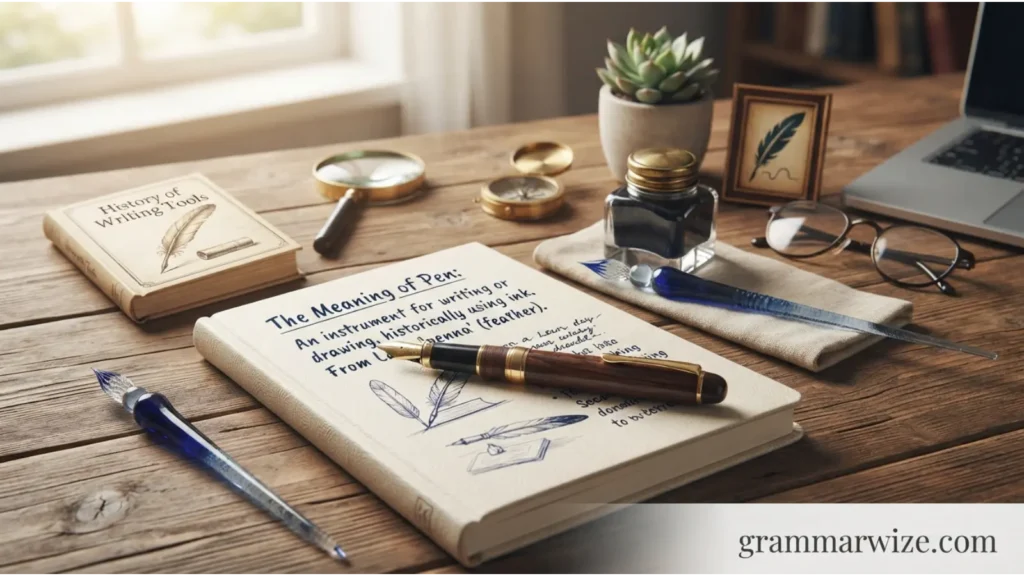
Meaning of Pen
The word pen has several meanings, but its most familiar meaning is a writing instrument that uses ink.
Examples
- I bought a new pen for school.
- Please sign the form with a blue pen.
- She writes beautifully with a fountain pen.
- He always carries a pen in his pocket.
The word can also function as a verb. To pen something means to write it.
- She penned a thoughtful letter.
- The author penned a new story.
A pen can also mean an enclosed place for animals.
- The sheep are inside the pen.
- The farmer cleaned the animal pen.

Meaning of Pin
A pin is generally a small, thin, pointed object. It can be used to fasten, attach, or hold things together.
Examples
- She used a pin to hold the fabric together.
- Put the note on the board with a pin.
- I found a loose pin on the floor.
- The dress has a decorative pin.
Pin can also work as a verb. It means to attach something or hold someone or something firmly in place.
- Pin the notice to the board.
- She pinned the picture to the wall.
- The wrestler pinned his opponent.
The word also appears in familiar expressions such as pins and needles and pin down.
Pen and Pin Comparison
| Word | Main Meaning | Part of Speech | Example |
|---|---|---|---|
| Pen | A writing instrument | Noun | I need a pen. |
| Pen | To write | Verb | She penned a letter. |
| Pen | An animal enclosure | Noun | The pigs are in the pen. |
| Pin | A pointed fastener | Noun | Use a pin to attach it. |
| Pin | An attachment or small pointed object | Noun | She wore a pin. |
| Pin | To attach or hold firmly | Verb | Pin the paper here. |
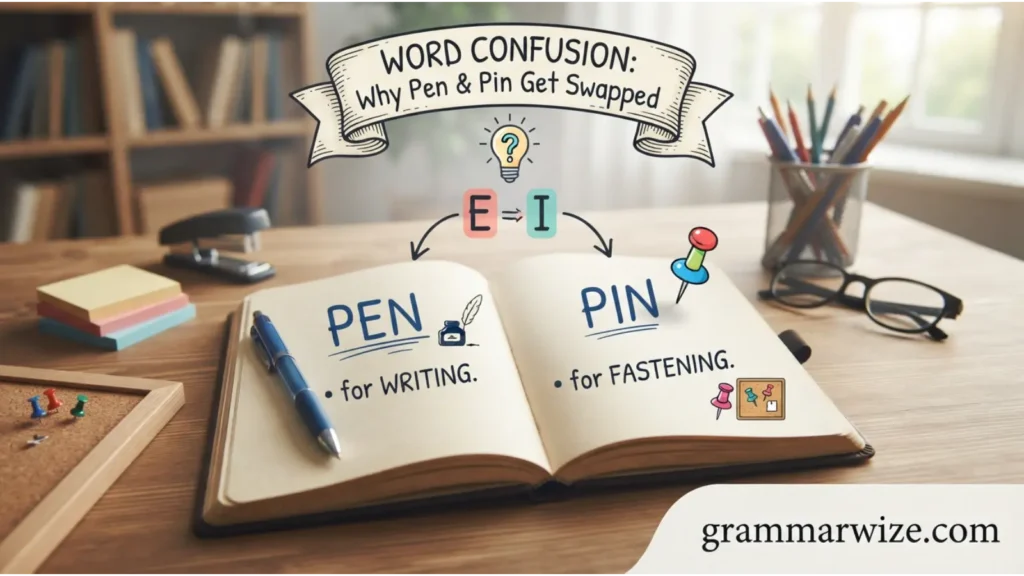
Why Pen and Pin Get Confused
The confusion usually comes from their similar spelling and pronunciation.
Both words are short and begin with p. The main spelling difference is the vowel:
- Pen contains e.
- Pin contains i.
Their meanings, however, are not interchangeable.
For example, saying “I need a pin to write this letter” would be incorrect if you mean a writing instrument. The correct sentence is “I need a pen to write this letter.”
Likewise, “Use a pen to attach the paper to the board” is incorrect if you mean a small fastener. In that case, use pin.
Origin of Pen
The writing-related noun pen comes from Middle English penne. It traces back through Old French to Latin penna, meaning “feather” or “plume.” The connection makes sense because early writing pens were made from feathers.
Over time, pen developed into the familiar word for a tool used to write with ink.
The word also developed other meanings. English uses pen for an animal enclosure and as a verb meaning to write or compose.
Origin of Pin
Pin has a much older history as a word for a pointed object used to hold things together. The Online Etymology Dictionary traces the noun to late Old English pinn, meaning a peg or bolt made of wood or metal.
The verb pin developed from the noun. It has long been associated with fastening or securing something in place.
This history explains why modern English uses pin for objects such as sewing pins, safety pins, and similar fasteners.
Dictionary Preference
Major English dictionaries recognize pen and pin as separate words. Neither spelling is simply an alternative spelling of the other.
Dictionary definitions distinguish them based on meaning:
- Pen is strongly associated with writing instruments, writing, and animal enclosures.
- Pin is associated with pointed fasteners, attachment, and holding something securely.
This distinction remains standard in modern English.
Real Life Examples
Understanding the context makes the difference easy to spot.
Use Pen for Writing
- I lost my pen during class.
- Can I borrow your pen?
- She signed the contract with a pen.
- This pen has blue ink.
Use Pin for Fastening
- I need a pin for this piece of fabric.
- She attached the badge with a pin.
- Use a pin to secure the paper.
- The map is held up with a pin.
Pen as a Verb
- He penned an article for the magazine.
- She penned a short poem.
Pin as a Verb
- Pin the poster to the wall.
- She pinned the message at the top of the page.
Common Mistakes
One common mistake is choosing the word based only on sound or appearance.
For example:
Incorrect: Please give me a pin so I can write my name.
Correct: Please give me a pen so I can write my name.
Another mistake happens when someone needs a fastener.
Incorrect: Use a pen to attach the photograph.
Correct: Use a pin to attach the photograph.
Remember that the object determines the spelling.
Pen or Pin for Writing
If you are talking about something used to write with ink, choose pen.
- ballpoint pen
- fountain pen
- gel pen
- ink pen
- black pen
Example:
I always keep a pen beside my notebook.
Do not use pin in this context.
Pen or Pin for Fastening
If you mean a small pointed object that attaches or holds something, choose pin.
- safety pin
- sewing pin
- drawing pin
- hair pin
- push pin
Example:
She used a pin to secure the fabric.
Do not use pen in this context.
A Simple Memory Trick
Use this easy trick:
Pen = paper and writing.
The word pen contains e, just like write contains an e.
Pin = point and fastening.
A pin has a pointed end and can hold things together.
You can also remember:
A pen is used for writing.
. You pin something in place.
This short association makes the difference easier to remember.
Professional Writing Recommendation
Use pen when your sentence refers to writing, an ink writing tool, or an animal enclosure.
Use pin when your sentence refers to fastening, attaching, securing, or holding something in place.
In professional writing, context should guide your choice. Do not treat the two words as spelling variants. Replacing one with the other can change the meaning of a sentence.
For example:
Please sign the document with a pen.
The sentence clearly refers to a writing tool.
Please pin the document to the notice board.
Here, pin means to attach the document.
Frequently Asked Questions
Is pen or pin correct?
Both pen and pin are correct. They have different meanings and should be used in different contexts.
Is a pen a pin?
No. A pen is commonly a writing instrument. A pin is generally a small pointed object used for fastening or attachment.
Do pen and pin sound the same?
No. They are different words with different vowel sounds. Pen uses the short e sound, while pin uses the short i sound.
Which word is used for writing?
Use pen for a writing instrument.
Example: I need a pen to complete this form.
Which word is used for fastening?
Use pin for a small pointed fastener.
Example: She used a pin to hold the fabric together.
Can pen be a verb?
Yes. Pen can mean to write or compose something.
Example: He penned a letter to his friend.
Can pin be a verb?
Yes. Pin can mean to attach or hold something firmly.
Example: Pin the note to the board.
Conclusion
Pen and pin are both correct words, but they cannot normally replace each other. Use pen for writing instruments, writing, and related meanings. Use pin for pointed fasteners, attachment, and holding something in place.
The easiest rule is simple: you write with a pen, and you pin something to keep it attached. Once you connect each word with its main meaning, the spelling becomes much easier to remember.

Olivia Bennett is a grammar expert and language content writer at GrammarWize.com. She specializes in English grammar, word usage, spelling differences, and writing improvement. Through clear explanations and practical examples, Olivia helps students, professionals, and language learners communicate more effectively. Her goal is to make English grammar simple, accessible, and easy to apply in everyday writing.