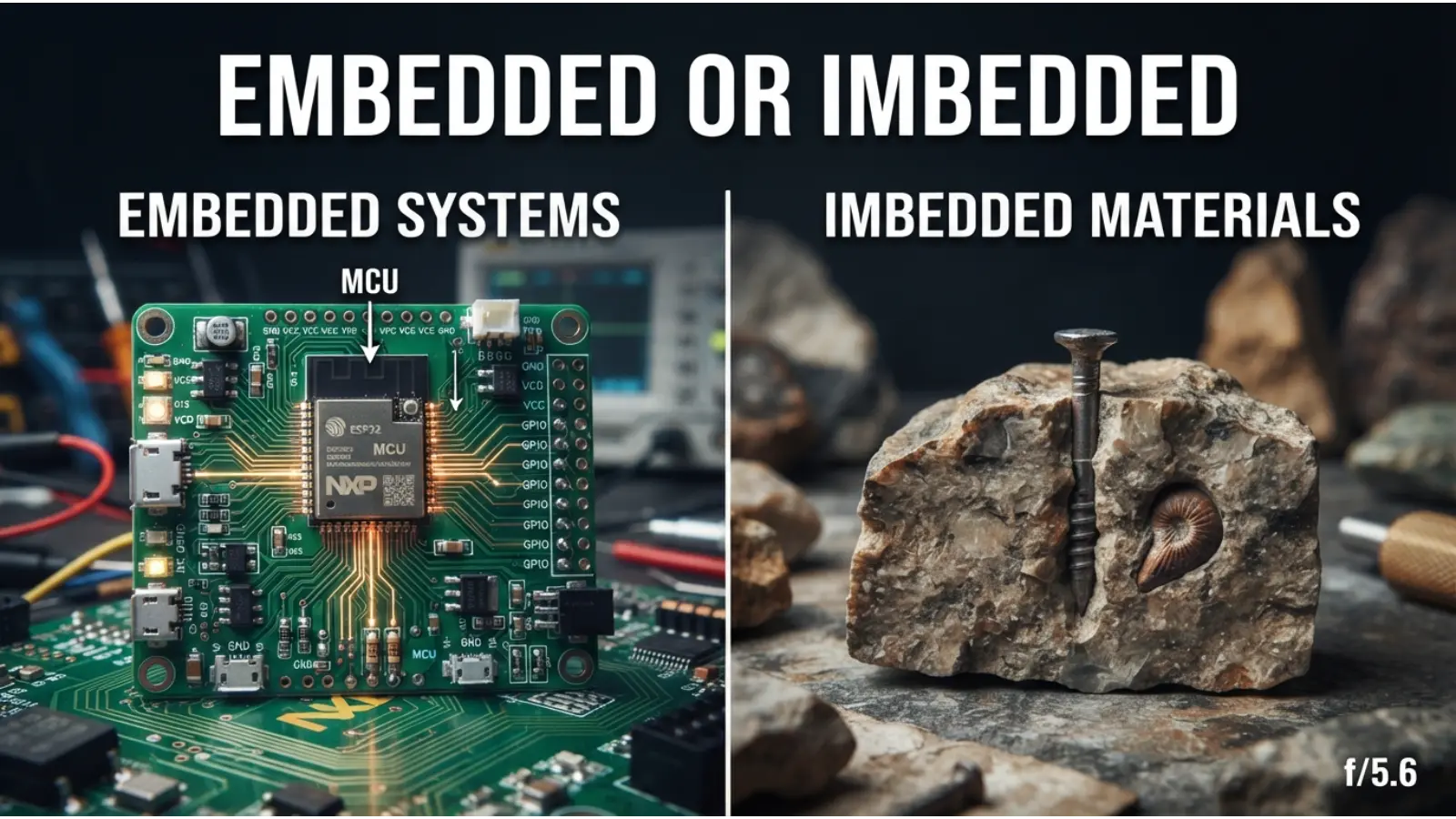
Both spellings are accepted, but embedded is the standard form most readers expect. Imbedded is a less common variant, especially associated with American English. Major dictionaries recognize both forms, so calling imbedded simply “wrong” would be inaccurate.
Embedded or Imbedded can be confusing because both spellings appear in English. However, embedded is the standard and far more common spelling in modern English. It means something is fixed firmly or placed deeply within something else.
Imbedded is also a recognized variant, but it is much less common. Understanding the difference can help you choose the clearest spelling for your writing.
If you are writing an essay, article, report, website, or professional document, embedded is usually the safest choice. It is the more familiar spelling and appears as the primary form in major dictionaries.
Quick Answer
Embedded is the preferred spelling in most modern writing.
Imbedded is also a legitimate spelling, but it is less common.
Merriam Webster lists imbed as a less common spelling of embed and recognizes both embedded and imbedded as past forms.
Cambridge lists embedded as the main entry and identifies imbedded as a US form.
So, for most readers:
Preferred: embedded
Accepted variant: imbedded
What Embedded Means
Embedded means firmly fixed, placed, or contained inside something.
It can describe a physical object, an idea, technology, media, or even a person working closely with a particular group.
For example:
- The glass became embedded in the wall.
- The concrete embedded the stone.
- The article embeds the image.
- The culture deeply embeds these traditions.
Cambridge defines embedded as something fixed into the surface of something. It also uses the word for ideas or emotions that have become a strong part of something.
What Imbedded Means
Imbedded has the same basic meaning as embedded.
It is an accepted variant spelling of the verb imbed, which is itself a variant of embed. Merriam Webster calls imbed a less common spelling of embed.
Examples include:
- The stone was imbedded in the wall.
- The technology was imbedded into the system.
- The idea became imbedded in the culture.
The meaning does not change simply because the spelling changes.
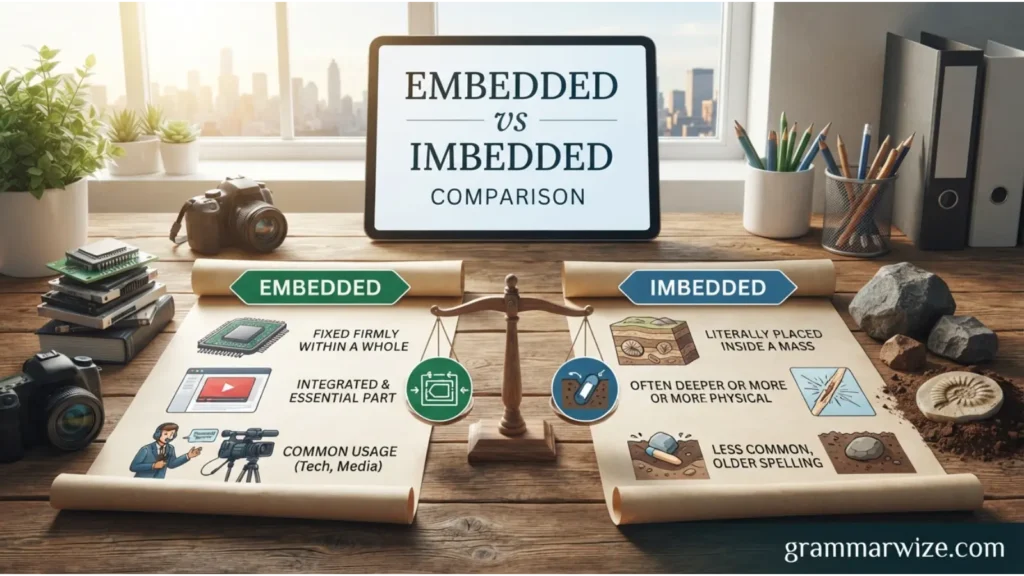
Embedded vs Imbedded Comparison
| Feature | Embedded | Imbedded |
|---|---|---|
| Basic meaning | Firmly fixed or incorporated | Firmly fixed or incorporated |
| Status | Standard and preferred | Accepted variant |
| Frequency | More common | Less common |
| Verb | Embed | Imbed |
| Past form | Embedded | Imbedded |
| Professional writing | Recommended | Usually avoided |
| Dictionary status | Primary form in major dictionaries | Recognized variant |
Major dictionaries support this distinction. Oxford lists embed with imbed as an alternative, while Cambridge identifies imbedded as a US form.
Why Are Embedded and Imbedded Confused
The confusion comes from the two accepted forms of the base verb.
English has embed and imbed. Both forms have been used for a long time, and their meanings are essentially the same.
The difference is mainly spelling and usage frequency rather than meaning.
Dictionary.com describes imbed as an alternate spelling of embed and says it is much less commonly used.
That is why you may encounter imbedded in older texts, American publications, technical writing, or other sources.
The Origin of Embedded
The word embed comes from em plus bed.
Its original sense involved placing something in a surrounding material or “bed.” Dictionary.com dates the word to the late eighteenth century and gives its formation as em plus bed.
Merriam Webster gives the first known use of embed as around 1794.
The basic idea remains easy to understand:
Something is embedded when it is placed firmly within something else.
For example:
The nail is embedded in the wood.
The nail is firmly inside the wood.

Embedded in Modern English
Today, embedded is used far beyond physical objects.
It can describe:
Technology
- The camera is embedded in the device.
- The software is embedded in the system.
- The website contains an embedded video.
Ideas and beliefs
- The tradition is deeply embedded in society.
- The principle is embedded in the company’s culture.
Media
- The article contains an embedded image.
- The page includes an embedded video.
Journalism
An embedded journalist travels with a military unit or another organized group to report from the area. Merriam Webster and Oxford both recognize this use.

Where Imbedded Appears
You may still see imbedded in American English.
Cambridge labels imbedded as a US form, while Collins describes imbed as a less common spelling in British English.
For that reason, the spelling is not necessarily an error.
For example:
The sensor was imbedded in the device.
This sentence is understandable and grammatically valid.
Still, many editors would change it to:
The sensor was embedded in the device.
The second version is more familiar to modern readers.
Common Mistakes
One common mistake is assuming imbedded is always incorrect.
That is too strong. Dictionaries recognize it as a variant.
Another mistake is mixing the forms incorrectly.
For example:
He embedded the material into the wall.
This uses the standard verb embed.
If you choose the variant verb, the form would be:
He imbeded the material into the wall.
That spelling is incorrect.
The correct past form of imbed is:
imbedded
The extra d is retained before the ed ending.
Embedded in Professional Writing
For professional writing, embedded is the better choice.
Use it in:
- Business reports.
- Academic papers.
- Website content.
- Technical documentation.
- News articles.
- Marketing copy.
- Formal correspondence.
The reason is simple: embedded is more widely recognized and more common.
Using the familiar form reduces the chance that readers will mistake a legitimate variant for a spelling error.
Embedded in Technology Writing
Embedded is especially common in technology.
You may see phrases such as:
- embedded system.
- embedded software.
- embedded device.
- embedded video.
- embedded image.
- embedded code.
- embedded processor.
- embedded technology.
In technical content, embedded should normally be your first choice.
For example:
The device uses an embedded processor.
This is clearer and more conventional than using the less common imbedded.
Embedded vs Imbedded in Real Life
Here are some practical examples.
Physical object:
The bullet was embedded in the wall.
Technology:
The software is embedded in the device.
Website:
The video is embedded in the article.
Culture:
The tradition is deeply embedded in the community.
Variant form:
The material was imbedded in the structure.
All five sentences can communicate the intended idea, but the first four use the more familiar spelling.
Which Form Should You Choose
Choose embedded in most situations.
It is the safest option for modern readers because major dictionaries present it as the primary form. Cambridge gives embedded as its main entry, and Oxford lists embed as the main verb with imbed as an alternative.
Choose imbedded only when you have a specific reason to preserve that spelling, such as:
- Quoting an original source.
- Maintaining a publication’s established style.
- Preserving historical wording.
- Following a house style that prefers the variant.
For new writing, embedded is the stronger default.
A Simple Memory Trick
Think of the word bed.
Embed = put something into a bed or surrounding material.
Then remember:
Embedded = the standard spelling.
Imbedded = an accepted but less common variant.
A second shortcut is:
Embed is the main form. Imbed is the variant.
This makes it easier to choose the spelling quickly.
FAQs:
Is embedded or imbedded correct?
Both are correct. Embedded is the standard and more common form, while imbedded is a less common variant.
Is imbedded a misspelling?
No. Imbedded is a recognized spelling variant of embedded. Cambridge and Merriam Webster both recognize the form.
Which spelling is more common?
Embedded is more common and is generally preferred in modern writing. Dictionary.com specifically describes imbed as much less commonly used than embed.
Is imbedded American English?
It is strongly associated with American usage. Cambridge labels imbedded as a US form, while Oxford’s American dictionary lists imbed as an alternative to embed.
Should I use embedded in an academic paper?
Yes. Embedded is the safer choice for academic and professional writing because it is the more familiar standard form.
Are embedded and imbedded pronounced the same?
Yes. The two spellings represent the same basic word and are pronounced the same in standard usage.
What is the past tense of embed?
The past tense is embedded.
Example:
The technician embedded the sensor in the device.
What is the past tense of imbed?
The past tense is imbedded.
Example:
The technician imbedded the sensor in the device.
Is embedded used in technology?
Yes. Embedded is very common in technology, especially in phrases such as embedded system, embedded software, and embedded device.
Conclusion
Embedded and imbedded are both legitimate spellings, so neither should automatically be treated as an error. The main difference is usage frequency.
Embedded is the preferred choice for most modern writing, including professional, academic, technical, and online content. Imbedded is an accepted variant but is less common.
The easiest rule is to remember embed as the main form and imbed as the less common variant. When you want the spelling most readers will recognize immediately, choose embedded.

Olivia Bennett is a grammar expert and language content writer at GrammarWize.com. She specializes in English grammar, word usage, spelling differences, and writing improvement. Through clear explanations and practical examples, Olivia helps students, professionals, and language learners communicate more effectively. Her goal is to make English grammar simple, accessible, and easy to apply in everyday writing.