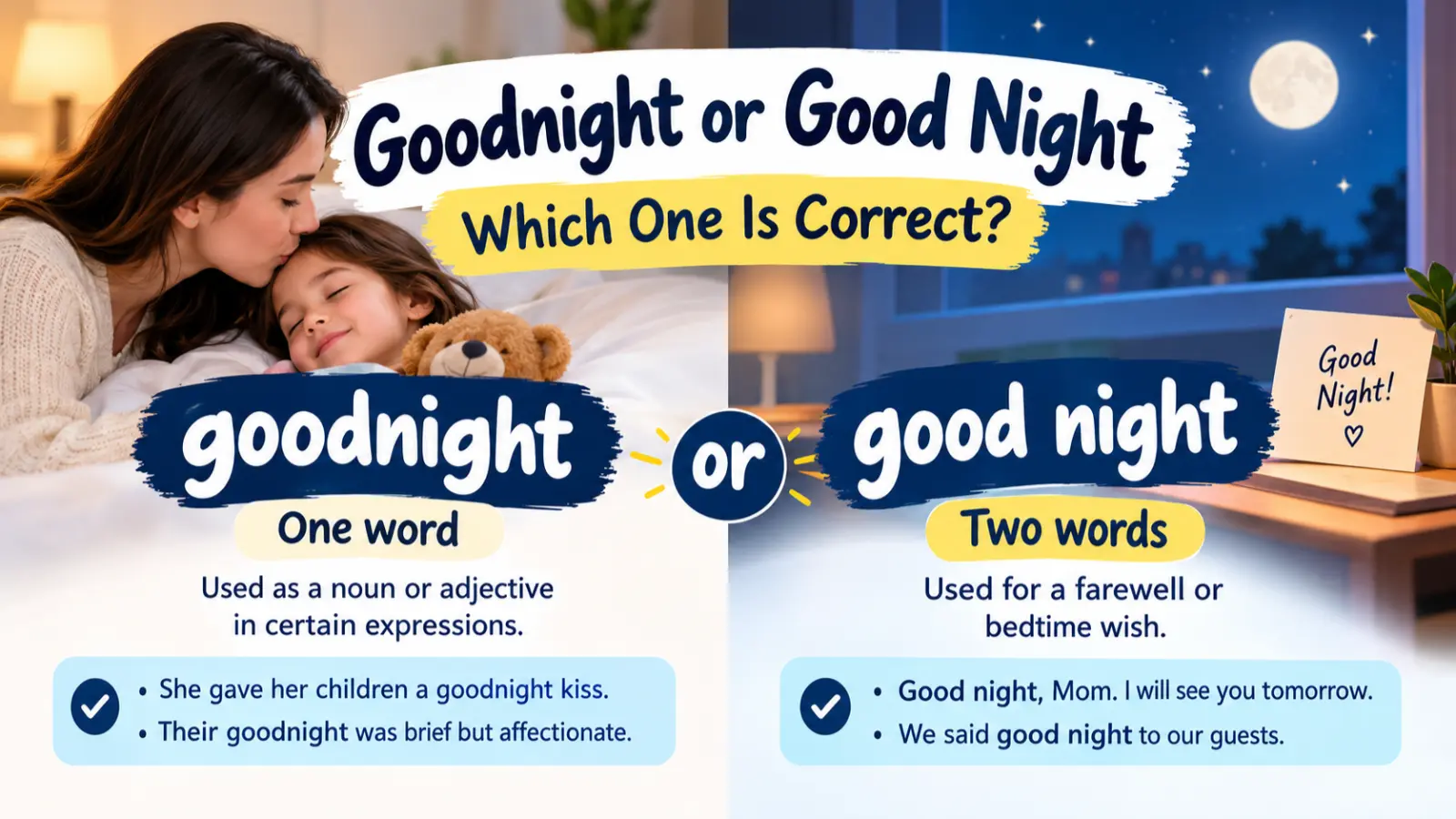
Goodnight or good night is a common English usage question because both forms appear in everyday writing. The main difference depends on how you use the phrase in a sentence. Good night is the standard choice when saying goodbye to someone before bedtime.
Goodnight or Good Night is a common spelling question that often confuses English writers, students, and everyday texters. Both forms appear in writing, but they do not always serve the same purpose. Should you write “goodnight” as one word or “good night” as two words? The answer depends on how you use the expression in a sentence.
In modern English, “good night” is the standard choice when saying goodbye before bedtime, while “goodnight” can appear as a single word in certain contexts, especially as a noun or adjective. Understanding this small difference can help you write clearer messages, emails, and everyday conversations. In this guide, you will learn the meanings of both forms, see practical examples, and discover which spelling works best for your writing.
Goodnight is also accepted, especially as a noun, an adjective, or in informal expressions. However, the two forms are not interchangeable in every sentence. Understanding their grammatical roles helps you choose the correct form for messages, emails, stories, and professional writing.
Quick Answer
Use good night when wishing someone a peaceful night or saying goodbye at the end of the day.
Use goodnight when it functions as a noun or adjective in certain expressions.
- Correct: Good night! See you tomorrow.
- Correct: She gave her children a goodnight kiss.
What Does Good Night Mean?
Good night is a phrase used to say goodbye to someone in the evening or before going to sleep. It expresses a friendly wish for a peaceful night.
Examples:
- Good night, Mom. I will see you in the morning.
- We said good night to our guests before leaving.
In both examples, the phrase acts as a farewell. The two words remain separate.
What Does Goodnight Mean?
Goodnight is a closed compound form that can work as a noun or adjective. It commonly appears in expressions related to bedtime or a final farewell.
Examples:
- The children received a goodnight kiss from their father.
- She whispered her goodnight before closing the door.
The adjective goodnight describes the kiss in the first sentence. In the second, it functions as a noun meaning a farewell.

Goodnight vs Good Night: Key Differences
| Feature | Good Night | Goodnight |
|---|---|---|
| Main use | Farewell or bedtime wish | Noun or adjective in certain expressions |
| Grammar | Two-word phrase | One-word compound |
| Common example | Good night, everyone! | A goodnight kiss |
| Everyday messages | Standard choice | Less common as a standalone greeting |
| Professional writing | Preferred for farewells | Suitable in established compounds |
Grammar Rules: When Should You Use Each Form?
Use Good Night for Farewells
Choose good night when speaking directly to someone before leaving or going to sleep.
Examples:
- Good night, Sarah. Sleep well.
- I said good night to my colleagues after the event.
- Good night, everyone. Thank you for joining us.
Use Goodnight Before a Noun
Use goodnight as an adjective in common expressions such as goodnight kiss.
Examples:
- He gave his daughter a goodnight kiss.
- Their goodnight routine includes reading a short story.
Use Goodnight as a Noun
The one-word form can also refer to a farewell, particularly in literary or informal contexts.
Example:
- Their goodnight was brief but affectionate.
For ordinary writing, however, say good night remains the safer and more familiar construction.

Sentence Structure and Real-Life Examples
The correct spelling becomes easier to understand when you see how each form fits into a sentence.
| Sentence | Correct Form | Reason |
|---|---|---|
| Good ___, Dad! | Good night | Standard farewell |
| She gave me a ___ kiss. | Goodnight | Adjective before a noun |
| We said ___ before bed. | Good night | Standard farewell phrase |
| Their final ___ was emotional. | Goodnight | Noun referring to a farewell |
| I texted her, “___!” | Good night | Conventional bedtime wish |
Common Mistakes to Avoid
1. Writing goodnight as two words in a compound adjective without checking the intended style
Incorrect for the usual compound: She gave him a good night kiss.
Better: She gave him a goodnight kiss.
2. Using goodnight in every farewell
Less conventional: Goodnight, everyone!
Preferred: Good night, everyone!
3. Assuming goodnight is always incorrect
This is a mistake because goodnight kiss and noun uses such as a final goodnight are accepted.
4. Confusing good night with good evening
Use good evening when greeting someone at night. Use good night mainly when saying goodbye or wishing someone well before sleep.
5. Ignoring consistency in formal writing
Choose the form that matches the grammatical role, and follow your publication’s style guide when it specifies a preference.

Goodnight or Good Night in Text Messages
Both forms may appear in casual messages, but good night is the clearest standard choice when sending someone a bedtime wish.
Examples:
- Good night! Talk to you tomorrow.
- Good night, sweetheart. Sleep well.
- Sending you a goodnight kiss.
The first two examples use a farewell phrase. The last uses goodnight to describe a kiss.
Formal vs Informal Usage
In formal emails, reports, and professional messages, use good night when saying goodbye at the end of an evening event or conversation.
Example: Thank you for attending the meeting. Good night, and have a safe journey home.
In casual writing, goodnight may appear as a standalone farewell, especially in text messages, social media posts, and creative writing. Still, the two-word form remains the more conventional choice for a direct bedtime wish.
Memory Trick
Remember this simple rule:
- Good night: Two words for saying goodbye.
- Goodnight: One word for describing a kiss or referring to a farewell as a noun.
Think of the sentence “Good night, followed by a goodnight kiss.” The first phrase says goodbye, while the second describes the kiss.
Frequently Asked Questions
1. Is goodnight one word or two?
Both forms exist. Use good night for the usual farewell and goodnight in compound expressions such as goodnight kiss.
2. Is good night grammatically correct?
Yes. It is the standard form for wishing someone a peaceful night or saying goodbye before bedtime.
3. Can I write goodnight in a text message?
Yes. It is common in informal messages, but good night is the more conventional spelling for a direct farewell.
4. Is goodnight kiss or good night kiss correct?
Goodnight kiss is the standard compound spelling. Here, goodnight describes the type of kiss.
5. Which form should I use in professional writing?
Use good night for a farewell. Use goodnight when it functions naturally as a noun or adjective in a compound expression.
Conclusion
Both goodnight and good night are accepted English forms, but they serve different grammatical purposes. Use good night when saying goodbye or wishing someone a peaceful night. Choose goodnight in expressions such as goodnight kiss or when referring to a farewell as a noun. Following this simple distinction will help you write more clearly in text messages, emails, stories, and professional communication.

Olivia Bennett is a grammar expert and language content writer at GrammarWize.com. She specializes in English grammar, word usage, spelling differences, and writing improvement. Through clear explanations and practical examples, Olivia helps students, professionals, and language learners communicate more effectively. Her goal is to make English grammar simple, accessible, and easy to apply in everyday writing.