Many English learners confuse accepting and excepting because they look and sound similar. However, they have completely different meanings and are used in different grammatical situations. Learning the difference helps you write more clearly in emails, academic work, and everyday conversations.
Accepting or Excepting is a common word comparison because the two words sound similar but have completely different meanings. Many English learners and writers confuse them in everyday writing. Using the wrong word can change the meaning of a sentence and create unnecessary mistakes. Understanding the difference helps you write more clearly and confidently.
Accepting means agreeing to receive, approve, or welcome something, while excepting means excluding or leaving something out. Although they are pronounced similarly, they are never interchangeable. This guide explains the meaning, usage, examples, and key differences between accepting and excepting so you can choose the correct word every time.
This guide explains the meaning, grammar, sentence structure, common mistakes, professional usage, and easy memory tricks so you can confidently choose the correct word every time.
Keyword Analysis
Category: Grammar Comparison
Both accepting and excepting are correct English words. They are not interchangeable because they come from different verbs and express different ideas.
- Accepting comes from accept.
- Excepting comes from except.

What Does Accepting Mean?
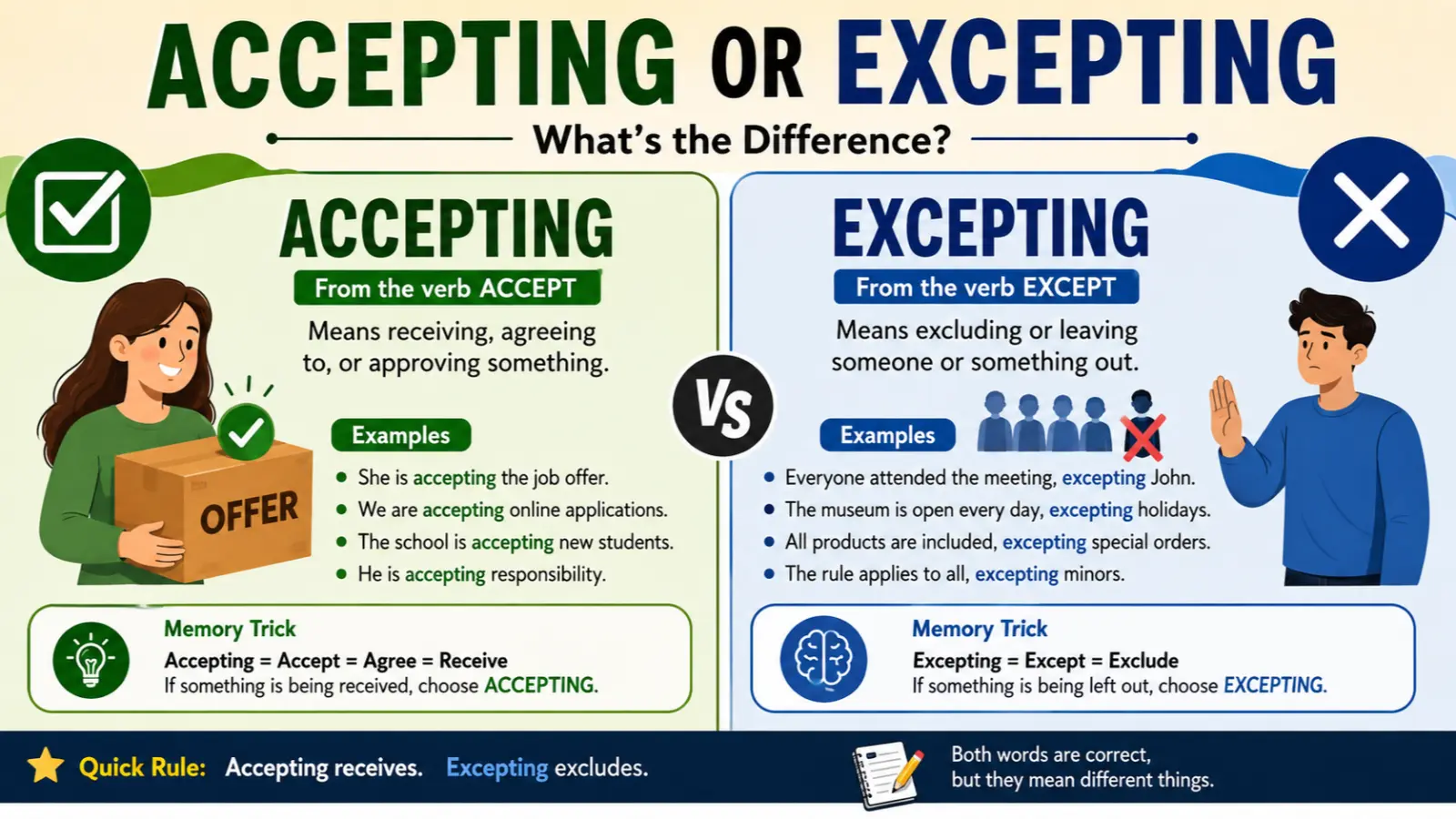
Accepting is the present participle of accept. It means receiving, agreeing to, approving, or welcoming something.
Examples
- She is accepting the job offer.
- We are accepting online applications.
- The school is accepting new students.
- He is accepting responsibility for the mistake.
In each sentence, accepting means willingly receiving or agreeing to something.

What Does Excepting Mean?
Excepting is the present participle of except. It means excluding or leaving someone or something out.
Although it is grammatically correct, it is much less common in modern English.
Examples
- Everyone attended the meeting, excepting John.
- The museum is open every day, excepting public holidays.
- All products are included, excepting special orders.
In these examples, excepting means excluding.

The Main Difference
| Accepting | Excepting |
|---|---|
| Means receiving or agreeing | Means excluding or leaving out |
| Comes from accept | Comes from except |
| Common in everyday English | Mostly used in formal or legal writing |
| Shows approval or willingness | Shows an exception |
Grammar Rule
The two words belong to different verbs.
Accepting
- Verb: Accept
- Function: Present participle or gerund
- Meaning: Receiving or agreeing
Example:
- They are accepting new members.
Excepting
- Verb: Except
- Function: Present participle
- Meaning: Excluding
Example:
- Everyone came, excepting the manager.
Sentence Structure
Using Accepting
Subject + be verb + accepting + object
Examples
- She is accepting the invitation.
- They are accepting customer feedback.
- We are accepting card payments.
Using Excepting
Subject + be verb + excepting + noun
Examples
- The rule applies to everyone, excepting minors.
- The invitation covers all guests, excepting children.
Everyday Examples
Accepting
- I am accepting your apology.
- The company is accepting applications today.
- He is accepting the award with gratitude.
- We are accepting donations.
- She is accepting constructive criticism.
Excepting
- Everyone passed, excepting one student.
- All roads are open, excepting the highway.
- Every chapter is complete, excepting the final one.
- The offer applies to all customers, excepting wholesale buyers.
- All items qualify, excepting clearance products.
Common Mistakes
Using accepting instead of excepting
❌ Everyone came accepting Sarah.
✅ Everyone came excepting Sarah.
Using excepting instead of accepting
❌ The company is excepting applications.
✅ The company is accepting applications.
Confusing the meanings
Remember that these words describe completely different actions.
- Accepting means receiving.
- Excepting means excluding.
Professional Writing
Use Accepting
Professional communication often uses accepting.
Examples
- We are accepting applications until Friday.
- The department is accepting project proposals.
- The client is accepting the revised agreement.
Use Excepting
Excepting appears mainly in legal documents, policies, contracts, and formal notices.
Examples
- All employees shall attend, excepting those on approved leave.
- The policy applies to all departments, excepting temporary offices.
In everyday business writing, except is usually preferred instead of excepting.
Formal and Informal Usage
Accepting
Formal
- We are accepting nominations through August.
Informal
- I’m accepting your apology.
Excepting
Formal
- The regulation applies to all persons, excepting licensed contractors.
Informal
People usually say:
- Everyone came except Tom.
instead of
- Everyone came excepting Tom.
Side by Side Comparison
| Situation | Correct Word |
|---|---|
| Receiving an offer | Accepting |
| Taking responsibility | Accepting |
| Welcoming new members | Accepting |
| Leaving someone out | Excepting |
| Creating an exception | Excepting |
| Excluding an item | Excepting |
Real Life Conversations
Conversation One
A: Is the university still taking applications?
B: Yes, they are accepting applications until next week.
Conversation Two
A: Did everyone attend the conference?
B: Everyone attended, excepting two speakers who were ill.
Conversation Three
A: Are they accepting online payments?
B: Yes, they accept all major cards.
Easy Memory Trick
Think of the first letters.
- Accepting = Accept = Agree = Receive
- Excepting = Except = Exclude
If something is being received, choose accepting.
If something is being left out, choose excepting.
Which Word Should You Use?
Choose accepting when talking about receiving, approving, or agreeing.
Choose excepting when talking about excluding someone or something.
For everyday English, people usually use except instead of excepting, making accepting the far more common word.
Frequently Asked Questions
Is accepting a correct English word?
Yes. It is the present participle of accept and means receiving or agreeing to something.
Is excepting a real word?
Yes. It is the present participle of except and means excluding something. It is less common in everyday English.
Can accepting and excepting be used interchangeably?
No. They have different meanings and should never replace each other.
Which word is more common?
Accepting is much more common in both spoken and written English.
Is excepting old fashioned?
Not exactly. It is still correct but mostly appears in formal, legal, or literary writing.
Conclusion
Accepting and excepting are both correct English words, but they serve different purposes. Accepting means receiving, agreeing, or approving, while excepting means excluding or leaving something out. Since accepting is common in everyday communication and excepting is mostly reserved for formal contexts, understanding their difference will make your writing more accurate and professional. Whenever you’re unsure, remember the simple rule: accepting receives, excepting excludes.

Olivia Bennett is a grammar expert and language content writer at GrammarWize.com. She specializes in English grammar, word usage, spelling differences, and writing improvement. Through clear explanations and practical examples, Olivia helps students, professionals, and language learners communicate more effectively. Her goal is to make English grammar simple, accessible, and easy to apply in everyday writing.