Have you ever paused while writing because you couldn’t decide between conscience and conscious? These two words look similar and are often confused, but they have completely different meanings. Choosing the correct one makes your writing clearer and more professional.
Conscience or Conscious is a common English confusion because these two words sound similar but have completely different meanings. Many people mix them up while writing or speaking because both words relate to the mind, thoughts, and feelings. However, conscience refers to your inner sense of right and wrong, while conscious describes being aware or awake.
Understanding the difference between conscience and conscious helps you use the correct word in everyday conversations, professional writing, and academic work. This guide explains their meanings, examples, differences, and simple tricks to remember them. With clear explanations, you can avoid common mistakes and confidently choose the right word every time.
This guide explains the difference in simple English, shows when to use each word, highlights common mistakes, and provides practical examples you can use in everyday conversations and professional writing.
Keyword Analysis
Category: Grammar Comparison
The words conscience and conscious are both correct English words. They are not interchangeable because they have different meanings and grammatical functions.
Quick Answer
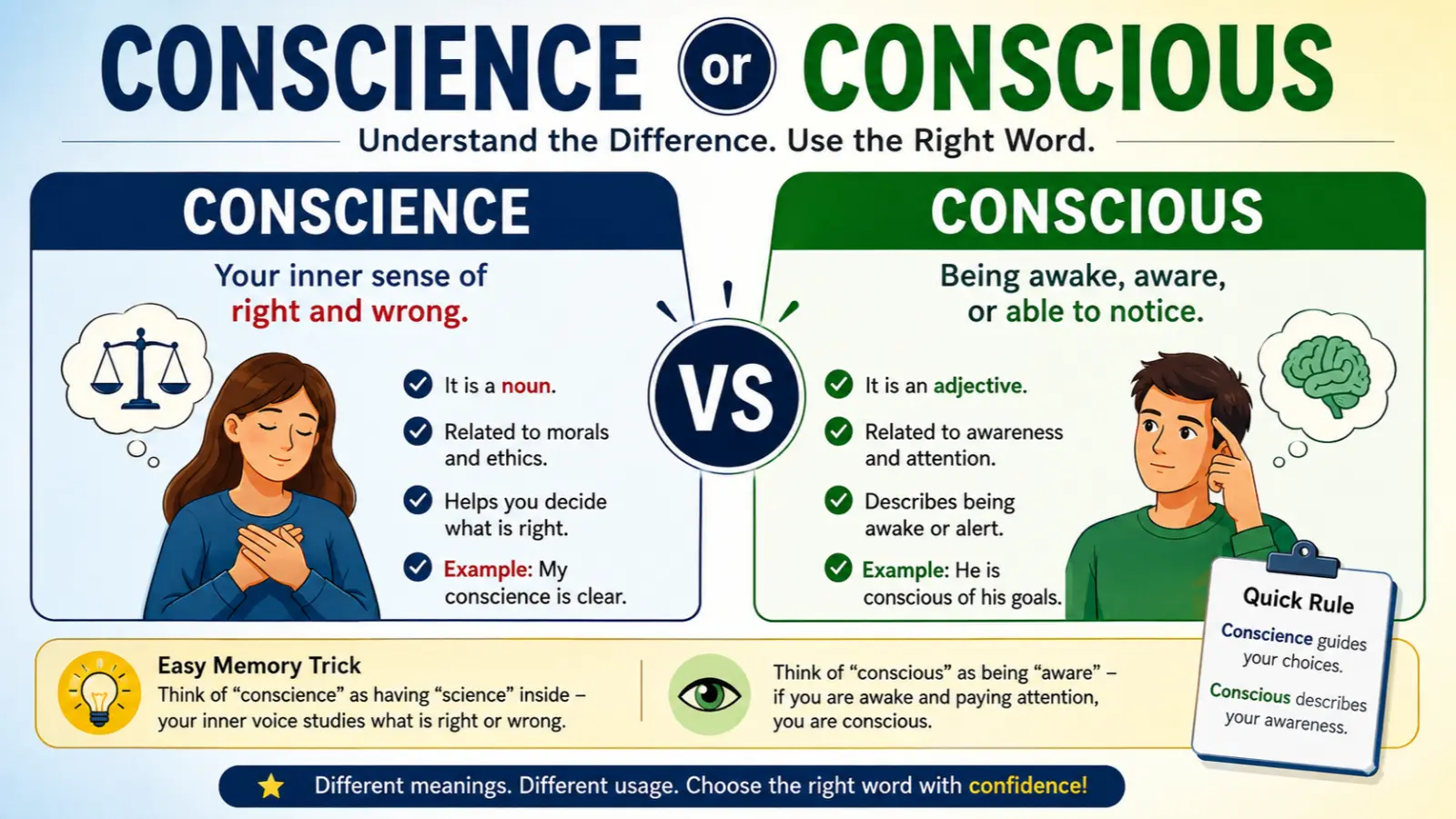
Conscience is your inner sense of right and wrong.
Conscious means awake, aware, or able to notice what is happening.
Simple Rule
If you are talking about morals or guilt, use conscience.
If you are talking about awareness or being awake, use conscious.
Understanding Conscience
Conscience is a noun.
It refers to the inner voice that helps you decide what is right and wrong.
Examples
- My conscience told me to return the lost wallet.
- She had a guilty conscience after lying.
- A clear conscience helps people sleep peacefully.
- His conscience would not let him cheat.
Understanding Conscious
Conscious is usually an adjective.
It describes someone who is awake, aware, or paying attention.
Examples
- He remained conscious after the accident.
- She is conscious of her spending habits.
- We should be conscious of environmental issues.
- The patient became conscious a few minutes later.

Side by Side Comparison
| Conscience | Conscious |
|---|---|
| Noun | Adjective |
| Means moral sense | Means aware or awake |
| Related to ethics | Related to awareness |
| Talks about right and wrong | Talks about noticing or understanding |
| Example: My conscience is clear. | Example: I am conscious of the problem. |
How Grammar Changes the Meaning
The easiest way to remember the difference is to identify what role the word plays in the sentence.
Use conscience when naming something.
Example
- Her conscience prevented her from lying.
Use conscious when describing someone or something.
Example
- She is conscious of the risks.

Common Mistakes People Make
Mistake One
❌ My conscious told me not to do it.
✅ My conscience told me not to do it.
Mistake Two
❌ He lost his conscience after the operation.
✅ He lost consciousness after the operation.
Mistake Three
❌ I am conscience of my mistakes.
✅ I am conscious of my mistakes.
Professional Writing Tips
In business, academic, and formal writing, using the correct word is important.
Use conscience when discussing ethics, honesty, responsibility, or personal values.
Example
- The company acted according to its conscience.
Use conscious when discussing awareness, health, safety, education, or decision making.
Example
- Employees should remain conscious of workplace safety policies.

Everyday Conversation Examples
Friend: Why did you return the extra money?
You: My conscience would not let me keep it.
Friend: Are you conscious of how much time you spend online?
You: Yes, I am trying to reduce my screen time.
Doctor: Is the patient conscious?
Nurse: Yes, the patient is fully conscious now.
Which Word Fits These Sentences
My ______ told me to apologize.
Answer: conscience
She became ______ after the surgery.
Answer: conscious
Parents should be ______ of online safety.
Answer: conscious
He followed his ______ and admitted the mistake.
Answer: conscience
Easy Memory Trick
Think of conscience as having science inside the word. Imagine your brain studying what is right and wrong before making a decision.
Think of conscious as meaning aware. If you are awake and paying attention, you are conscious.
When Both Words Might Appear Together
Sometimes both words belong in the same sentence because they describe different ideas.
Example
- She was conscious of her mistake, and her conscience encouraged her to apologize.
Here:
- Conscious means she was aware of the mistake.
- Conscience means her moral sense encouraged her to do the right thing.
Quick Quiz
Choose the correct word.
I have a clear ______.
Answer: conscience
The driver remained ______ after the crash.
Answer: conscious
She is ______ of the company’s new policy.
Answer: conscious
His ______ would not let him ignore the truth.
Answer: conscience
Frequently Asked Questions
Is conscience the same as conscious?
No. Conscience refers to your moral sense, while conscious means aware or awake.
Which one is used for guilt?
Conscience is used when talking about guilt, honesty, and moral decisions.
Which one is used in medical situations?
Conscious is used to describe a person who is awake or responsive.
Can conscious be a noun?
No. Conscious is mainly an adjective. The related noun is consciousness.
Why do people confuse these words?
They have similar spelling and pronunciation, but they belong to different parts of speech and express different ideas.
Conclusion
Conscience and conscious are both correct English words, but they serve different purposes.
Use conscience when talking about morality, honesty, guilt, or your inner sense of right and wrong.
Use conscious when talking about awareness, attention, or being awake.
Remember this simple rule:
Conscience guides your choices. Conscious describes your awareness.
Once you connect each word with its meaning, choosing the correct one becomes easy in both everyday conversations and professional writing.

Olivia Bennett is a grammar expert and language content writer at GrammarWize.com. She specializes in English grammar, word usage, spelling differences, and writing improvement. Through clear explanations and practical examples, Olivia helps students, professionals, and language learners communicate more effectively. Her goal is to make English grammar simple, accessible, and easy to apply in everyday writing.