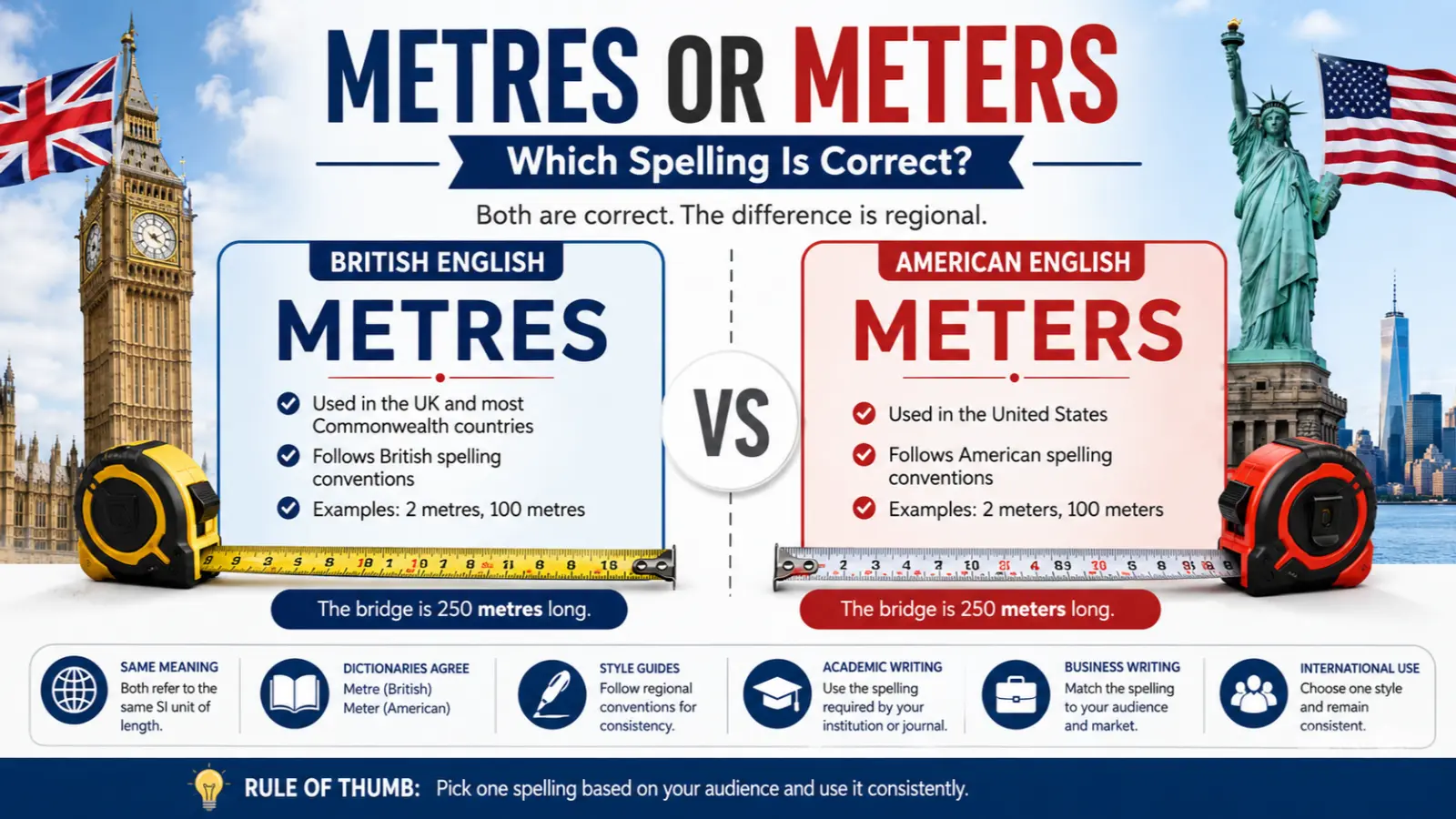
Both metres and meters are correct spellings. The difference depends on the variety of English you are using.
Metres or Meters is a common spelling question that confuses many English learners, writers, and students. Both words refer to the same unit of length in the metric system, but the correct choice depends on the type of English you are using. Understanding the difference helps you write accurately in academic, professional, and everyday contexts.
The good news is that both spellings are correct. This guide explains the difference between metres and meters, shows when to use each one, provides simple examples, and answers common questions so you can choose the right spelling with confidence.
- Metres is the standard spelling in British English and most countries that follow British spelling.
- Meters is the standard spelling in American English.
If you are writing for an international audience, the best choice is to stay consistent with one style throughout your document.
What Is the Difference Between Metres and Meters?
The words metres and meters refer to the same unit of length in the International System of Units (SI).
| British English | American English |
|---|---|
| metres | meters |
| kilometres | kilometers |
| centimetres | centimeters |
The meaning never changes. Only the spelling differs.
Example (British English):
The bridge is 250 metres long.
Example (American English):
The bridge is 250 meters long.

Which Countries Use Metres?
The spelling metres is standard in countries that primarily follow British English, including:
- United Kingdom
- Australia
- New Zealand
- Ireland
- South Africa
- India
- Pakistan
- Most Commonwealth countries
Government publications, universities, and newspapers in these countries normally use metres.

Which Countries Use Meters?
The spelling meters is standard in:
- United States
American publishers, schools, businesses, and media almost always write meters.
Why Are There Two Different Spellings?
The difference comes from the historical development of British and American spelling.
During the 19th century, American English gradually adopted spelling patterns that differed from British English. While the metric system itself originated in France, English-speaking countries adapted the spelling according to their regional conventions.
As a result:
- British English kept metre.
- American English standardized meter.
Both forms have existed for well over a century.
Dictionary Recommendations
Major dictionaries recognize both spellings.
| Dictionary | Recommendation |
|---|---|
| Oxford English Dictionary | Metre (British), Meter (American) |
| Cambridge Dictionary | Metre in British English, Meter in American English |
| Merriam-Webster | Meter |
| Collins Dictionary | Both spellings depending on region |
The dictionaries agree that the difference is regional rather than grammatical.
What Do Official Style Guides Recommend?
Most professional style guides follow regional spelling conventions.
British Style Guides
These generally recommend:
- metre
- kilometre
- centimetre
Common examples include:
- Oxford Style Manual
- UK Government Style Guide
American Style Guides
These recommend:
- meter
- kilometer
- centimeter
Examples include:
- The Chicago Manual of Style
- AP Style
The important rule is consistency within the same document.
Which Spelling Should Academic Writers Use?
Academic writing depends on the institution or journal.
Use metres if:
- Your university follows British English.
- Your journal uses British spelling.
- Your institution is located in the UK or Commonwealth countries.
Use meters if:
- Your institution follows American English.
- Your publisher requires American spelling.
- Your journal uses US editorial standards.
Scientific papers should never mix both spellings.

Which Spelling Is Better for Business Writing?
Business communication should match the audience.
Choose metres when writing for:
- UK clients
- Australian companies
- European organizations using British English
Choose meters when writing for:
- American customers
- US businesses
- American marketing materials
Consistency helps maintain professionalism.
International Communication
International organizations often publish documents in either British or American English.
There is no universal requirement to use one spelling over the other.
The best practice is to:
- Follow your organization’s editorial style.
- Keep the spelling consistent throughout the document.
- Match the spelling to your target audience.
Real World Examples
British English
- The stadium measures 120 metres in length.
- The race covers 400 metres.
- Stay two metres apart.
American English
- The stadium measures 120 meters in length.
- The race covers 400 meters.
- Stay two meters apart.
All of these sentences are correct within their respective language varieties.
Publishing Standards
Professional publishers expect writers to follow one language standard consistently.
For example:
British publication
- metres
- litres
- centimetres
- kilometres
American publication
- meters
- liters
- centimeters
- kilometers
Switching between styles in one article is generally considered poor editorial practice.
Current Usage Trends
Modern English continues to use both spellings widely.
Metres dominates in
- British publications
- Commonwealth countries
- UK education
- British government documents
Meters dominates in
- American books
- US education
- American journalism
- US government publications
Neither spelling is replacing the other because each serves its own regional standard.
Common Mistakes
Mixing British and American spelling
❌ The road is 500 metres long and the bridge is 200 meters away.
Choose one style instead.
Using the wrong regional spelling
If writing for a UK audience:
✔ 300 metres
If writing for a US audience:
✔ 300 meters
Quick Comparison Table
| Feature | Metres | Meters |
|---|---|---|
| Correct spelling | Yes | Yes |
| British English | ✔ | ✘ |
| American English | ✘ | ✔ |
| Same meaning | ✔ | ✔ |
| SI unit | ✔ | ✔ |
| Academic use | British institutions | American institutions |
| Business use | UK and Commonwealth | United States |
Should You Use Metres or Meters?
Use metres if your document follows British English.
Use meters if your document follows American English.
Neither spelling is more correct than the other. The right choice depends entirely on your audience and the editorial style you are following.
Frequently Asked Questions
Is metres correct?
Yes. Metres is the standard British English spelling of the metric unit of length.
Is meters wrong?
No. Meters is the standard American English spelling.
Which spelling does the SI system use?
The International System of Units (SI) uses the French-derived unit name metre in its official English documentation. However, American English publications commonly write meter while referring to the same SI unit.
Which spelling should students use?
Students should follow the spelling style required by their school, university, or instructor.
Can I use both spellings in one article?
It is best not to. Choose British English or American English and remain consistent.
Do metres and meters have different meanings?
No. Both refer to exactly the same unit of measurement.
Conclusion
Metres and meters are both correct spellings for the same metric unit of length. The only difference is regional usage. Metres is the standard form in British English and throughout most Commonwealth countries, while meters is the accepted spelling in American English. Dictionaries, style guides, publishers, and academic institutions all recommend using the spelling that matches your chosen variety of English. For clear and professional writing, select one style and use it consistently from beginning to end.

Olivia Bennett is a grammar expert and language content writer at GrammarWize.com. She specializes in English grammar, word usage, spelling differences, and writing improvement. Through clear explanations and practical examples, Olivia helps students, professionals, and language learners communicate more effectively. Her goal is to make English grammar simple, accessible, and easy to apply in everyday writing.