Have you ever wondered if people and persons mean the same thing? Many English learners assume they are interchangeable, but that is only partly true. Both words are correct English, yet they are used in different situations depending on the context, grammar, and level of formality.
People or Persons is a common grammar question because both words are correct, but they are used in different situations. Many English learners and writers wonder which one fits better in everyday conversation, formal writing, or legal documents. Understanding the difference can help you write more naturally and avoid common mistakes.
In most cases, people is the preferred plural of person and is widely used in daily English. Persons, however, appears mainly in legal, official, or formal contexts where precision is important. This guide explains the meaning, differences, examples, and correct usage of both words so you can choose the right one with confidence every time.
This guide explains the difference between people and persons in simple English. You will learn when to use each word, common mistakes to avoid, professional writing rules, and easy tricks to remember the correct choice.
Keyword Analysis
Category: Plural Forms
Both people and persons are correct. They are not spelling mistakes. The difference is based on usage, grammar, and formality rather than correctness.
Quick Answer
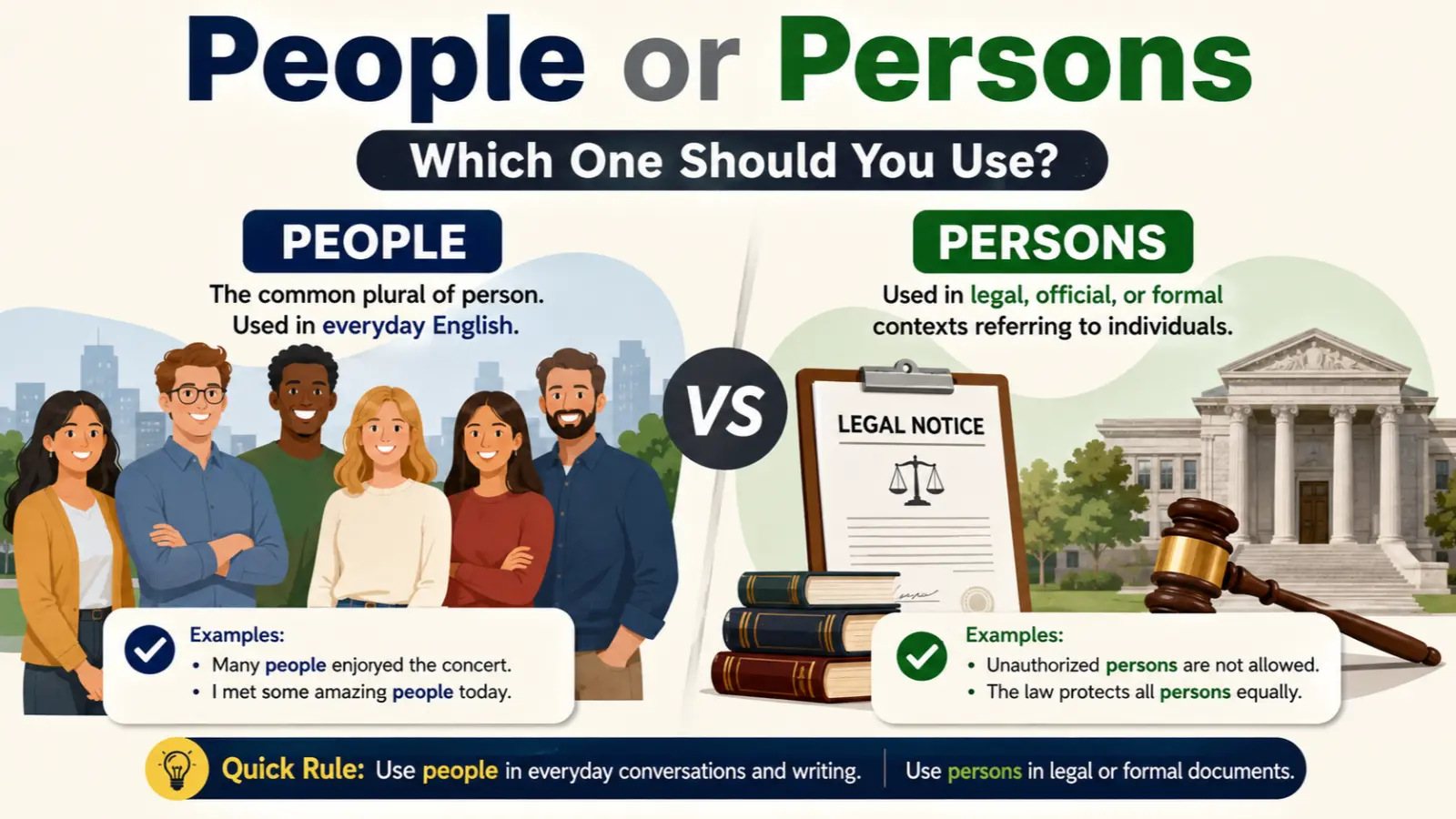
People is the standard plural of person in everyday English.
Persons is mainly used in legal, official, or formal documents when referring to individuals separately.
Examples
✅ Five people attended the meeting.
✅ The police are searching for three persons involved in the incident.
Understanding the Meaning
What Does People Mean
People refers to two or more human beings as a group. It is the normal plural form used in conversations, books, news articles, and everyday writing.
Examples
- Many people enjoyed the concert.
- The people in the restaurant were friendly.
- Young people use social media every day.
What Does Persons Mean
Persons refers to individual human beings in legal, official, or technical contexts. It emphasizes each individual rather than the group.
Examples
- Unauthorized persons are not allowed beyond this point.
- The law protects all persons equally.
- Missing persons should be reported immediately.
The Grammar Rule
In modern English
- Person = one individual
- People = two or more individuals in almost every situation
- Persons = used mainly in legal and formal writing
For everyday English, choose people.

When to Use People
Use people when writing or speaking naturally.
Examples
- People love good food.
- I met several interesting people today.
- The people at work were helpful.
- More people are choosing electric cars.
This is the preferred choice in schools, business communication, blogs, and conversations.

When to Use Persons
Use persons when writing official or legal documents.
Examples
- Persons under eighteen cannot enter.
- The notice applies to all persons on the property.
- Missing persons investigations continue.
Outside these situations, people usually sounds more natural.

People vs Persons Comparison
| Feature | People | Persons |
|---|---|---|
| Everyday English | ✔ Yes | Rare |
| Formal Documents | Sometimes | ✔ Yes |
| Legal Writing | Rare | ✔ Common |
| Business Communication | ✔ Preferred | Rare |
| Natural Conversation | ✔ Yes | No |
| Academic Writing | ✔ Usually | Sometimes |
Sentence Comparison
Everyday Conversation
✔ I saw many people at the park.
❌ I saw many persons at the park.
Legal Notice
✔ No unauthorized persons may enter.
✔ No unauthorized people may enter.
Both are correct, but persons sounds more formal.
News Writing
✔ Several people were rescued.
More natural than
Several persons were rescued.
Common Mistakes
Using Persons in Casual Conversation
❌ I invited ten persons to dinner.
✔ I invited ten people to dinner.
Thinking Persons Is More Correct
Many learners believe persons is the proper plural because it follows the normal grammar pattern.
In reality, people has been the standard plural in English for centuries.
Using People in Legal Documents
Legal writing often prefers persons because it refers to each individual separately.
Professional Writing Tips
Use people in
- Emails
- Blog posts
- School assignments
- Business communication
- Marketing content
- News articles
Use persons in
- Laws
- Contracts
- Government notices
- Legal policies
- Official regulations
Real Life Conversations
At School
Student: How many people are in your class?
Teacher: Around thirty people.
At the Airport
Announcement: Unauthorized persons are prohibited beyond this point.
At Work
Manager: We need more people on this project.
Memory Trick
Think of it this way.
People = Daily life
Persons = Legal life
If you are talking normally, use people.
If you are writing a law or official notice, persons may be the better choice.
Why Does This Confusion Happen
English usually forms plurals by adding s, so learners expect persons to be the normal plural.
However, people became the standard plural through historical language development and remains the preferred choice in modern English.
Frequently Asked Questions
Is people grammatically correct?
Yes. People is the standard plural of person in modern English.
Is persons wrong?
No. It is correct in legal, official, and formal writing.
Which word should students use?
Students should normally use people unless writing about legal topics.
Why do legal documents use persons?
Because legal writing often refers to individuals separately instead of as a group.
Can I use persons in everyday conversation?
You can, but it sounds unnatural. Native speakers almost always say people.
Conclusion
Both people and persons are correct English words, but they serve different purposes.
Use people in everyday speech, writing, education, and business because it is the standard plural of person.
Use persons only in legal, official, or highly formal contexts where each individual is being referred to separately.
If you remember one rule, make it this:
Choose “people” for almost every situation. Choose “persons” only when writing legal or official documents.

Olivia Bennett is a grammar expert and language content writer at GrammarWize.com. She specializes in English grammar, word usage, spelling differences, and writing improvement. Through clear explanations and practical examples, Olivia helps students, professionals, and language learners communicate more effectively. Her goal is to make English grammar simple, accessible, and easy to apply in everyday writing.