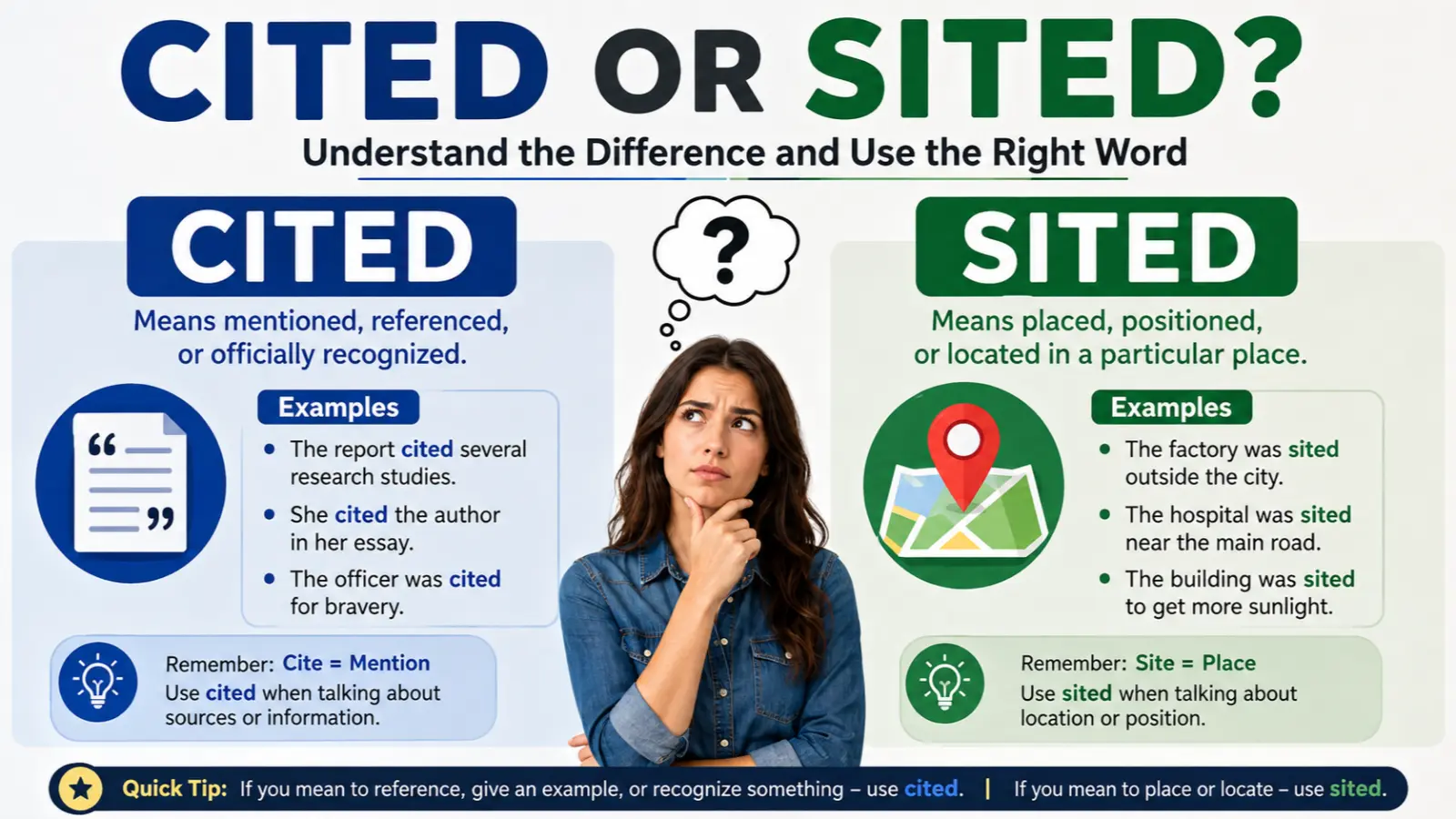
Cited or sited can be confusing because both words sound exactly the same, but they have completely different meanings. Cited usually relates to mentioning a source, giving an example, or officially recognizing someone. Sited means placed or located in a particular position.
Cited or Sited often confuses writers because the words look similar when written quickly, but they have different meanings and pronunciations. Cited means mentioning or referring to a source, person, or piece of information. Sited means located or placed in a particular position. Understanding this difference helps you choose the correct word in academic, professional, and everyday writing.
For example, you might have cited a research paper to support your argument. A new building may be sited near a busy road because of its location. Although both words are correct, they have completely different meanings and uses. Learning their definitions and examples makes this spelling and usage difference much easier to remember.
Remember the difference easily: cited means you referenced a source, while sited means you placed something at a location. Once you understand this small difference, choosing the right word becomes much easier.
Cited or Sited: What Is the Difference?
Cited is the correct word when you mean mentioned, quoted, referenced, or officially recognized.
Sited is the correct word when you mean placed or located somewhere.
Word
Meaning
Example
Cited
Mentioned or referenced
The article cited several studies.
Cited
Officially recognized
The officer was cited for bravery.
Sited
Located or placed
The new school was sited near the highway.
Both words are correct. The right choice depends on what you want to say.
What Does Cited Mean?
Cited is the past tense and past participle of cite.
The verb cite can mean to mention a source, quote information, give an example, or officially recognize someone.
For example:
The researcher cited three scientific studies.
She cited the author in her essay.
The lawyer cited an important case.
The firefighter was cited for bravery.
The teacher cited several examples during the lesson.
In academic and professional writing, cited often refers to sources and evidence.
Cited in Academic Writing
Academic writers often cite books, articles, websites, studies, and other sources.
For example:
The report cited recent research on climate change.
Here, cited means that the report referred to or used information from research.
You might also see phrases such as:
cited sources
cited evidence
cited research
cited references
properly cited information
What Does Sited Mean?
Sited is the past tense and past participle of site when site is used as a verb.
It means placed, positioned, or located in a particular place.
For example:
The factory was sited outside the city.
The hospital was sited near the main road.
The company sited its new office downtown.
The wind turbines were sited on the hill.
The building was carefully sited to receive natural light.
Think of site as a location. Therefore, sited usually describes where someone places something.
Why Do Cited and Sited Cause Confusion?
The main reason is pronunciation.
Cited and sited are homophones. They sound the same but have different spellings and meanings.
Compare:
cited → cite → reference or recognize
sited → site → location or place
This creates confusion when writing because you cannot hear the difference in speech.
For example, if someone says:
The company cited the new building there.
You need the context to understand what they mean. If the meaning is about location, sited may be the correct spelling.
Grammar Rules for Cited
Cited works as the past tense or past participle of cite.
The basic sentence structure is:
Subject + cited + object
Examples:
The author cited several sources.
The journalist cited new evidence.
The professor cited the study.
It can also appear in passive constructions:
Several researchers cited the study.
The lawyer cited the case during the trial.
Cited With Sources
When referring to a source, cited often appears with words such as:
source
study
article
report
research
evidence
example
author
Example:
The writer cited a government report in the article.
Grammar Rules for Sited
Sited is the past tense or past participle of the verb site.
It usually describes the location or placement of something.
The basic structure is:
Subject + sited + object + location
Examples:
The city sited the facility near the airport.
Engineers sited the tower on higher ground.
The company sited the factory outside town.
In passive sentences, it commonly appears as:
Something + was/were + sited + location
Examples:
The company sited the factory near the river.
The company sited the new offices in the business district.
Cited vs Sited in Everyday Examples
Seeing the words in context makes the difference clearer.
Examples With Cited
The student cited two books in her paper.
The article cited reliable sources.
The lawyer cited a previous court decision.
The report cited several possible causes.
The officer was cited for outstanding service.
Examples With Sited
The owner sited the hotel near the beach.
The company sited the factory outside the town.
The new school was sited on donated land.
The developers sited the wind farm in a remote area.
The architects sited the building carefully to reduce noise.
Common Mistakes With Cited and Sited
Using Sited for a Source
Incorrect:
The writer sited three academic studies.
Correct:
The writer cited three academic studies.
The sentence is about references, so cited is correct.
Using Cited for a Location
Incorrect:
The new factory was cited outside the city.
Correct:
The new factory was sited outside the city.
The sentence explains where someone placed the factory, so sited is correct.
Confusing Site With Cite
A useful comparison is:
site = place
cite = mention or reference
Examples:
The company chose a new site for its office.
The company cited several reasons for the move.
Cited or Sited in Professional Writing
Both words can appear in professional writing, but they serve different purposes.
Cited is common in:
Academic papers
Research reports
Legal documents
Journalism
Business reports
Technical writing
Sited is common in:
Architecture
Construction
Urban planning
Engineering
Real estate
Geography
Environmental planning
For example:
The report cited several environmental studies.
This is professional usage of cited.
The facility was sited away from residential areas.
This is professional usage of sited.
Formal vs Informal Usage
Cited is common in both formal and everyday English.
You might say:
She cited her source.
You might also write:
The researcher cited multiple peer reviewed studies.
Sited is less common in casual conversation. People often use located or placed instead.
For example:
The building is located near the station.
This sounds more natural in everyday English than:
The building is sited near the station.
However, sited is perfectly correct and useful in formal contexts involving planning, construction, or location.
A Simple Memory Trick
Use this trick:
Cited = Cite = Mention
Sited = Site = Place
If you are talking about a source, reference, example, or recognition, use cited.
If you are talking about a place, position, or location, use sited.
Remember:
Cited talks about information. Sited talks about location.
Cited or Sited in Real Life Conversations
Here are some natural examples.
Person 1: Why did the teacher mark this paragraph?
Person 2: You didn’t properly cite your source.
Another example:
Person 1: Where will the new hospital be built?
Person 2: It will be sited near the highway.
One more:
Person 1: Why is that research mentioned in the report?
Person 2: The author cited it as supporting evidence.
These examples show how context determines the correct spelling.
Quick Comparison
Feature
Cited
Sited
Base word
Cite
Site
Main meaning
Mention or reference
Place or locate
Pronunciation
Same as sited
Same as cited
Grammar
Past tense or past participle
Past tense or past participle
Common context
Research and references
Location and planning
Example
She cited the study.
The building was sited nearby.
How to Choose the Right Word
Ask yourself one question:
Am I talking about information or location?
If you mean information, evidence, a source, an example, or recognition, choose cited.
If you mean a place, position, or where something is located, choose sited.
For example:
The researcher cited the report.
The researcher mentioned the report.
The factory was sited near the highway.
The factory was located near the highway.
Frequently Asked Questions
Is cited or sited correct?
Both are correct words. Cited means mentioned, referenced, or officially recognized. Sited means placed or located somewhere.
Is sited a real word?
Yes. Sited is the past tense and past participle of site when you use site as a verb to mean placing or locating something.
Do cited and sited sound the same?
Yes. Cited and sited are homophones because they have the same pronunciation but different spellings and meanings.
How do you remember cited vs sited?
Remember cite = mention and site = place. Use cited for references and sited for locations.
Should I use cited in academic writing?
Yes. Cited is commonly used when explaining that a writer referred to a source, study, article, or piece of evidence.
Is sited formal English?
Yes. Sited is standard English, but it appears more often in formal contexts involving construction, planning, architecture, engineering, and locations.
What is the difference between cited and located?
Cited means mentioned or referenced, while located means found or positioned somewhere. Sited can also mean deliberately placed or located in a particular position.
Conclusion
Cited and sited are both correct, but they have different meanings. Use cited when you mean mentioned, referenced, quoted, or officially recognized. Use sited when you mean placed or located in a particular position.
The easiest memory trick is cite means mention, while site means place. Once you connect each word with its meaning, this common homophone confusion becomes much easier to avoid.
Olivia Bennett is a grammar expert and language content writer at GrammarWize.com. She specializes in English grammar, word usage, spelling differences, and writing improvement. Through clear explanations and practical examples, Olivia helps students, professionals, and language learners communicate more effectively. Her goal is to make English grammar simple, accessible, and easy to apply in everyday writing.