Lose or loss are commonly confused English words because they sound and look related. However, they have different meanings and grammar roles.
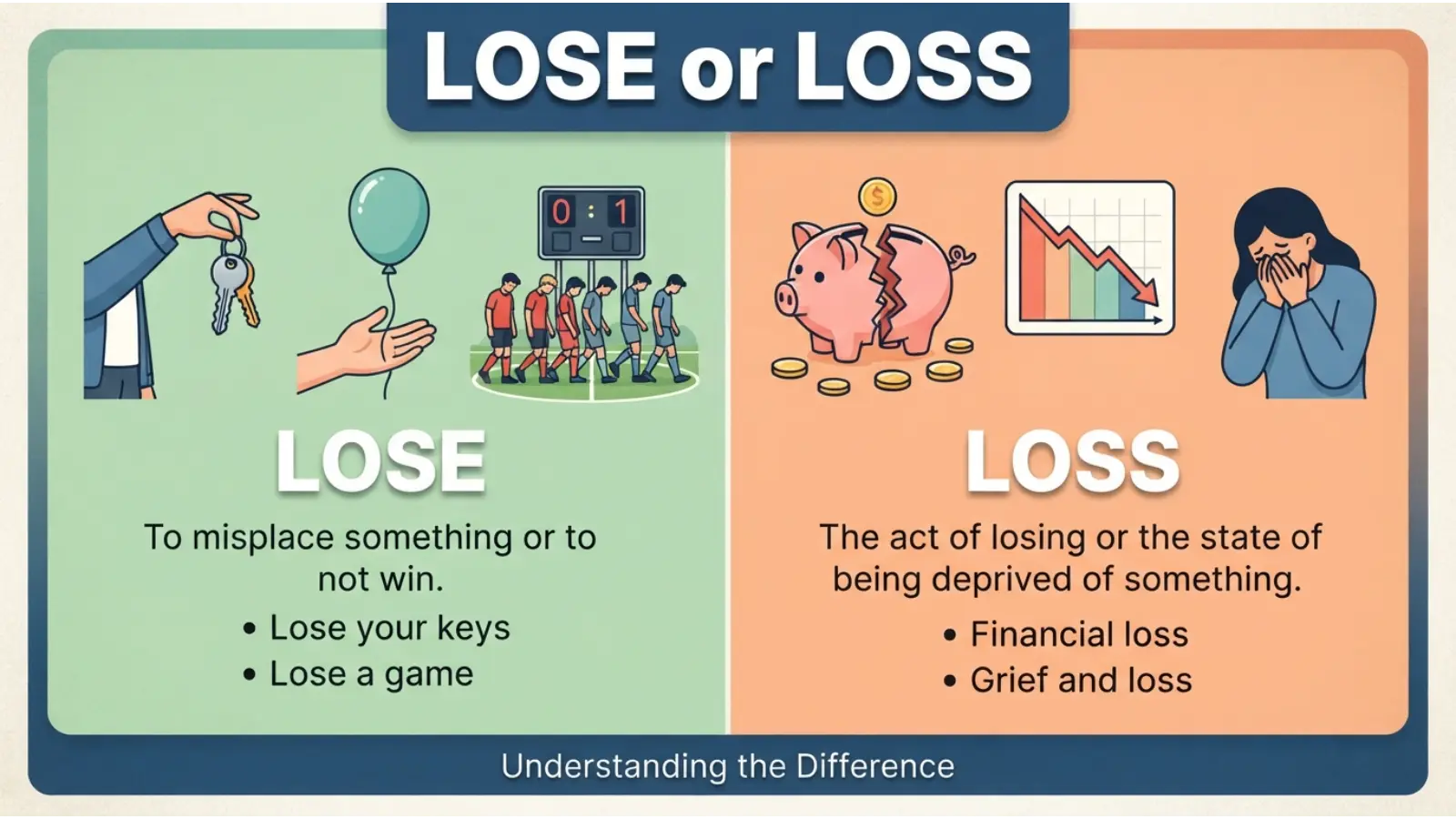
Lose or Loss can be confusing because both words relate to something going missing, failing, or not being won. However, they have different meanings and grammatical uses. Lose is a verb that means to misplace something, fail to win, or no longer have something. Loss is a noun that describes the result or experience of losing something.
Understanding the difference between lose or loss helps you avoid common grammar mistakes in everyday writing. For example, you can lose your keys, but losing your keys can be a loss. Learning when to use each word makes your sentences clearer and more accurate.
Lose is a verb that describes an action or situation. Loss is a noun that describes something that has been lost or the experience of losing something. Learning this simple difference makes it much easier to choose the right word.
Lose vs Loss at a Glance
| Word | Part of Speech | Main Meaning | Example |
|---|---|---|---|
| Lose | Verb | To no longer have something | I do not want to lose my phone. |
| Loss | Noun | The act or result of losing something | The loss of my phone was frustrating. |
The easiest rule is simple:
Lose = action
Loss = result or experience
What Does Lose Mean?
Lose is a verb. It describes an action or a situation where someone no longer has something.
You can lose an object, game, opportunity, job, relationship, money, or even your way.
Examples of Lose
- I do not want to lose my keys.
- She may lose her job.
- Our team could lose the game.
- He lost his wallet yesterday.
- Do not lose hope.
- I always lose my glasses.
The word can also describe failing to win.
Our team might lose the match.
Here, lose describes what the team may do.
What Does Loss Mean?
Loss is a noun. It refers to the result, experience, or amount connected with losing something.
It often appears after words such as a, the, her, his, or their.
Examples of Loss
- The company suffered a major loss.
- His death was a great loss to the family.
- The business reported a financial loss.
- The loss of trust damaged their relationship.
- We were shocked by the loss.
- The team experienced a disappointing loss.
In these sentences, loss names the situation or result rather than the action.
The Main Grammar Difference
The biggest difference is their grammatical role.
Lose is a verb.
It tells us what someone does or what happens.
I might lose my phone.
Loss is a noun.
It names the experience or result.
The loss of my phone caused problems.
This distinction helps you choose the correct word quickly.

How Lose Works in a Sentence
Because lose is a verb, it can change according to tense.
Present tense
I often lose my keys.
Past tense
I lost my keys yesterday.
Future tense
I might lose my keys again.
Infinitive form
I do not want to lose my keys.
A common mistake is writing loss when an action is needed.
Incorrect:
I do not want to loss my phone.
Correct:
I do not want to lose my phone.

How Loss Works in a Sentence
Because loss is a noun, it can work as the subject or object of a sentence.
The loss was unexpected.
The company reported a financial loss.
The loss of the documents created serious problems.
You can also use plural forms.
The company experienced several losses.
This does not work with lose because lose is a verb.
Lose and Loss in Comparison
These examples show the difference clearly.
I do not want to lose my money.
The loss of money caused financial stress.
The team could lose the final.
The team suffered a painful loss.
She may lose her position.
Her loss of confidence affected her work.
The first sentence in each pair focuses on the action. The second focuses on the result or experience.

Common Mistakes With Lose and Loss
One of the most common mistakes is using loss as a verb.
Incorrect:
I do not want to loss my job.
Correct:
I do not want to lose my job.
Another common mistake is using lose as a noun.
Incorrect:
The team suffered a lose.
Correct:
The team suffered a loss.
Remember that the verb is lose, while the noun is loss.
Lose vs Lost
Another important point is the difference between lose and lost.
Lose is the base form of the verb.
I do not want to lose.
Lost is the past tense and past participle of lose.
I lost my wallet yesterday.
Do not use loss as the past tense of lose.
Incorrect:
I loss my wallet.
Correct:
I lost my wallet.
Lose vs Loss in Professional Writing
Both words are common in professional English, but they serve different purposes.
Lose is useful when discussing an action or possible outcome.
The company may lose several customers.
Loss is useful when discussing business results, financial effects, or measurable consequences.
The company reported a significant financial loss.
Professional reports often use loss in phrases such as:
- financial loss
- business loss
- revenue loss
- data loss
- loss of income
- loss of productivity
- loss of confidence
- loss of customers
Formal and Informal Usage
Both lose and loss are standard English words. Neither is specifically informal.
In everyday conversation, you might say:
I do not want to lose my phone.
In formal writing, you might see:
The loss of company data created significant operational problems.
The difference comes from grammar and context, not from formality.
Real Life Conversation Examples
Talking about losing something
A: Where are your keys?
B: I think I might lose them if I keep putting them here.
Talking about a financial problem
A: How did the business perform this year?
B: We experienced a significant loss.
Talking about a sports game
A: Did your team win?
B: No, we lost the game.
Talking about an emotional experience
A: Why is she upset?
B: She is still dealing with the loss of her friend.
These conversations show how naturally the two words can appear in different situations.
An Easy Memory Trick
Use this simple trick:
Lose has an E for Event or action.
Think:
Lose = do something
Loss = the result
For example:
I could lose my job.
The action is lose.
The loss of my job was difficult.
The experience or result is loss.
Another useful clue is the spelling.
Lose has one s sound.
Loss ends with a strong ss sound.
Quick Test
Try replacing the word with misplace, fail to keep, or not win.
If that meaning works, you probably need lose.
I might lose my phone.
Now try replacing the word with absence, damage, or result of losing.
If that meaning works, you probably need loss.
The loss of my phone was frustrating.
Lose or Loss: Which One Should You Use?
Both words are correct. The choice depends on the grammatical role of the word.
Use lose when you need a verb.
Do not lose your passport.
Use loss when you need a noun.
The loss of the passport caused serious problems.
So, there is no single correct word between lose and loss. They are both correct but cannot normally replace each other.
Frequently Asked Questions
Is lose a noun or a verb?
Lose is a verb. It describes an action or situation involving no longer having something or failing to win.
Is loss a noun or a verb?
Loss is a noun. It describes the result, experience, or amount connected with losing something.
Is it lose weight or loss weight?
The correct phrase is lose weight.
I want to lose weight.
Is it lose money or loss money?
The correct phrase is lose money.
You could lose money on that investment.
Is it a lose or a loss?
The correct phrase is a loss.
The team suffered a loss.
Is it lost or loss?
Use lost as the past form of lose.
I lost my wallet.
Use loss as a noun.
The loss of my wallet was frustrating.
Can lose and loss be used in the same sentence?
Yes. They can appear together when the sentence needs both a verb and a noun.
The company could lose money because of the financial loss.
What is the easiest way to remember lose and loss?
Remember:
Lose is a verb. Loss is a noun.
Think lose = action and loss = result.
Conclusion
Lose and loss are both correct words, but they perform different jobs in a sentence. Lose is a verb used for an action or situation, while loss is a noun used for the result or experience of losing something.
If you are describing what someone might do, use lose. If you are naming the result or experience, use loss.
Lose = action
Loss = result
Once you remember this simple difference, choosing between lose or loss becomes much easier.

Olivia Bennett is a grammar expert and language content writer at GrammarWize.com. She specializes in English grammar, word usage, spelling differences, and writing improvement. Through clear explanations and practical examples, Olivia helps students, professionals, and language learners communicate more effectively. Her goal is to make English grammar simple, accessible, and easy to apply in everyday writing.