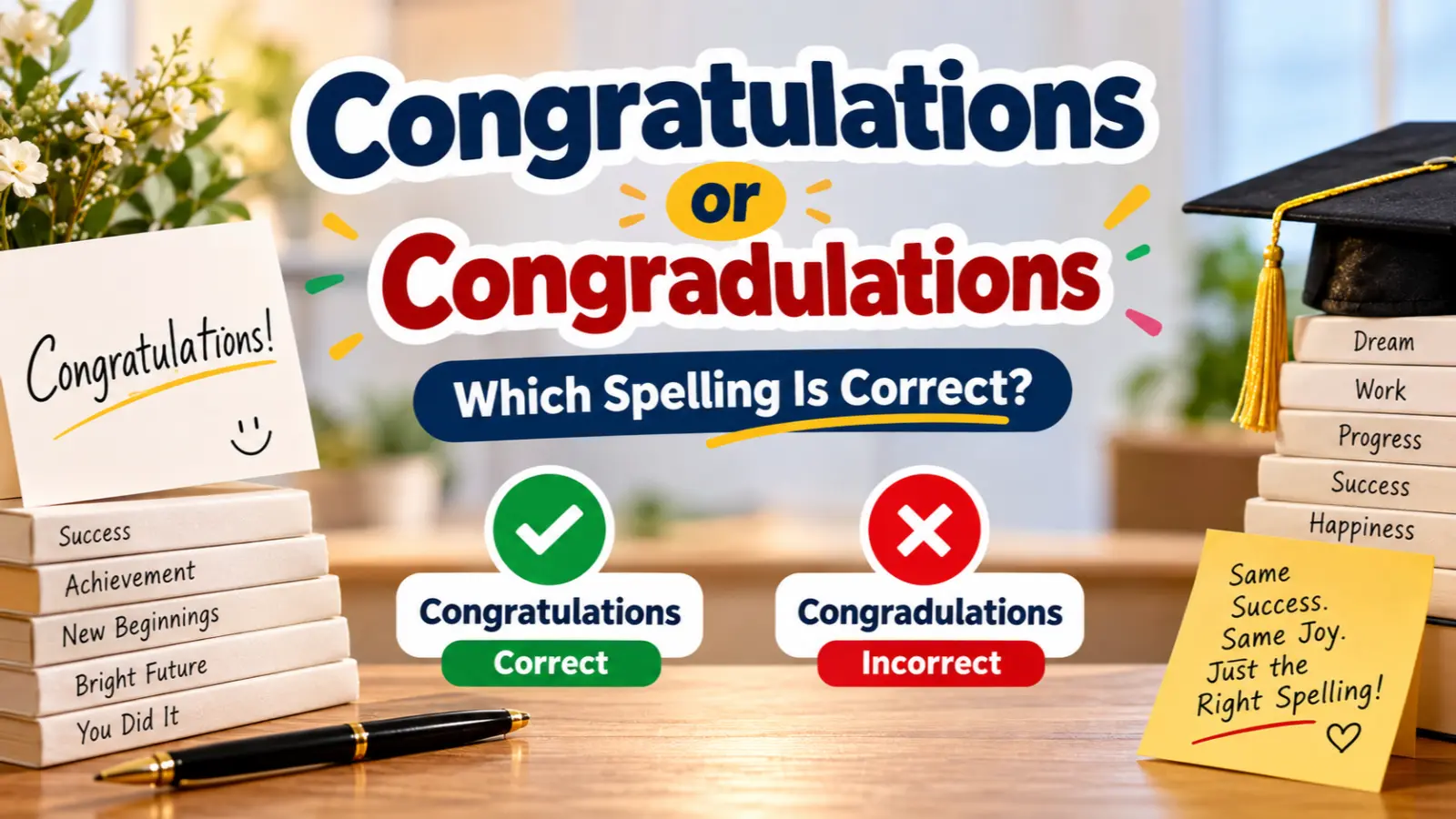
Congratulations is the correct spelling. Congradulations is a common misspelling caused by the way people pronounce the word and connect it with other words ending in “d.” If you are writing a card, email, school assignment, or professional message, use congratulations.
Congratulations is the correct spelling, while Congradulations is a common misspelling. If you are unsure which word to use in a message, card, email, or social media post, Congratulations is always the right choice. This guide explains the difference, meaning, pronunciation, and correct usage with simple examples.
The word is used to show happiness about someone’s success, achievement, or good news. You can write “Congratulations on your promotion” or simply say “Congratulations!” Cambridge Dictionary lists congratulations as the standard expression used to congratulate someone.
Quick Answer
Congratulations is correct.
Congradulations is incorrect.
The correct spelling is:
Congratulations
The incorrect spelling is:
Congradulations
There is no standard spelling congradulations in English. The extra d does not belong in the word.
Meaning of Congratulations
Congratulations is used to express pleasure or approval when someone achieves something important or receives good news.
For example:
- Congratulations on your new job.
- Congratulations on passing your exam.
- Congratulations on your graduation.
- Congratulations on your wedding.
- Congratulations! You did it.
Cambridge Dictionary defines congratulations as something said when you want to congratulate someone. It also identifies the word as a plural noun and an exclamation.
The related verb is congratulate.
For example:
I want to congratulate you on your success.
Cambridge Dictionary defines congratulate as praising someone and showing pleasure about a special achievement.
Comparison Table
| Word | Correct | Meaning | Example |
|---|---|---|---|
| Congratulations | Yes | An expression of praise or happiness for someone’s success | Congratulations on your promotion. |
| Congradulations | No | Common misspelling of congratulations | Avoid this spelling. |
The important difference is the letter d.
Congratulations contains t after “congra.”
Congradulations incorrectly changes that sound into a d.

Why Congratulations Is Correct
The correct word comes from congratulation, which has a long history in English.
Oxford Learner’s Dictionaries lists congratulation as the noun connected with the expression congratulations. It gives examples such as “Congratulations!” and “Congratulations on your exam results!”
The spelling follows the word family:
- congratulate
- congratulated
- congratulating
- congratulation
- congratulations
- congratulatory
None of these standard forms adds a d after “congra.”
That makes congratulations the reliable spelling for formal and everyday English.

Why Congradulations Is a Common Mistake
The confusion mainly comes from pronunciation.
The middle sound in congratulations can sound different to different speakers. Cambridge gives American pronunciation forms that include both a “tch” sound and a “dj” sound.
When people hear the word quickly, they may connect the sound with d and spell it as congradulations.
Another reason is the related word congratulate. Learners may remember the general sound but incorrectly insert a d while writing.
This is a spelling mistake, not a different English variation.
Dictionary Recommendations
Major English dictionaries support congratulations and congratulation, not congradulations.
Cambridge Dictionary lists congratulations as the expression used to show happiness about someone’s success.
Oxford Learner’s Dictionaries lists congratulation and gives congratulations as its common plural form.
Oxford also records congrats as an informal shortening of congratulations.
So, for standard English writing, choose congratulations.
Origin of the Word
The history of congratulation helps explain its spelling.
Oxford traces congratulation to Late Middle English and Latin congratulatio, from congratulari, meaning to show or wish joy. The Latin elements include con meaning “with” and gratulari meaning “show joy.”
Etymonline similarly traces congratulate to Latin congratulari, with the sense of wishing joy or expressing pleasure.
The word has therefore developed around the congrat spelling, not congrad.

Real Life Examples
Use congratulations when someone achieves an important goal.
At work
Congratulations on your promotion.
At school
Congratulations on graduating with honors.
For an award
Congratulations on winning the award.
For a new job
Congratulations on your new position.
As an engagement
Congratulations on your engagement.
For a wedding
Congratulations to the happy couple.
In a short message
Congratulations! You earned it.
These examples work in personal, academic, and professional communication.
Congratulations in Formal Writing
Congratulations is appropriate in professional writing when the situation calls for praise.
For example:
Congratulations on your well deserved promotion. We wish you continued success in your new role.
A shorter message can also be professional:
Congratulations on this outstanding achievement.
For formal documents, avoid the misspelled form congradulations because it can make your writing look careless.
Congratulations in Casual Writing
In casual messages, people often shorten congratulations to congrats.
For example:
Congrats on the new job!
Cambridge identifies congrats as an informal noun and exclamation.
Oxford also lists congrats as an informal shortening of congratulations.
Use congrats for texts, social media, and friendly conversations. Use congratulations when you want a more polished tone.
Common Mistakes
Here are some frequent spelling mistakes related to this word:
- Congradulations
- Congratualtions
- Congratualtions
- Congradualtions
- Congratulaitons
- Congratulions
The correct spelling is:
Congratulations
The most common mistake is adding d after “congra.”
Memory Trick
Use this simple trick:
Congratulations has “congratulate” inside it.
Think:
Congratulate → Congratulations
Both words begin with:
CONGRAT
Do not change T to D.
You can also remember this sentence:
I congratulate you, so I say congratulations.
If you remember congratulate, the spelling of congratulations becomes much easier.
Congratulations vs Congratulation
There is a small grammatical difference between these forms.
Congratulation is the singular noun.
Congratulations is the plural form and the usual expression used when directly praising someone.
For example:
He received a congratulation from his manager.
However, in normal direct speech, people usually say:
Congratulations!
Oxford lists congratulation as a noun and shows congratulations as the plural form used for messages of praise.
Is Congradulations Ever Correct?
No. Congradulations is not the standard spelling of the English word.
It is simply a misspelling of congratulations.
It can appear in informal online writing because people sometimes type words as they hear them. That does not make the spelling correct.
For schoolwork, business communication, websites, applications, and other polished writing, always use congratulations.
FAQs:
Is congratulations spelled with a D?
No. The correct spelling is congratulations. The incorrect form congradulations adds an unnecessary d.
What is the correct spelling, congratulations or congradulations?
Congratulations is correct. Congradulations is a misspelling.
Why do people spell congratulations with a D?
The pronunciation can make the middle sound confusing. Some speakers hear a sound that resembles d, which can lead to the spelling congradulations.
Is congratulations one word?
Yes. Congratulations is normally written as one word.
Is congrats a correct word?
Yes. Congrats is an informal shortening of congratulations. Cambridge and Oxford both recognize it as an informal form.
Can I use congratulations in a professional email?
Yes. Congratulations is appropriate for professional messages about promotions, awards, achievements, new jobs, and similar successes.
Is congratulation a word?
Yes. Congratulation is a standard noun. It can refer to the act of congratulating someone or a message expressing congratulations.
Professional Writing Recommendation
Always choose congratulations in professional and academic writing.
If you are writing a formal email, announcement, card, article, or business message, the safest choice is:
Congratulations on your achievement.
For informal communication, congrats is also acceptable when the tone is friendly.
Avoid congradulations in all standard writing.
Conclusion
Congratulations is the correct spelling, while congradulations is a common spelling error. The confusion mainly comes from pronunciation, but the standard spelling keeps t in the middle.
Remember the related verb congratulate. Both words begin with congrat, which makes the correct spelling easier to remember. When you are praising someone’s success, write Congratulations!

Olivia Bennett is a grammar expert and language content writer at GrammarWize.com. She specializes in English grammar, word usage, spelling differences, and writing improvement. Through clear explanations and practical examples, Olivia helps students, professionals, and language learners communicate more effectively. Her goal is to make English grammar simple, accessible, and easy to apply in everyday writing.