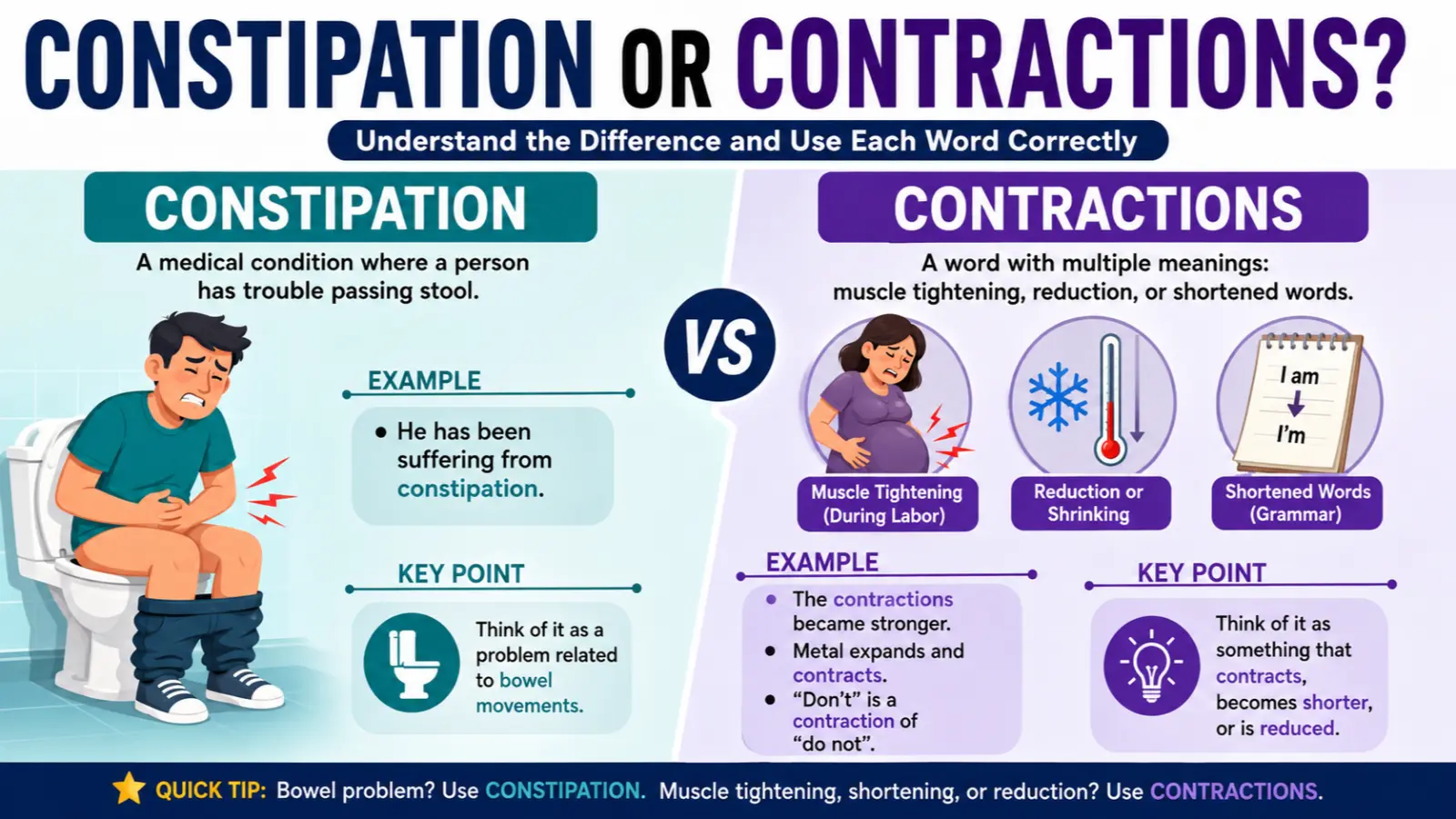
Constipation or contractions can look confusing because both words are longer terms ending in tion. However, they describe completely different ideas. Constipation refers to difficulty passing stool, while contractions can describe muscle tightening, shortened words, or reductions.
Constipation or Contractions can be confusing because both words describe different things related to the body.
Understanding the difference can help you use each term correctly. In this guide, you will learn their meanings, differences, examples, and common uses in simple English.
Knowing the difference helps you choose the right word in medical, grammatical, and everyday writing. This guide explains their meanings, origins, examples, and common mistakes in simple English.
Quick Answer
Constipation and contractions are both correct words, but they are not interchangeable.
- Constipation means a condition involving difficulty or reduced frequency in emptying the bowels.
- Contractions is the plural of contraction.
- A contraction can mean a muscle tightening, a reduction, or a shortened grammatical form.
- Use constipation when discussing bowel problems.
- Use contractions when discussing muscle movements, childbirth, grammar, or something becoming smaller.
Cambridge Dictionary defines constipation as a condition that makes someone unable to empty their bowels as often as they should. It defines contraction as a reduction, muscle movement, or shortened form of words.
Meaning of Constipation
Constipation is a noun that refers to a bowel condition. It involves difficulty emptying the bowels or doing so less often than normal.
Examples include:
- The doctor asked about my constipation.
- Drinking enough water can support healthy digestion.
- She spoke with her doctor about ongoing constipation.
- Constipation can make bowel movements difficult.
The related adjective is constipated.
Example:
He felt constipated after several days without a bowel movement.
Cambridge lists constipated as an adjective describing someone who cannot empty their bowels as often as they should.
Meaning of Contractions
Contractions is the plural form of contraction. The word has several meanings.
Muscle contractions
A contraction can describe the tightening or shortening of a muscle. The term is also commonly used for the strong muscle movements associated with childbirth.
Examples:
- The athlete experienced muscle contractions during the exercise.
- The contractions became stronger during labor.
- Muscle contractions help the body produce movement.
Grammar contractions
In grammar, a contraction is a shortened form made by combining words and leaving out letters.
Examples include:
- I am → I’m
- do not → don’t
- cannot → can’t
- they are → they’re
- we will → we’ll
Cambridge explains that contractions are common in everyday speech and informal writing. They are generally less suitable for formal writing.
Reduction or shrinking
Contraction can also describe something becoming smaller or shorter.
Example:
The metal undergoes contraction as it cools.
Cambridge gives contraction as a term for something becoming smaller or shorter.
Constipation vs Contractions
| Word | Part of Speech | Main Meaning | Example |
|---|---|---|---|
| Constipation | Noun | Difficulty emptying the bowels | He was dealing with constipation. |
| Contraction | Noun | Muscle tightening, reduction, or shortened word form | “Can’t” is a contraction of “cannot.” |
| Contractions | Plural noun | More than one contraction | The contractions became stronger. |
| Constipated | Adjective | Experiencing constipation | He felt constipated. |
The key point is simple: constipation concerns bowel function, while contractions have several meanings involving shortening, tightening, or reducing.
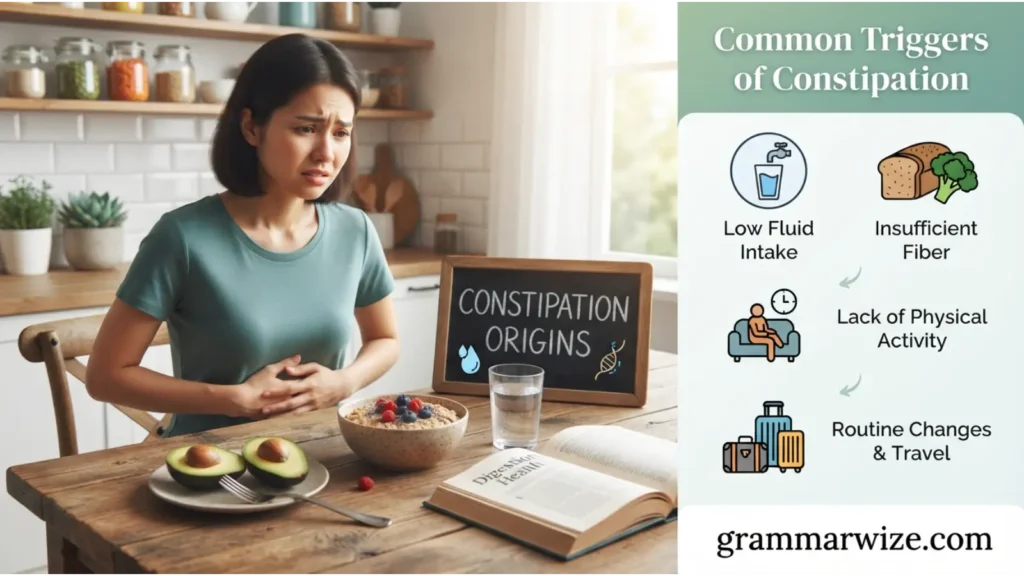
Origin of Constipation
The word constipation has a long history in English. The Online Etymology Dictionary traces it to around 1400, from Late Latin constipationem. The Latin root constipare meant to press or crowd together.
This history connects with the idea of things being packed or pressed together. The medical meaning developed around difficulty or obstruction involving the bowels.

Origin of Contractions
Contraction entered English in the early 15th century. It came through Old French or directly from Latin contractionem. The Latin source was connected with the idea of drawing things together, shortening, or reducing them.
The grammatical meaning developed later. The Online Etymology Dictionary records the grammatical sense of contraction from the early 18th century.
This explains why the modern word can refer to shortened words as well as physical tightening or reduction.
Why the Words Cause Confusion
The confusion usually comes from their similar appearance.
Both words:
- Start with con.
- Contain several similar letters.
- End with tion.
- Have multiple syllables.
- Can appear in health related discussions.
However, their meanings are very different.
The easiest way to separate them is to focus on the subject:
Bowel problem → constipation.
Muscle tightening, shortening, or grammar → contraction.
Dictionary Recommendations
Major English dictionaries recognize constipation and contraction as separate words with different meanings.
Cambridge Dictionary defines constipation as a bowel condition and contraction as a term connected with reduction, muscles, and shortened word forms.
For contractions in grammar, Cambridge also explains how forms such as I’m, we’re, and don’t are created.
These dictionary distinctions make the usage clear: neither word is a misspelling of the other.

Real Life Examples
Examples with constipation
- The patient reported constipation.
- She wanted advice about occasional constipation.
- Constipation can make bowel movements difficult.
- The doctor asked about his digestive symptoms.
- He mentioned constipation during his appointment.
Examples with contractions
- The nurse monitored the contractions.
- The exercise caused repeated muscle contractions.
- “They’ve” is a contraction of “they have.”
- The material experiences contraction as it cools.
- Contractions can make informal writing sound more natural.
Side by side examples
- Correct: She was concerned about constipation.
- Incorrect: She was concerned about contractions.
This changes the meaning completely. - Correct: The contractions became more frequent.
- Incorrect: The constipation became more frequent.
This does not express the intended meaning when discussing labor.
Common Mistakes
Using contractions for a bowel condition
A writer may accidentally choose contractions when they mean constipation.
Incorrect: He has contractions and needs medical advice.
Correct: He has constipation and needs medical advice.
Using constipation for muscle activity
The opposite mistake can also happen.
Incorrect: The doctor monitored the constipation during labor.
Correct: The doctor monitored the contractions during labor.
Confusing contraction with constipation
The first parts of the words can look similar, but their meanings are unrelated in ordinary usage.
Remember the subject before choosing the word.
Forgetting the plural form
Contraction is singular.
Contractions is plural.
Examples:
- One contraction.
- Several contractions.
Constipation is generally treated as an uncountable noun.
Memory Trick
Use this simple memory trick:
Constipation = bathroom difficulty.
Contraction = something contracts or becomes shorter or tighter.
For grammar, remember:
Can’t = can + not.
That is a contraction because letters are removed and the words are combined.
For physical movement, think:
Contract = tighten or shrink.
This makes contraction easier to remember.
Professional Writing Recommendation
Use constipation when your sentence concerns bowel function or digestive health.
Use contraction or contractions when discussing muscle movement, childbirth, physical shrinking, economic reduction, or shortened grammatical forms.
In formal writing, avoid contractions such as don’t, can’t, and it’s when a more formal tone is expected. Cambridge notes that contractions are common in everyday speech and informal writing but are generally not appropriate for formal writing.
The correct choice depends on the meaning you want to communicate, not on spelling preference.
FAQs:
Is constipation the same as contractions?
No. Constipation refers to difficulty emptying the bowels. Contractions can refer to muscle tightening, childbirth movements, reductions, or shortened grammatical forms.
Is contractions the plural of contraction?
Yes. Contraction is singular, while contractions is plural.
Is constipation spelled correctly?
Yes. Constipation is the standard English spelling recognized by major dictionaries.
Is contraction a grammar term?
Yes. In grammar, a contraction is a shortened form such as I’m, can’t, or they’re.
Can contraction refer to muscles?
Yes. A contraction can describe a muscle tightening or shortening. The word is also widely used for the muscle movements associated with childbirth.
Which word should I use for bowel difficulty?
Use constipation.
Which word should I use for shortened words?
Use contraction.
For example, don’t is a contraction of do not.
Conclusion
Constipation and contractions are both correct words, but they have completely different meanings. Constipation describes difficulty emptying the bowels, while contractions can describe muscle tightening, physical reduction, or shortened grammatical forms.
The simplest rule is to connect constipation with bowel function and contraction with shortening or tightening. Once you remember that distinction, choosing the right word becomes much easier.

Olivia Bennett is a grammar expert and language content writer at GrammarWize.com. She specializes in English grammar, word usage, spelling differences, and writing improvement. Through clear explanations and practical examples, Olivia helps students, professionals, and language learners communicate more effectively. Her goal is to make English grammar simple, accessible, and easy to apply in everyday writing.