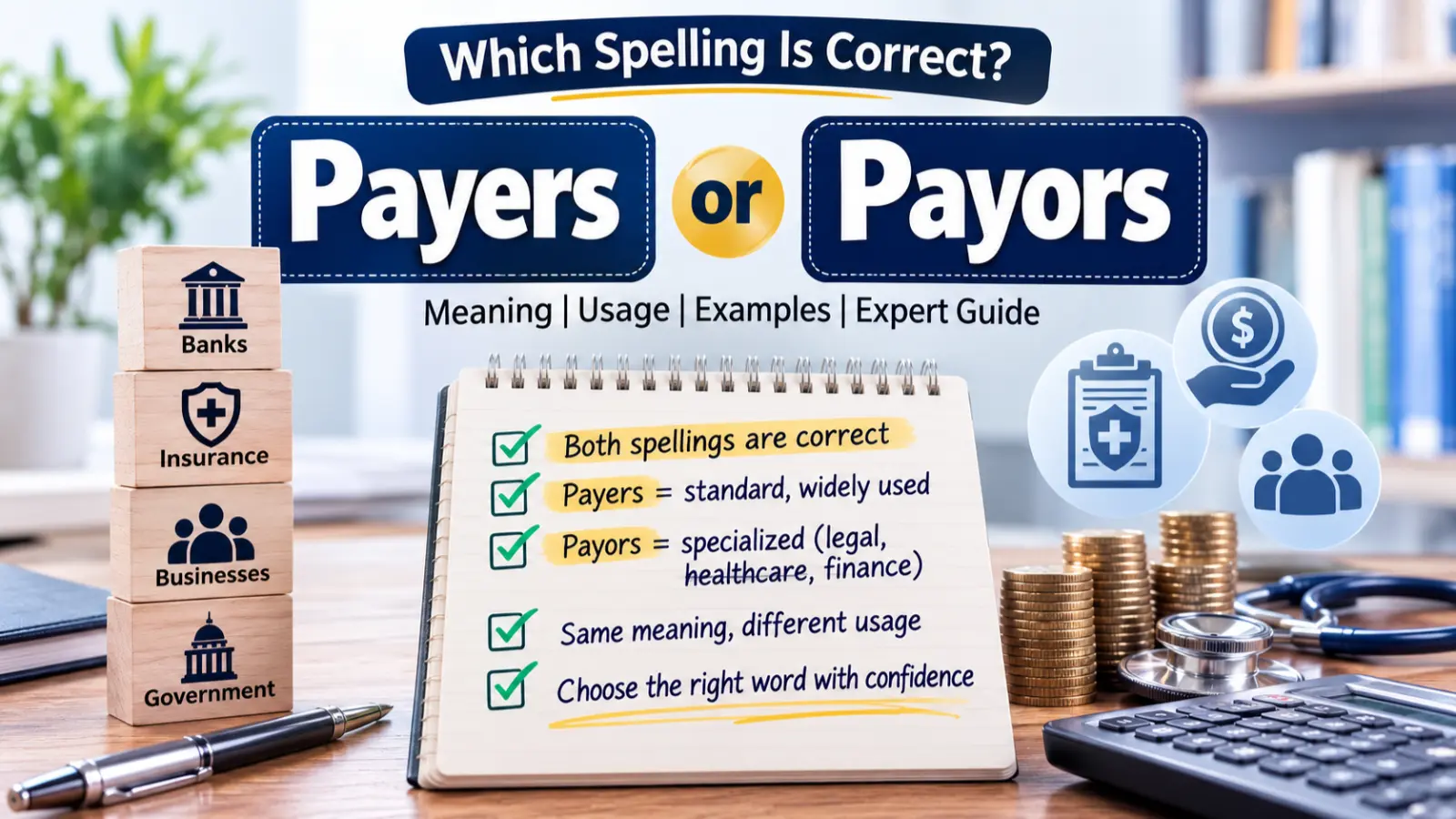
The correct choice depends on context. Payers and payors are both recognized English words for people or organizations that make payments. However, payers is the more general and widely preferred spelling, while payors is especially common in legal, financial, and healthcare contexts.
Payers or Payors is a common spelling confusion, especially in healthcare, insurance, and financial writing. Both terms are correct, but they can have different usage patterns depending on the context. Payers is the more common spelling in American English and often refers to people, organizations, or companies that make payments.
Payors is also correct and appears frequently in healthcare and insurance contexts, particularly when referring to an organization responsible for paying medical claims. Understanding the difference can help you choose the right term for professional writing. In this guide, we will explain the meaning, usage, and key differences between Payers and Payors with clear examples.
This spelling difference can cause confusion because both words have the same basic meaning and pronunciation. Understanding their usage makes it easier to choose the right form for business, legal, medical, and everyday writing.
Quick Answer
Payers is the standard choice for general English and professional writing.
Payors is also correct, but it is a specialized variant often found in legal, financial, banking, and healthcare language. Merriam Webster lists payor as a variant of payer, while Cambridge labels payor as specialized and primarily associated with law.
For most readers, use payers unless your industry or organization specifically prefers payors.

Meaning of Payers
Payers is the plural form of payer.
A payer is a person or organization that pays money or is responsible for making a payment. Cambridge defines a payer as someone who pays or owes money that should be paid. It also uses the word for people or organizations that make payments in business and finance.
Examples include:
- Taxpayers who pay taxes.
- Customers who pay for products.
- Companies that pay invoices.
- Insurance companies that cover medical costs.
Example:
The company works with several international payers.

Meaning of Payors
Payors is the plural form of payor.
A payor is also a person or organization that makes a payment. Cambridge lists payor as a specialized noun, particularly associated with law.
The spelling appears frequently in specialized fields. Healthcare writing, for example, commonly refers to insurance companies and other organizations as payors.
Example:
Healthcare providers negotiate rates with insurance payors.
So, payors is not simply a misspelling of payers. It is an accepted variant with a more specialized usage.

Payers vs Payors Comparison
| Word | Correct? | Meaning | Typical Usage |
|---|---|---|---|
| Payers | Yes | People or organizations that pay | General, business, finance |
| Payors | Yes | People or organizations that pay | Legal, healthcare, specialized writing |
The important difference is usage rather than meaning.
Why Both Spellings Exist
The two forms developed from the same basic word, pay.
The ending er commonly creates a noun for someone who performs an action. For example, a person who teaches is a teacher, and someone who pays is a payer.
The spelling payor uses or, an ending often seen in formal or legal vocabulary. Over time, this form became established in specialized contexts.
Merriam Webster treats payor as a variant of payer, confirming that both forms are legitimate.
Origin of Payer
The word payer has a long history in English.
Dictionary.com traces payer to Middle English, with records dating from roughly 1325 to 1375. Its formation comes from pay plus the agent ending er.
The Online Etymology Dictionary traces payer to late 14th century English and Old French paiere, an agent noun formed from paier, meaning to pay.
The underlying verb pay entered English through Anglo French and ultimately traces back to Latin pacare, meaning to pacify or satisfy. The financial sense developed around satisfying a creditor or giving what was owed.
Origin of Payor
Payor appeared later as a variant spelling.
The Online Etymology Dictionary dates payor to around 1817. It describes the form as an agent noun built from pay in a Latin style and notes its strong connection with legal language.
This history helps explain why payor can sound more formal or technical than payer.
Dictionary Recommendations
Major dictionaries recognize both forms, but their treatment gives useful guidance.
Merriam Webster lists payer as the main entry and identifies payor as a less common variant. Its legal dictionary also lists payor and gives payer as a variant.
Cambridge Dictionary gives payer as a standard noun used in general and business English. It also includes payor, but labels it specialized and associates it with law.
This makes payer the safer default for broad audiences.
Real Life Examples
Examples with Payers
- The bank contacted several late payers.
- Many taxpayers are required to file annual returns.
- The service helps businesses manage customer payers.
- Healthcare providers often work with multiple payers.
- The company offers flexible options for international payers.
Examples with Payors
- The hospital negotiates contracts with insurance payors.
- The agreement identifies the payors responsible for payment.
- Lawyers reviewed the rights of the payors.
- The bank requested additional information from the payors.
- The healthcare system works with government and private payors.
Both forms can work in these sentences, but payors sounds more specialized.
Payers or Payors in Healthcare
Healthcare is one area where payors appears frequently.
Insurance companies, government programs, and other organizations that finance healthcare services may be called payors. Cambridge provides healthcare related examples using payers as well, showing that both forms occur in this field.
For healthcare content, follow the terminology used by your organization, publication, or industry style guide.
If no specific style is required, payers is usually easier for a general audience to understand.
Payers or Payors in Legal Writing
Payor has a particularly strong connection with legal terminology.
Merriam Webster’s Legal Dictionary defines payor as a person who pays, especially someone responsible for paying a bill or note.
Therefore, payor can be a suitable choice in contracts, statutes, legal documents, and specialized financial language.
For plain language aimed at the general public, payer is often clearer.
Common Mistakes
One common mistake is assuming that payor is always incorrect because payer is more familiar. That is not true. Payor is a recognized dictionary variant.
Another mistake is assuming that payers and payors have different meanings. In most contexts, they refer to the same basic concept.
A third mistake is switching between the spellings within one document without a reason. Consistency matters in professional writing.
For example, if a healthcare report consistently uses payors, do not randomly change some instances to payers.
Payers vs Payors and Payees
Do not confuse payer with payee.
A payer is the person or organization that gives the money.
A payee is the person or organization that receives the money.
For example:
The payer sent the payment to the payee.
This simple distinction can help prevent another common vocabulary mistake.
Memory Trick
Remember:
Payer = the one who pays.
The ending er often identifies the person performing an action.
Think:
Pay + er = payer
For payor, remember that the or spelling often appears in specialized legal or technical contexts.
If you are unsure, choose payer for general writing.
Professional Writing Recommendation
Use payers as your default spelling in general, business, educational, and public facing content.
Choose payors when:
- Your industry commonly uses the term.
- A legal document uses the spelling.
- A healthcare organization follows that terminology.
- Your company’s style guide requires it.
- You are matching established terminology in a specialized document.
The most important rule is consistency. If your organization has an established preference, follow it throughout the document.
For general readers, payers is usually the clearest and safest option because major dictionaries present it as the standard form.
Frequently Asked Questions
Is payers correct?
Yes. Payers is the standard plural form of payer and is widely used in general and professional English.
Is payors correct?
Yes. Payors is the plural form of payor, an accepted variant that is especially common in specialized and legal contexts.
Which is more common, payers or payors?
Payers is the safer general English choice. Payors is more specialized and frequently appears in legal, financial, and healthcare terminology.
Is payor a misspelling of payer?
No. Payor is a recognized spelling variant, not simply an error. Merriam Webster lists it as a variant of payer.
Should I use payers in formal writing?
Yes. Payers is perfectly suitable for formal writing and is often the preferred choice for broad professional audiences.
Should healthcare writers use payers or payors?
Both forms are used. If your healthcare organization or publication has a preferred style, follow it. Otherwise, payers is a clear general choice.
What is the difference between a payer and a payee?
A payer makes a payment, while a payee receives the payment.
Conclusion
Payers and payors are both correct English words. They share the same basic meaning, but their usage differs by context.
Payers is the better default for general and professional writing. Payors is an established variant that appears more often in legal, financial, and healthcare language.
When no industry style guide tells you otherwise, choose payers. When working with specialized terminology, use the spelling that matches the established style of your field.

Olivia Bennett is a grammar expert and language content writer at GrammarWize.com. She specializes in English grammar, word usage, spelling differences, and writing improvement. Through clear explanations and practical examples, Olivia helps students, professionals, and language learners communicate more effectively. Her goal is to make English grammar simple, accessible, and easy to apply in everyday writing.