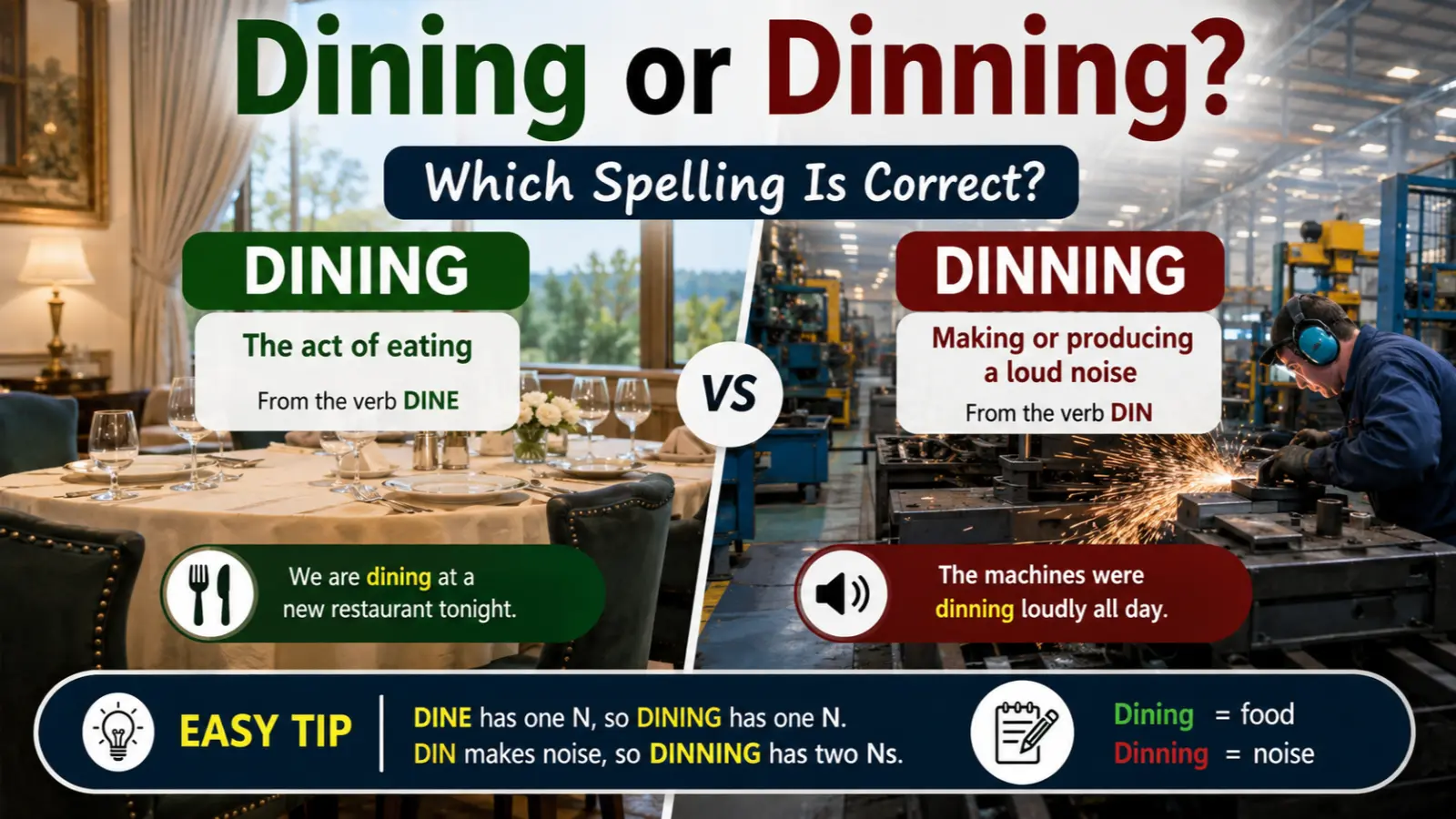
If you are talking about eating a meal, dining is the correct spelling. Dinning is also a real English word, but it has a completely different meaning. It is the present participle of din, a verb meaning to make or produce a loud, unpleasant noise.
Dining or Dinning can be confusing because these words look almost identical. However, they have different meanings and uses. Dining is the correct word when talking about eating a meal, having dinner, or enjoying a meal at a restaurant. Dinning is also a real word, but it has a completely different meaning. It refers to making a loud, continuous noise.
Understanding this small spelling difference can help you avoid common writing mistakes. In this guide, we will explain the meanings, differences, examples, and correct usage of Dining or Dinning in simple English. By the end, you will know which word to use when talking about meals, restaurants, or loud sounds.
This small spelling difference can change the meaning of a sentence. Understanding the connection between dine and dining makes the correct spelling much easier to remember.
Quick Answer
Dining is correct when you mean eating a meal or the activity of eating.
Dinning is correct only when you mean making a loud or continuous noise, or subjecting someone to such noise.
Examples.
- We are dining at a new restaurant tonight.
- The machines were dinning loudly throughout the building.
For food, restaurants, meals, and eating, always use dining.
Meaning of Dining
Dining is the present participle of the verb dine. Cambridge Dictionary defines dining as the present participle of dine, which means to eat the main meal of the day.
It can describe the act of eating or work as an adjective in phrases such as dining room, dining table, and fine dining.
Examples.
- We enjoyed dining by the lake.
- The hotel has a beautiful dining room.
- Fine dining often involves formal service.
- They are dining with their friends tonight.
Meaning of Dinning
Dinning is a legitimate word, but it does not normally relate to eating.
It comes from the verb din, which means to make a loud, confused, or unpleasant noise. Collins lists dinning as the present participle of din.
Examples.
- The construction workers were dinning all morning.
- The alarms were dinning in the background.
- The constant noise was dinning in his ears.
So, dinning is not the spelling you want when discussing restaurants or meals.
Dining vs Dinning
| Word | Correct use | Meaning | Example |
|---|---|---|---|
| Dining | Eating and meals | The act of eating | We are dining at a restaurant. |
| Dinning | Noise | Making or producing a loud noise | The machines were dinning nearby. |
The two words look almost identical, but they come from different verbs.
Dine → dining
Din → dinning

Why Dining Drops the E
The spelling becomes clearer when you look at the base verb.
The verb is dine, not din. When dine takes the ing ending, the final silent e is normally removed.
So:
dine + ing = dining
The same pattern appears in other English verbs.
- make → making
- write → writing
- take → taking
- use → using
- dine → dining
This explains why dinning is not the correct form of dine.

Why Dinning Has Two Ns
The base verb for dinning is din.
When a short one syllable verb ends in a consonant after a short vowel, the final consonant can double before ing.
So:
din + ing = dinning
This creates a useful contrast.
dine → dining
din → dinning
The extra n belongs to din, not dine.
Origin of Dining
The word dining comes from the verb dine, which has a long history in English. Etymonline traces dine to around 1300 and connects it with Old French disner, meaning to dine, eat, or have a meal. The word ultimately relates to the idea of breaking a fast.
Etymonline dates the noun dining to around 1400 and identifies it as a verbal noun derived from dine.
This history confirms that dining is the established form connected with eating and meals.
Dictionary Recommendations
Major dictionaries clearly distinguish the two words.
Cambridge Dictionary lists dining as the present participle of dine, with examples connected to eating and dining spaces.
Collins lists dining as the present participle of dine. It separately lists dinning as the present participle of din, meaning to make or subject someone to a loud noise.
Therefore, dictionary evidence supports both spellings as English words, but they have different meanings.
Real Life Examples of Dining
Use dining when the sentence involves eating, restaurants, meals, or food.
- We are dining out tonight.
- The couple enjoyed dining at the new restaurant.
- The hotel offers fine dining.
- They spent the evening dining with friends.
- The restaurant has a large dining area.
- She loves dining outdoors during summer.
- We were dining when the phone rang.

Real Life Examples of Dinning
Use dinning only when the sentence refers to din, meaning loud or persistent noise.
- The machines kept dinning throughout the night.
- The factory workers heard the equipment dinning nearby.
- The bells were dinning loudly.
- The engines were dinning in the distance.
- The constant sound kept dinning in my ears.
These uses are much less common than dining, especially in everyday writing.
Common Mistakes
A common mistake is writing dinning room instead of dining room.
Incorrect: The hotel has a beautiful dinning room.
Correct: The hotel has a beautiful dining room.
Another mistake is writing dinning out when you mean eating at a restaurant.
Incorrect: We are dinning out tonight.
Correct: We are dining out tonight.
The mistake happens because dinning looks like it could be the normal ing form of dine. However, the spelling rules produce dining.
Memory Trick
Remember this simple connection.
Dine has one N, so dining has one N.
Think:
DINE → DINING
The word dinning has two Ns because it comes from DIN, which is related to noise.
Dining = food.
Dinning = noise.
This quick association can help you choose the right spelling instantly.
Professional Writing Recommendation
Use dining whenever you write about eating, restaurants, meals, hospitality, or food experiences.
For professional writing, common phrases include:
- dining experience
- dining room
- dining area
- dining table
- dining options
- fine dining
- outdoor dining
- casual dining
- dining services
- dining establishment
Use dinning only when the intended meaning involves the verb din and loud or persistent noise.
For business websites, restaurant descriptions, menus, travel content, and food articles, confusing dining with dinning can make the writing look careless. Always check the meaning before choosing the spelling.
Is Dining or Dinning More Common?
Dining is far more common in everyday writing because people frequently use it to discuss meals, restaurants, and eating.
Dinning is a valid word, but its meaning is much narrower. It refers to the action associated with din, such as producing a loud or continuous noise. Collins specifically identifies it as the present participle of din.
FAQs:
Is dining the correct spelling for eating?
Yes. Dining is the correct spelling when you mean eating or having a meal.
Is dinning a real word?
Yes. Dinning is a real English word. It is the present participle of din, which means to make or produce a loud noise.
Is it dining room or dinning room?
The correct phrase is dining room because it refers to a room used for eating.
Is dining out correct?
Yes. Dining out means eating a meal away from home, commonly at a restaurant.
Why does dining have one N?
Dining comes from dine. The final silent e is dropped before adding ing, producing dining.
Why does dinning have two Ns?
Dinning comes from din. The final consonant is doubled before ing, giving dinning.
Is fine dining spelled with one N?
Yes. The correct phrase is fine dining.
Which spelling should I use in professional writing?
Use dining for anything related to eating, restaurants, meals, or food. Use dinning only when you specifically mean making or producing a loud noise.
Conclusion
Dining is the correct choice when you mean eating, restaurants, meals, or food. It comes from the verb dine and appears in common phrases such as dining room, dining experience, and fine dining.
Dinning is also a correct English word, but it has a different meaning. It comes from din and describes making or producing a loud noise. The easiest way to remember the difference is simple: dining is about food, while dinning is about noise.

Olivia Bennett is a grammar expert and language content writer at GrammarWize.com. She specializes in English grammar, word usage, spelling differences, and writing improvement. Through clear explanations and practical examples, Olivia helps students, professionals, and language learners communicate more effectively. Her goal is to make English grammar simple, accessible, and easy to apply in everyday writing.