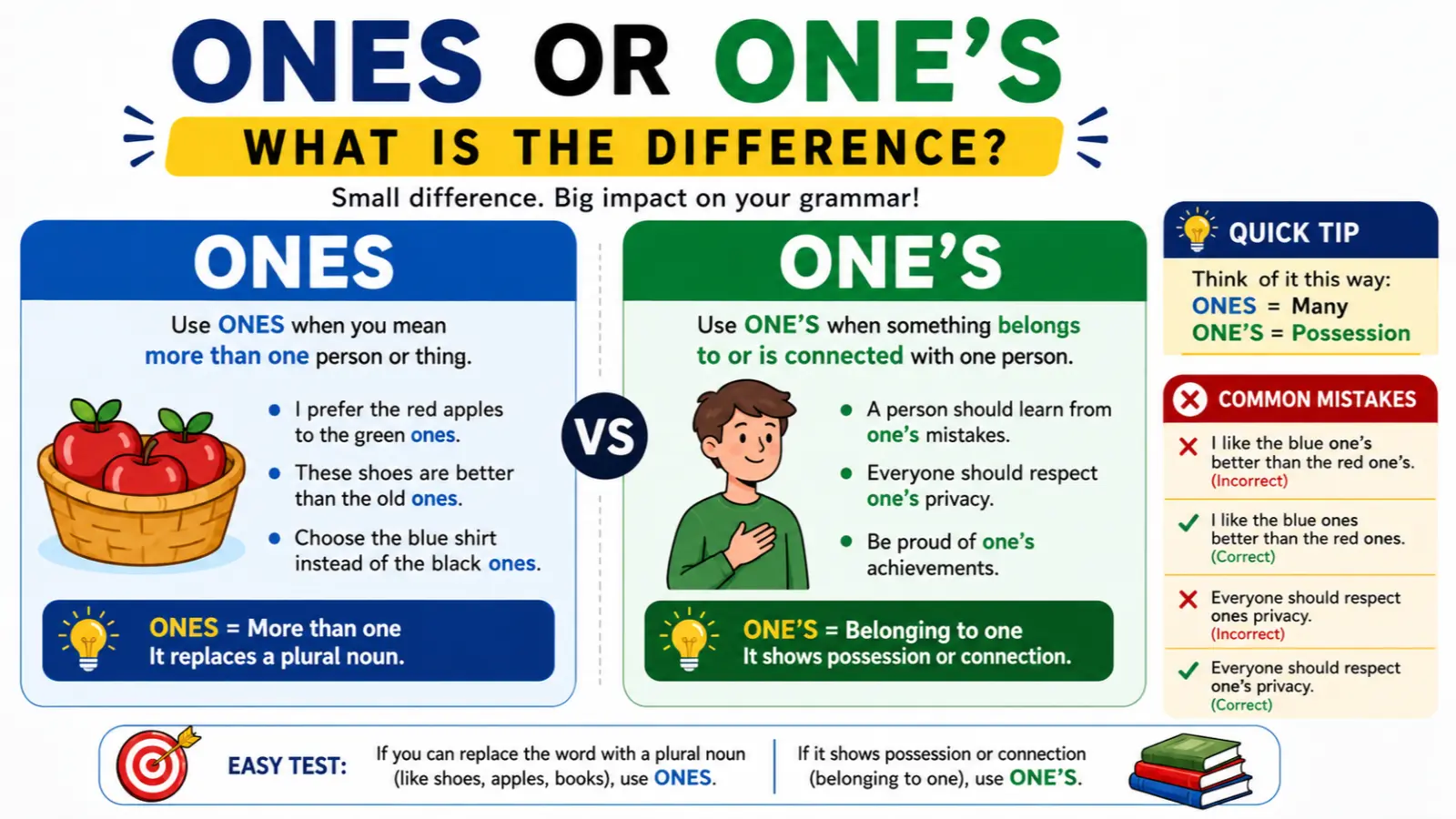
Ones and one’s look almost identical, but they have different meanings and grammatical roles. The apostrophe changes the word completely.
Ones or One’s can be confusing because both forms look almost identical, but they have different meanings and uses. Ones is the plural form of “one,” while one’s is the possessive form. Knowing this simple difference can help you avoid common grammar and punctuation mistakes.
In this guide, you will learn when to use ones and one’s with clear examples and simple explanations. You will also see how the apostrophe changes the meaning of the word, making it easier to choose the correct form in your writing.
One’s is usually a possessive form of one. Ones is the plural form of one and is used when talking about more than one person or thing. Learning this small difference can help you avoid common grammar mistakes in emails, essays, and everyday writing.
Ones or One’s: The Quick Answer
Use ones when you mean more than one person or thing.
Use one’s when you mean something belongs to or is connected with one person.
Examples
- Choose the blue shoes instead of the black ones.
- One should always respect these parents.
- The old books were replaced with new ones.
- A person should take care of one’s belongings.
The key difference is simple: ones means multiple items, while this shows possession or connection.

What Does Ones Mean?
Ones is the plural form of one. It refers to multiple people or things that have already been mentioned or are understood from context.
It does not normally take an apostrophe.
Examples of Ones
- I like the red apples more than the green ones.
- These cookies are better than the ones we bought yesterday.
- The expensive phones are faster than the cheaper ones.
- Some students finished early, while other ones needed more time.
Here, ones replaces a plural noun.
For example:
I like the red shoes more than the black shoes.
You can avoid repeating shoes by saying:
I like the red shoes more than the black ones.

What Does One’s Mean?
It is most commonly the possessive form of one.
It can mean something belongs to, affects, or is associated with a person.
Examples of One’s
- Everyone should respect these family.
- A person should learn from one’s mistakes.
- It is important to protect one’s privacy.
- One should be proud of one’s achievements.
In these sentences, one’s indicates possession or association.
For example:
One should learn from one’s mistakes.
The mistakes belong to the person represented by one.
Ones vs One’s Grammar Difference
The main grammatical difference is the apostrophe.
| Word | Meaning | Grammar Role | Example |
|---|---|---|---|
| ones | More than one | Plural pronoun | I prefer these ones. |
| one’s | Belonging to one | Possessive form | Protect one’s rights. |
Remember that ones does not mean possession.
The apostrophe in it signals a possessive relationship.
When Should You Use Ones?
Use ones when you need to replace a plural noun that has already been mentioned.
Examples
- I prefer the large boxes to the small ones.
- These shoes are more comfortable than those ones.
- The new chairs are stronger than the old ones.
- Pick the ripe bananas instead of the green ones.
A useful test is to replace ones with the plural noun.
I prefer the large boxes to the small ones.
The original meaning is:
I prefer the large boxes to the small boxes.
If the sentence works with a plural noun, ones may be correct.
When Should You Use One’s?
Use one’s when you are showing possession or connection.
Examples
- One should consider one’s options carefully.
- Everyone should know one’s responsibilities.
- It is wise to protect Someone’s personal information.
- A person should accept one’s mistakes.
You can often understand Someone’s as meaning belonging to one.
For example:
One should protect one’s reputation.
This means a person should protect that person’s reputation.
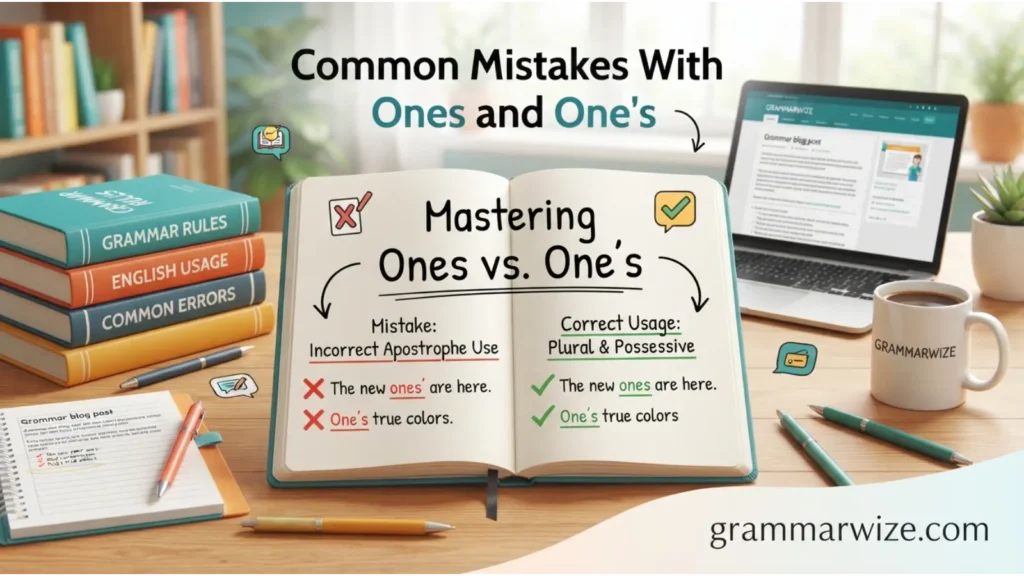
Common Mistakes With Ones and One’s
The most common mistake is adding an apostrophe to ones when you only mean the plural form.
Incorrect
I like the blue ones better than the red one’s.
Correct
I like the blue ones better than the red ones.
There is no possession in this sentence, so no apostrophe is needed.
Another common mistake is removing the apostrophe from a person’s.
Incorrect
Everyone should respect ones privacy.
Correct
Everyone should respect one’s privacy.
Here, A person’s shows that the privacy belongs to the person.
Ones Does Not Always Sound Natural
Although ones is grammatically correct in many sentences, native speakers often avoid it when a specific noun would sound clearer.
For example:
I prefer the red ones.
This is natural when the noun is already clear.
However:
I prefer the red ones in the kitchen.
may sound less clear if the reader does not know what ones refers to.
In professional writing, using the actual noun can sometimes make the sentence easier to understand.
One’s Can Also Mean One Is
There is another important use of one’s.
In informal writing, one’s can sometimes appear as part of a contraction meaning one is.
For example:
One’s never completely prepared for everything.
Here, one’s means one is, not possession.
However, this use is uncommon and can sound formal or old-fashioned.
In clear professional writing, it is usually better to write one is instead.
Compare
- One’s never completely prepared.
- One is never completely prepared.
The second version is clearer for most readers.
Ones vs One’s in Everyday Conversation
These words can appear in ordinary conversations.
Using Ones
A: Which cookies do you want?
B: I’ll take the chocolate ones.
A: Do you like these shoes?
B: Yes, but I prefer the black ones.
Using One’s
A: What should a person do when things go wrong?
B: One should learn from one’s mistakes.
A: Why is privacy important?
B: Everyone should protect one’s personal information.
In everyday American English, speakers often use your or their instead of the formal one’s.
For example:
You should protect your privacy.
This usually sounds more natural than:
One should protect one’s privacy.
Ones or One’s in Professional Writing
Both forms can appear in professional writing, but they serve different purposes.
Ones works well when replacing a repeated plural noun.
The updated policies are clearer than the old ones.
One’s is grammatically correct in formal statements using one.
One should consider one’s responsibilities carefully.
However, professional writers often choose their or rewrite the sentence for a more natural tone.
Instead of:
One should review one’s work carefully.
You could write:
Writers should review their work carefully.
This version is often more direct and reader-friendly.
A Simple Memory Trick
Use this quick trick:
Ones = many
Think of ones as the plural form of one.
one → ones
One’s = possession
Think of the apostrophe as a signal that something belongs to or relates to one.
one’s = belonging to one
You can also ask yourself:
Am I talking about multiple things?
Use ones.
Am I showing possession or association?
Use one’s.
Ones and One’s Comparison Examples
Example 1
I prefer the newer ones.
Use ones because it refers to multiple things.
Example 2
One should respect one’s neighbors.
Use one’s because it shows a relationship between one and the neighbors.
Example 3
These are better than the old ones.
Use ones because it replaces a plural noun.
Example 4
Everyone should know one’s limits.
Use one’s to show association with the person represented by one.
Example 5
The small boxes are stronger than the large ones.
Use ones because it refers to multiple boxes.
Quick Test to Choose the Right Word
When you are unsure, follow these steps.
Step 1: Look at the meaning.
If you mean multiple people or things, choose ones.
Step 2: Check for possession.
If something belongs to or relates to one person, choose one’s.
Step 3: Look at the apostrophe.
An apostrophe in one’s is meaningful. Do not add it simply to make the word plural.
Quick Test
I like the expensive ___.
The answer is ones because it refers to multiple expensive items.
A person should protect ___ reputation.
The answer is one’s because the reputation belongs to the person.
Frequently Asked Questions
Is ones grammatically correct?
Yes. Ones is grammatically correct when it functions as the plural form of one or replaces a plural noun.
Is one’s grammatically correct?
Yes. One’s is grammatically correct when it shows possession or association with one. It can also appear as a contraction for one is in some contexts.
Is ones the plural of one?
Yes. Ones is the plural form of one when referring to multiple items or people.
Does one’s mean one is?
Sometimes. One’s can be a contraction of one is, although this use is less common. It can also be the possessive form of one.
Should ones have an apostrophe?
No, not when ones is simply plural. The apostrophe belongs in one’s when it expresses possession or serves as the contraction one is.
Which is correct, ones or one’s?
Both are correct. They are used for different purposes. Ones refers to multiple things, while one’s usually expresses possession or association.
Conclusion
Ones and one’s are both correct words, but they have different grammatical jobs. Use ones when referring to multiple people or things. Use one’s when showing possession or a connection with one person.
The easiest rule is to remember ones means plural, while one’s usually shows possession. Checking the meaning before adding an apostrophe will help you choose the correct form every time.

Olivia Bennett is a grammar expert and language content writer at GrammarWize.com. She specializes in English grammar, word usage, spelling differences, and writing improvement. Through clear explanations and practical examples, Olivia helps students, professionals, and language learners communicate more effectively. Her goal is to make English grammar simple, accessible, and easy to apply in everyday writing.