Trully or truly is a common spelling question because both words look believable at first glance. Many writers accidentally add an extra L, especially since words like fully and carefully contain double letters.
The good news is that the answer is simple. Knowing the correct spelling helps you write with confidence in emails, school assignments, professional documents, and everyday conversations. This guide explains the difference, why the confusion happens, and how to remember the correct form forever.
Quick Answer
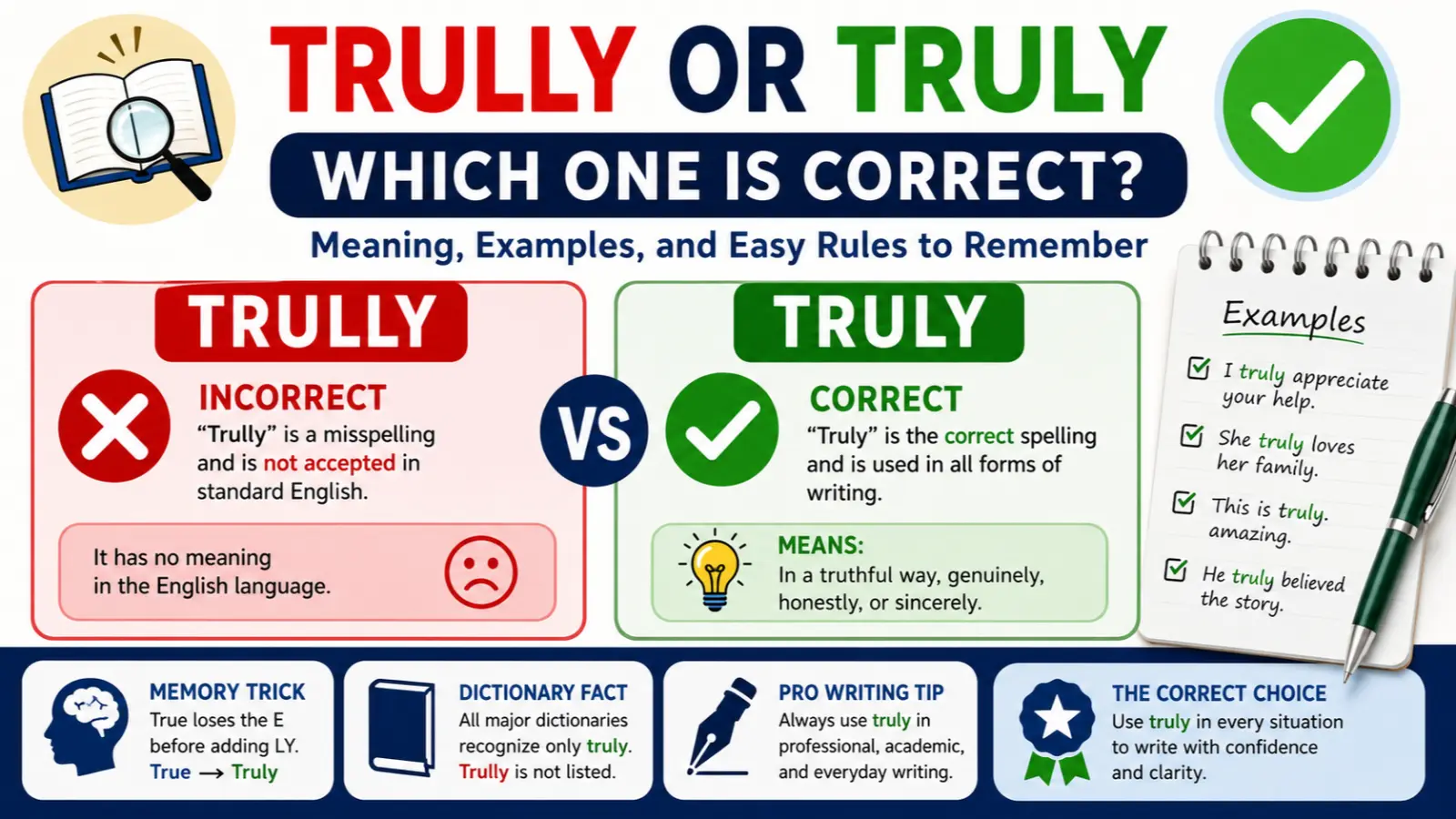
✅ Truly is the correct spelling.
❌ Trully is a misspelling and is not accepted in standard English dictionaries.
Use truly in all forms of writing.
Meaning of Both Spellings
Truly
Truly is an adverb that means:
- In a truthful way.
- Genuinely.
- Honestly.
- Completely or sincerely.
Examples:
- I truly appreciate your help.
- She truly loves her family.
- This is truly amazing.
- He truly believed the story.
Trully
Trully has no accepted meaning in modern English.
It is simply a spelling mistake created by adding an extra L.

Trully vs Truly Comparison
| Feature | Truly | Trully |
|---|---|---|
| Correct English spelling | ✅ Yes | ❌ No |
| Found in dictionaries | ✅ Yes | ❌ No |
| Accepted in professional writing | ✅ Yes | ❌ No |
| Used in books and journalism | ✅ Yes | ❌ No |
| Safe for academic writing | ✅ Yes | ❌ No |
Why Is Truly Spelled Without a Double L
Many English learners expect true to become trully because words like these use double letters:
- fully
- carefully
- skillfully
However, true follows a different spelling rule.
When -ly is added to true, the final e is dropped.
true + ly = truly
No extra L is added.
This spelling has been standard English for centuries.
Origin of Truly
The word truly comes from the adjective true, which developed from Old English words meaning faithful, accurate, or genuine.
As English evolved, true combined with the suffix -ly to form truly, meaning “in a true or sincere manner.”
The spelling has remained consistent throughout modern English.
Why the Confusion Exists
People often write trully because English contains many words with double consonants before -ly.
For example:
- full → fully
- dull → dully
Writers naturally assume the same pattern applies to true, but it does not.
Typing quickly, autocorrect mistakes, and unfamiliarity with spelling rules also contribute to the error.
Dictionary Recommendations
Major English dictionaries recognize only truly.
These include:
- Merriam-Webster
- Cambridge Dictionary
- Oxford English Dictionary
- Collins Dictionary
- Dictionary.com
None of these dictionaries list trully as a correct spelling. If it appears, it is identified only as a misspelling or search variation.

Real Life Examples
Correct:
- I truly enjoyed the presentation.
- Thank you for being truly honest.
- She truly deserves the award.
- This restaurant is truly excellent.
- They are truly grateful for your support.
- He truly understands the problem.
- We truly appreciate your patience.
- That movie was truly unforgettable.
Incorrect:
- I trully enjoyed the presentation.
- She trully loves music.
- We trully appreciate your help.

Common Mistakes
Many writers accidentally:
- Add an extra L and write trully.
- Think all -ly words follow the same spelling pattern.
- Miss the typo because spell check is turned off.
- Repeat the incorrect spelling after seeing it online.
Always proofread before publishing important writing.
Easy Memory Trick
Remember this simple rule:
True loses the E before adding LY.
True → Truly
There is only one L in truly.
If you remember that true does not end with LL, you will avoid writing trully.
Professional Writing Recommendation
Always use truly in:
- Academic papers
- Business emails
- Job applications
- Blog articles
- Books
- Marketing content
- Social media posts
- Legal documents
Using trully can make your writing appear unprofessional and may reduce credibility.
Frequently Asked Questions
Is trully ever correct?
No. Trully is not considered correct in standard English.
Why do people spell truly as trully?
The mistake happens because many English words use double consonants before -ly, leading writers to assume the same rule applies here.
Is truly British or American English?
Both British English and American English use the same spelling: truly.
Is truly an adverb?
Yes. Truly is an adverb that describes how something is done or emphasizes sincerity or truth.
Can I use trully in formal writing?
No. Replace trully with truly in all professional and academic writing.
Does Microsoft Word mark trully as incorrect?
Yes. Most modern spell checkers identify trully as a spelling error and suggest truly.
Conclusion
When comparing trully or truly, the answer is straightforward. Truly is the only correct spelling recognized by modern English dictionaries and style guides. Trully is simply a common misspelling caused by confusion over English spelling patterns.
For clear, professional, and grammatically correct writing, always choose truly. Remember the simple rule: true becomes truly by dropping the final “e” and adding “ly”—without adding another “l.”

Olivia Bennett is a grammar expert and language content writer at GrammarWize.com. She specializes in English grammar, word usage, spelling differences, and writing improvement. Through clear explanations and practical examples, Olivia helps students, professionals, and language learners communicate more effectively. Her goal is to make English grammar simple, accessible, and easy to apply in everyday writing.