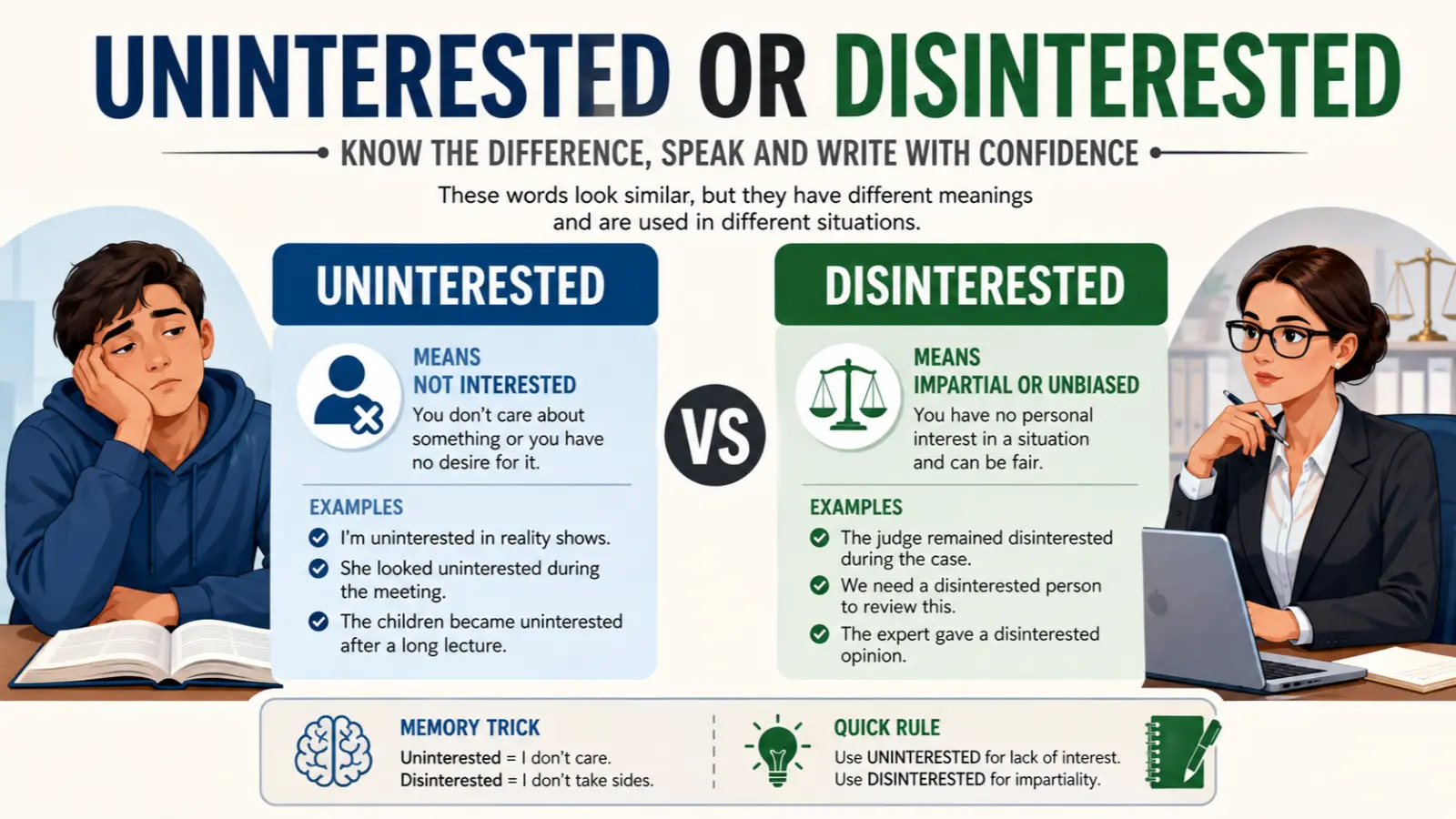
Uninterested or disinterested can look interchangeable, but they traditionally express different ideas. Uninterested means having no interest in something, while disinterested means being impartial and free from personal benefit.
However, they have different meanings and should not always be used in the same situations. Uninterested means having no interest, curiosity, or desire to engage with something.
Disinterested traditionally means being impartial and free from personal bias or benefit. For example, someone may feel uninterested in a movie, while a judge should remain disinterested during a case. In modern English, people sometimes use disinterested to mean uninterested, but the traditional distinction remains useful in formal writing.
Understanding this difference can help you choose the right word and make your writing clearer. This guide explains their meanings, differences, examples, common mistakes, and easy ways to remember when to use each term.
This difference matters most in professional, academic, and formal writing. Using the right word helps readers understand exactly what you mean.
Uninterested or Disinterested: The Quick Difference
The easiest way to remember the difference is:
- Uninterested means not interested.
- Disinterested means impartial or unbiased.
For example:
- Sarah was uninterested in the movie.
- The judge remained disinterested during the dispute.
Sarah did not care about the movie. The judge had no personal interest in either side.
What Does Uninterested Mean?
Uninterested describes someone who does not have interest, curiosity, attention, or enthusiasm about something.
It commonly refers to a person’s feelings or attitude.
Examples:
- The students seemed uninterested in the lecture.
- Mark was uninterested in playing video games.
- She looked uninterested during the meeting.
- The customer was uninterested in the offer.
The word follows a simple idea:
Uninterested = not interested.
What Does Disinterested Mean?
Disinterested traditionally means impartial, unbiased, or not influenced by personal gain.
It often describes someone who can make a fair decision because they have no personal stake in the matter.
Examples:
- We need a disinterested person to review the complaint.
- The judge must remain disinterested in the case.
- An independent expert gave a disinterested opinion.
- The committee asked for a disinterested third party.
The basic idea is:
Disinterested = impartial and unbiased.

Uninterested vs Disinterested in Simple Terms
Think about the difference like this:
| Word | Main Meaning | Example |
|---|---|---|
| Uninterested | Not interested | He was uninterested in the discussion. |
| Disinterested | Impartial or unbiased | She gave a disinterested opinion. |
A person can be uninterested because they simply do not care.
A person can be disinterested because they have no personal advantage or connection that could affect their judgment.
When Should You Use Uninterested?
Use uninterested when you want to say that someone does not care about something or does not want to participate.
It works naturally in everyday conversations.
For example:
I am uninterested in watching that show.
The children became uninterested after the lesson continued for an hour.
He seemed uninterested in the job opportunity.
In each sentence, the person lacks interest.
When Should You Use Disinterested?
Use disinterested when you mean someone is neutral, impartial, or free from personal motives.
This meaning is especially useful in formal situations.
For example:
The company hired a disinterested expert to investigate the complaint.
Both sides wanted a disinterested person to settle the disagreement.
The board requested a disinterested review of the proposal.
Here, disinterested does not mean bored or uninterested. It means the person can judge the situation fairly.

Why Do People Confuse These Words?
The confusion comes partly from their similar appearance.
Both words contain interested, and both can relate to a lack of personal interest. Over time, disinterested has also been used by some speakers to mean simply “not interested.”
Modern dictionaries recognize this broader usage in some contexts. However, the traditional distinction remains useful, especially in careful and professional writing.
If you want your meaning to be completely clear, follow this rule:
Use uninterested for lack of interest and disinterested for impartiality.
Grammar and Sentence Structure
Both uninterested and disinterested are adjectives.
They can appear before a noun or after a linking verb.
Before a noun
- An uninterested student left the classroom.
- A disinterested observer watched the debate.
After a linking verb
- The student was uninterested.
- The observer remained disinterested.
Common linking verbs include be, seem, appear, become, remain, feel, and look.
Examples:
- She seemed uninterested in the topic.
- He remained disinterested throughout the discussion.
- They became uninterested after several delays.
Common Mistakes to Avoid
Mistake 1: Using disinterested for boredom
Incorrect in traditional usage:
I was disinterested in the concert.
If you mean you did not enjoy or care about the concert, uninterested is clearer.
Better:
I was uninterested in the concert.
Mistake 2: Using uninterested for an impartial person
If someone has no personal stake in a dispute, disinterested is the better traditional choice.
Better:
We need a disinterested mediator.
This means the mediator is impartial.
Mistake 3: Assuming disinterested always means uninterested
This is a common misunderstanding.
Although some modern usage treats disinterested as a synonym for uninterested, the traditional distinction is still important in formal writing.

Uninterested or Disinterested in Professional Writing
In professional writing, precision matters.
Use uninterested when describing a lack of attention, enthusiasm, or concern.
Example:
The employee appeared uninterested in the training session.
Use disinterested when describing an impartial person, judgment, or opinion.
Example:
The company requested a disinterested assessment from an independent consultant.
This distinction makes business communication more precise.
Formal vs Informal Usage
Uninterested is common in both casual and formal English.
Examples:
- Casual: I am uninterested in that game.
- Formal: The committee members appeared uninterested in the proposal.
Disinterested is more strongly associated with formal contexts when it means impartial.
Examples:
- The court requires a disinterested decision maker.
- An independent reviewer provided a disinterested assessment.
In everyday conversation, people may use disinterested to mean uninterested. However, choosing uninterested for lack of interest avoids ambiguity.
Real Life Conversation Examples
Conversation about entertainment
Alex: Do you want to watch the new movie?
Sam: No, I am uninterested in it.
Here, Sam has no interest in watching the movie.
Conversation about a dispute
Alex: Who should review the disagreement?
Sam: We need a disinterested person.
Here, Sam wants someone who has no personal connection to the dispute.
Conversation about a meeting
Manager: Why did Tom leave early?
Employee: He seemed uninterested in the discussion.
Tom lacked interest in the discussion.
Conversation about an investigation
Manager: Who can investigate the complaint?
Employee: An independent and disinterested reviewer would be best.
The reviewer should remain neutral.
Side by Side Examples
Compare these sentences carefully:
- Uninterested: The customer was uninterested in the product.
- Disinterested: The consultant gave a disinterested evaluation.
- Uninterested: The child was uninterested in the lesson.
- Disinterested: The mediator remained disinterested during the conflict.
- Uninterested: She seemed uninterested in joining the club.
- Disinterested: We need a disinterested person to make the decision.
The first word describes lack of interest.
The second describes lack of bias or personal involvement.
A Simple Memory Trick
Remember this:
Uninterested = uninterested in something.
The word un can help you connect it with not.
Disinterested = detached from personal interest.
Think of a judge who has no personal benefit from either side winning. That judge should be disinterested.
A quick memory line is:
Uninterested means I do not care. Disinterested means I do not take sides.
Are Both Words Correct?
Yes. Uninterested and disinterested are both correct English words.
The important difference is their traditional meaning.
Use uninterested for a lack of interest.
Use disinterested for impartiality or freedom from personal benefit.
Some dictionaries also record disinterested with the meaning “not interested.” This usage is established in modern English, but it can still create confusion.
For maximum clarity, especially in formal writing, keeping the traditional distinction is the safest approach.
Which One Should You Use?
Choose uninterested when you mean:
- Not interested.
- Not curious.
- Not enthusiastic.
- Not concerned.
- Not willing to participate.
Choose disinterested when you mean:
- Impartial.
- Unbiased.
- Neutral.
- Free from personal advantage.
- Independent in judgment.
Quick rule
Not interested = uninterested.
Not taking sides = disinterested.
Frequently Asked Questions
Is uninterested or disinterested correct?
Both are correct. Uninterested means not interested, while disinterested traditionally means impartial or unbiased.
Is disinterested a synonym for uninterested?
In some modern usage, yes. Many dictionaries recognize disinterested as meaning not interested. However, the traditional distinction remains useful in formal writing.
What is the difference between uninterested and disinterested?
Uninterested means lacking interest in something. Disinterested traditionally means impartial and free from personal motives.
Is disinterested more formal than uninterested?
Disinterested is often used in formal contexts when discussing impartiality. Uninterested works naturally in both casual and formal English.
Can a person be uninterested and disinterested?
Yes. The words describe different qualities. Someone could lack interest in a matter while also having no personal stake in it.
Which word should I use in a business email?
Use uninterested if you mean someone lacks interest. Use disinterested if you mean someone is neutral or impartial.
Is “I am disinterested in this” correct?
It can be correct under modern usage if you mean “I am not interested.” However, I am uninterested in this is clearer when lack of interest is your intended meaning.
Conclusion
The difference between uninterested and disinterested becomes simple once you focus on the intended meaning.
Uninterested means you have no interest in something. Disinterested traditionally means you are impartial and have no personal stake in an issue.
Modern English sometimes uses disinterested to mean “not interested,” but the traditional distinction remains valuable. In professional and formal writing, using uninterested for lack of interest and disinterested for impartiality gives readers the clearest meaning.

Olivia Bennett is a grammar expert and language content writer at GrammarWize.com. She specializes in English grammar, word usage, spelling differences, and writing improvement. Through clear explanations and practical examples, Olivia helps students, professionals, and language learners communicate more effectively. Her goal is to make English grammar simple, accessible, and easy to apply in everyday writing.