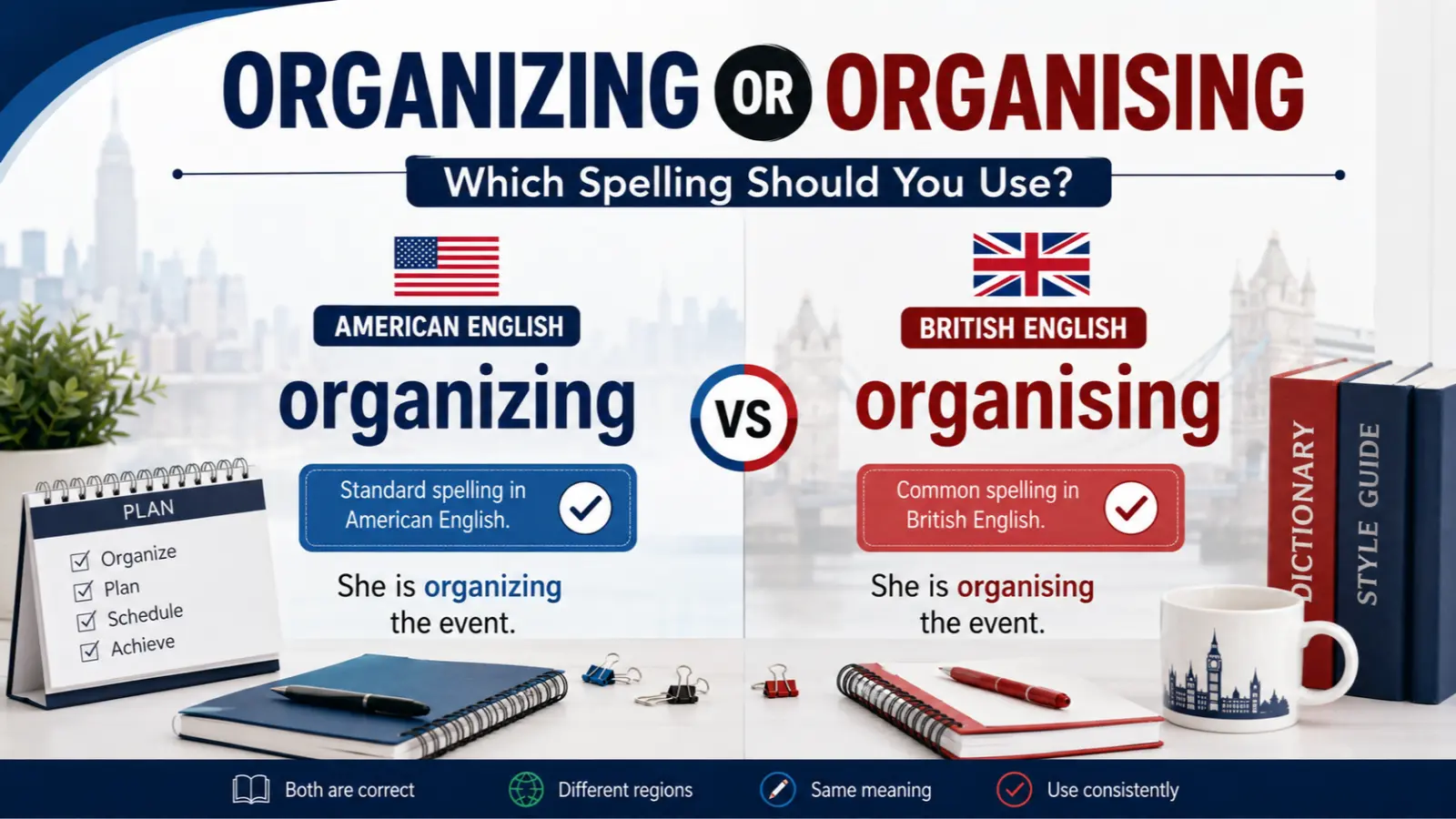
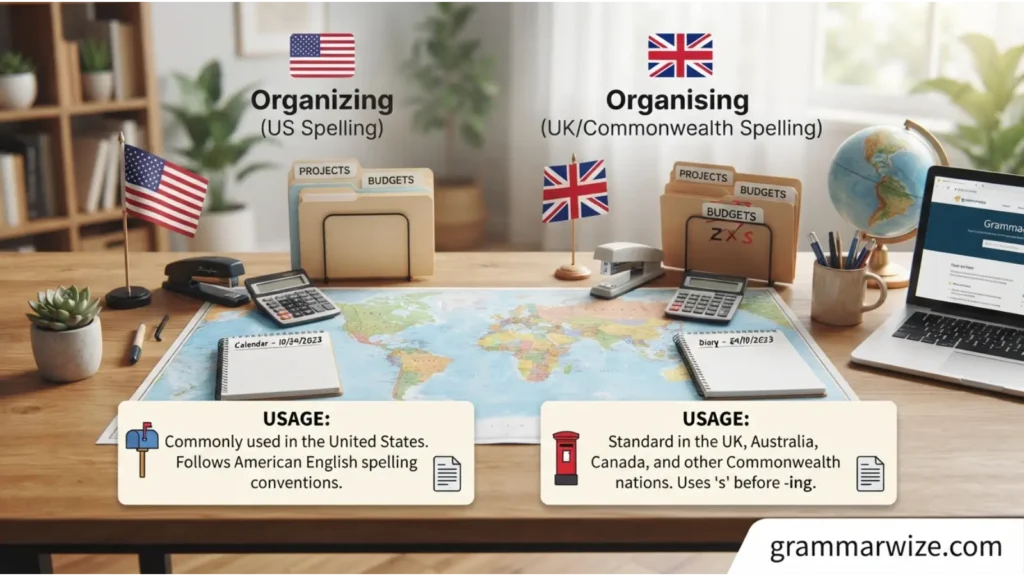
Organizing and organising are both correct spellings of the same word. The main difference is regional English usage. Organizing is the standard spelling in American English, while organising is the usual spelling in British English and many other varieties of English.
Organizing or Organising is a common spelling question for English learners and writers. Both forms are correct, but the choice depends on the type of English you use. Organizing is the standard American English spelling, while organising is commonly used in British English and other regions that follow British spelling rules. The difference comes from the use of z and s in the suffix.
Understanding this small spelling difference can help you write more clearly and consistently. In this guide, you will learn the meaning of organizing and organising, where each spelling is used, and how to choose the right form. You will also see simple examples that make the difference easy to remember.
The difference comes from the spelling pattern used for words ending in -ize and -ise. American English generally favors -ize, while British English commonly uses -ise, although British dictionaries and style guides also recognize -ize in many cases.
Which Spelling Is Correct
Both organizing and organising are correct.
Use organizing when writing in American English.
Use organising when following British English conventions.
The meaning does not change. Both forms are the present participle of organize or organise, meaning to arrange or plan something in an orderly way.
American English
Organizing is the standard form in American English.
Example:
She is organizing a meeting for next week.
British English
Organising is widely used in British English.
Example:
She is organising a meeting for next week.
Organizing vs Organising by Region
Spelling
Main usage
Organizing
American English
Organising
British English
Organizing
Also accepted in some British English publishing systems
Organising
Common in British influenced varieties
The same regional difference appears in related forms such as organize/organise, organized/organised, and organization/organisation.
Dictionary Recommendations
Major dictionaries confirm that the two spellings reflect different English conventions.
Merriam Webster uses organize as the standard American spelling.
Cambridge Dictionary recognizes organize and organise, reflecting the spelling variation between English varieties.
Oxford English Dictionary records the broader history and usage of both forms.
For American English, an American dictionary is usually the best reference. For British English, consult a British dictionary and follow the spelling system used throughout your document.
Official Style Guides
Style guides generally recommend consistency rather than mixing regional spelling systems.
For American writing, The Chicago Manual of Style and The Associated Press Stylebook follow American English conventions, making organizing the natural choice.
For British publishing, organizations and publishers may use either -ise or -ize according to their house style. The Oxford style tradition generally favors -ize where the ending is appropriate, while many British publishers use -ise.
The important point is to follow the style guide required by your publication, institution, or client.
Academic Writing
Academic writers should choose the spelling that matches the English variety required by their institution or journal.
For an American university or American academic journal, use organizing.
For a British university or journal that follows British spelling, use organising.
Consistency matters more than choosing one form as universally correct.
For example:
The researchers are organizing the data into three groups.
A British academic publication may write:
The researchers are organising the data into three groups.
Business Writing
Business communication should match the audience.
Use organizing for American customers, companies, and professional publications that use American English.
Use organising for British organizations and audiences that follow British spelling.
For international companies, check the organization’s official style guide. A consistent spelling system makes professional communication clearer.
International Communication
Both spellings are widely understood internationally.
If your website targets readers in the United States, organizing is usually the better choice.
If your website targets readers in the United Kingdom, organising is generally more appropriate.
For a global audience, either form can work, but maintaining one spelling convention throughout the same document is recommended.
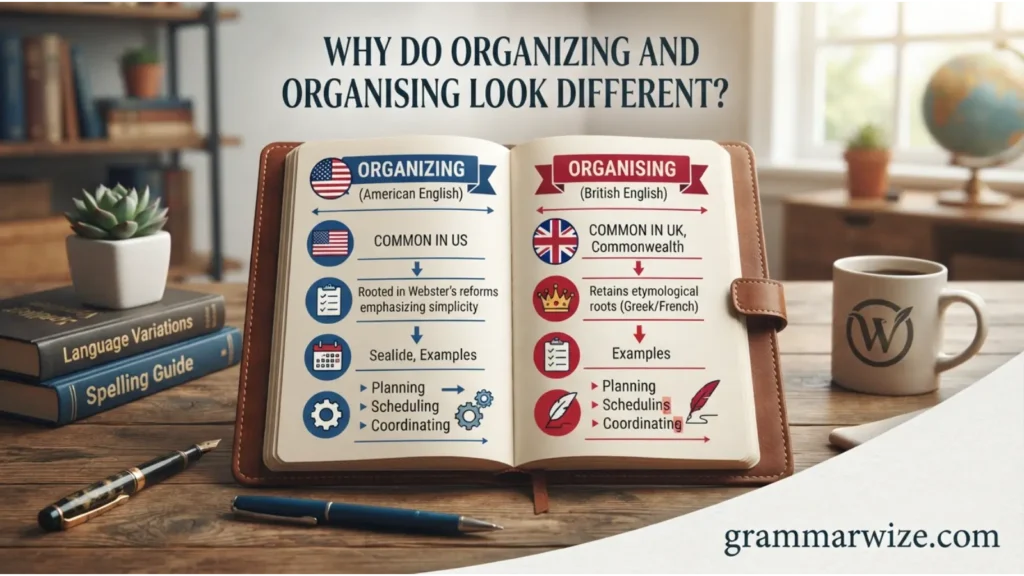
Why Do Organizing and Organising Look Different
The difference comes from the spelling of the suffix attached to the word.
American English generally uses -ize in words such as:
organize
organization
organized
organizing
British English commonly uses -ise in these forms:
organise
organisation
organised
organising
However, British English is not completely limited to -ise. The -ize spelling has a long history in British English and remains standard in some British dictionaries and publishing traditions.
History of Organize and Organise
The spelling difference has a long history in English.
The -ize ending has historical roots in Greek derived words and entered English through forms influenced by French and Latin. The -ise spelling developed alongside it and became particularly common in British usage.
American English eventually developed a stronger preference for -ize in many words.
British English retained both traditions, which is why British dictionaries can recognize organize as well as organise.
The modern difference is therefore not simply a case of one spelling being correct and the other being incorrect.
Publishing Standards
Publishers usually have their own spelling policies.
An American publisher will normally prefer organizing.
A British publisher may prefer organising or organizing, depending on its editorial style.
Writers should avoid switching between the two systems without a reason. For example, using organizing in one paragraph and organising in another can make an article appear inconsistently edited.
Real World Examples
Here are examples showing how the spelling changes by English variety.
American English:
We are organizing a conference in Chicago.
British English:
We are organising a conference in London.
American English:
The team is organizing the files.
British English:
The team is organising the files.
The meaning remains exactly the same.
Current Usage Trends
American English strongly favors organizing.
British English commonly uses organising, although organizing remains an established British spelling in dictionaries and some publishing systems.
Digital publishing has also made regional spelling more visible. Websites often choose spelling based on their primary audience, search market, brand guidelines, or editorial standards.
For SEO, the best choice is normally the spelling that matches your target audience and the language style of your website.
Quick Answer
Organizing is the preferred American English spelling.
Organising is the common British English spelling.
Both are correct. Choose the form that matches your regional English style and use it consistently.
FAQ
Is organizing or organising correct?
Both are correct. Organizing is standard in American English, while organising is common in British English.
Is organising British English?
Yes. Organising is a common British English spelling.
Is organizing American English?
Yes. Organizing is the standard American English spelling.
Do organizing and organising mean the same thing?
Yes. They have exactly the same meaning. The difference is primarily spelling convention.
Which spelling should I use for a US audience?
Use organizing for an American audience.
Which spelling should I use for a UK audience?
Use organising if your publication follows the common British -ise convention.
Is organizing wrong in British English?
No. Organizing is also an established British English spelling, especially in traditions that prefer -ize.
Conclusion
Organizing and organising are both correct spellings. The main distinction is regional and editorial rather than grammatical.
Choose organizing for American English and organising for the common British -ise style. Most importantly, follow the spelling convention used by your audience, publisher, institution, or organization and remain consistent throughout your writing.
Olivia Bennett is a grammar expert and language content writer at GrammarWize.com. She specializes in English grammar, word usage, spelling differences, and writing improvement. Through clear explanations and practical examples, Olivia helps students, professionals, and language learners communicate more effectively. Her goal is to make English grammar simple, accessible, and easy to apply in everyday writing.