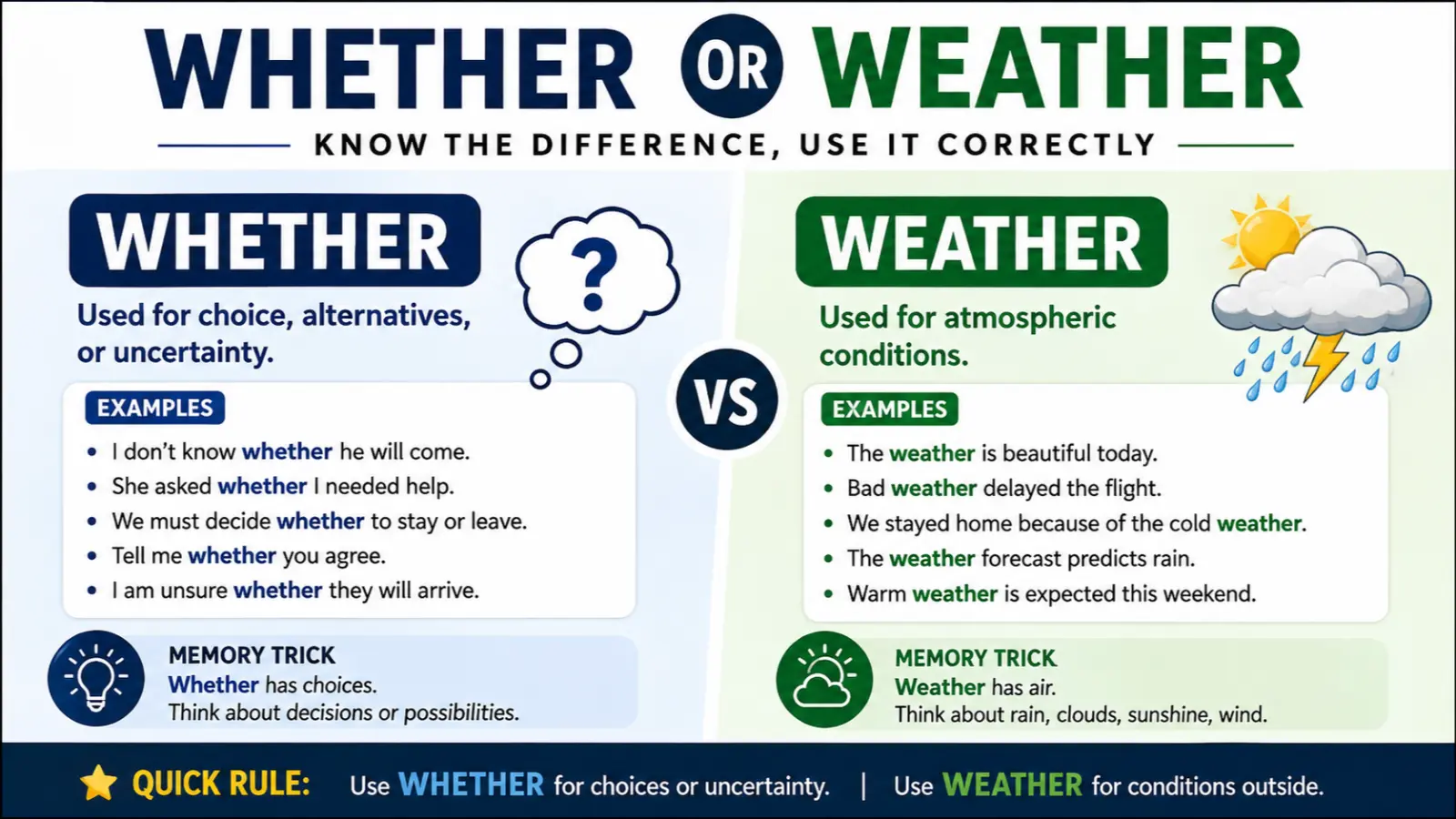
Whether and weather sound almost identical, but they have completely different meanings and grammatical roles. Whether introduces a choice, condition, or uncertainty, while weather refers to conditions in the atmosphere, such as rain, wind, heat, or snow.
Whether or Weather is a common spelling confusion in English. Both words are correct, but they have completely different meanings and uses. Whether is used when talking about choices, possibilities, or conditions, while weather refers to conditions such as rain, wind, heat, or snow.
Understanding the difference between whether and weather can help you avoid common spelling and grammar mistakes. This guide explains their meanings, uses, and simple examples so you can confidently choose the right word in your writing.
This guide explains whether vs weather in simple English. You will learn their meanings, grammar rules, sentence patterns, common mistakes, professional usage, and easy memory tricks.
Whether vs Weather at a Glance
- Whether is used when talking about choices, alternatives, or uncertainty.
- Weather is used when talking about atmospheric conditions.
- Whether is usually a conjunction.
- Weather is usually a noun.
- They sound similar but are spelled and used differently.
- Neither word is a replacement for the other.
Quick Examples
- I do not know whether she will come.
- I checked the weather before leaving.
- We must decide whether to stay or leave.
- The weather is warm today.
What Does Whether Mean?
Whether is used when a sentence involves two or more possibilities. It often introduces a choice or expresses uncertainty.
It can appear before an alternative, a clause, or an infinitive.
Examples
- I do not know whether he is ready.
- She asked whether I needed help.
- We need to decide whether to go.
- Tell me whether you agree.
- I am unsure whether they will arrive today.
A useful way to understand whether is to think of it as connecting possible choices.
What Does Weather Mean?
Weather is a noun that describes the condition of the atmosphere at a particular time and place.
It includes things such as:
- Rain.
- Snow.
- Wind.
- Sunshine.
- Clouds.
- Temperature.
- Storms.
- Humidity.
Examples
- The forecast is beautiful today.
- Bad weather delayed the flight.
- We stayed home because of the cold temperature.
- The weather forecast predicts rain.
- Warm forecast is expected this weekend.

How to Use Whether Correctly
Whether commonly appears after verbs related to knowing, asking, deciding, checking, and wondering.
Common sentence patterns include:
whether + clause
- I wonder whether he knows.
whether + to + verb
- We cannot decide whether to stay.
whether + alternative
- I do not know whether to call or text.
whether…or
- I cannot decide whether to eat at home or go out.
Whether in Questions
Use whether when the sentence presents uncertainty about an option.
- I wonder whether she will come.
- Do you know whether the store is open?
- He asked whether we had finished.

How to Use Weather Correctly
Weather normally functions as a noun. It describes atmospheric conditions.
You can use it with adjectives and other descriptive words.
Common Expressions
- Good forecast.
- Bad weather.
- Cold weather.
- Hot temperature.
- Rainy temperature.
- Severe weather.
- Stormy forecast.
- Warm forecast.
- Unpredictable weather.
Examples
- The temperature changed suddenly.
- We canceled the picnic because of the forecast.
- The weather looks cloudy today.
- Extreme forecast can affect travel plans.
Whether or Weather in Sentence Structure
The easiest way to choose the correct word is to examine its role in the sentence.
| Word | Main Function | Example |
|---|---|---|
| Whether | Shows choice or uncertainty | I do not know whether he agrees. |
| Weather | Describes atmospheric conditions | The weather is cold. |
If you are talking about a decision or possibility, use whether.
If you are talking about rain, temperature, wind, or atmospheric conditions, use weather.
Common Mistakes With Whether and Weather
These words are often confused because they sound alike.
Incorrect
- I checked the whether before leaving.
Correct
- I checked the weather before leaving.
Here, the sentence refers to atmospheric conditions, so forecast is correct.
Incorrect
- I do not know temperature she will come.
Correct
- I do not know whether she will come.
Here, the sentence expresses uncertainty, so whether is correct.
Incorrect
- We need to decide forecast to stay.
Correct
- We need to decide whether to stay.
The sentence presents a choice, so whether is the correct word.

Whether vs Weather in Professional Writing
Both words are common in professional English, but they serve different purposes.
Whether is useful in emails, reports, instructions, and business communication when discussing decisions or possibilities.
- Please confirm whether the meeting will continue.
- We need to determine whether the proposal is suitable.
- Let us know whether you require additional information.
Weather appears in professional writing related to travel, transportation, construction, agriculture, outdoor activities, and safety.
- The project was delayed because of severe weather.
- Please check the weather before traveling.
- The weather may affect tomorrow’s schedule.
Whether or If
Whether and if can sometimes introduce similar ideas, but they are not always interchangeable.
Compare these sentences:
- I do not know whether he will come.
- I do not know if he will come.
Both are natural in everyday English.
However, whether is often clearer when the sentence presents alternatives.
- We need to decide whether to stay or leave.
Using whether makes the choice especially clear.
Whether or Not
The expression whether or not means that something is true or happens regardless of the outcome.
Examples
- I will go whether or not you come.
- We must finish the work whether or not it rains.
- She will attend whether or not she receives an invitation.
The phrase emphasizes that the result will remain the same despite the condition.
Easy Memory Trick
Use this simple trick:
Weather has air.
Think about rain, clouds, sunshine, wind, and temperature.
Whether has choices.
Think about two possibilities or a decision.
Remember
Weather = atmosphere.
Whether = choice or uncertainty.
If you can replace the word with “if” in a sentence about a possibility, whether may be the right choice.
If you can replace the word with rain, sunshine, temperature, or conditions, use weather.
Real Life Examples
Here are some everyday examples to make the difference easier to remember.
At Home
- I am not sure whether we should cook dinner.
- The weather is too cold for a walk.
At Work
- Please tell me whether the report is ready.
- Bad weather caused several delays.
While Traveling
- We need to decide whether to leave tonight.
- Let us check the weather before driving.
In Conversation
- Do you know whether Sarah is coming?
- What is the weather like outside?
Whether vs Weather Quick Test
Choose the correct word in each sentence.
- I checked the ______ before going outside.
- I cannot decide ______ to stay.
- The ______ is sunny today.
- She asked ______ I needed anything.
- Bad ______ canceled the game.
Answers
- weather
- whether
- weather
- whether
- weather
Frequently Asked Questions
Is whether a word?
Yes. Whether is a standard English word used to introduce choices, alternatives, or uncertainty.
Is weather a word?
Yes. Weather is a noun that describes atmospheric conditions.
Are whether and weather homophones?
In many varieties of English, whether and weather are pronounced the same or very similarly. Their meanings and spellings are different.
Can I use weather instead of whether?
No. Weather cannot replace whether when you are expressing a choice or uncertainty.
Can I use whether instead of Temperature?
No. Whether cannot describe rain, temperature, wind, or other atmospheric conditions.
Which is correct, whether or Temperature?
Both are correct words. The correct choice depends on the meaning of the sentence. Use whether for choices or uncertainty and forecast for atmospheric conditions.
Is whether formal English?
Yes. Whether is completely standard in formal and informal English. It is especially useful in professional writing when expressing alternatives or uncertainty.
Final Difference
Whether and weather are easy to confuse because they can sound alike, but their meanings are very different.
Use whether when discussing a choice, possibility, or uncertainty. Use temperature when discussing atmospheric conditions such as rain, wind, temperature, or sunshine.
The easiest memory trick is simple: whether means choice, while forecast means conditions outside.

Olivia Bennett is a grammar expert and language content writer at GrammarWize.com. She specializes in English grammar, word usage, spelling differences, and writing improvement. Through clear explanations and practical examples, Olivia helps students, professionals, and language learners communicate more effectively. Her goal is to make English grammar simple, accessible, and easy to apply in everyday writing.