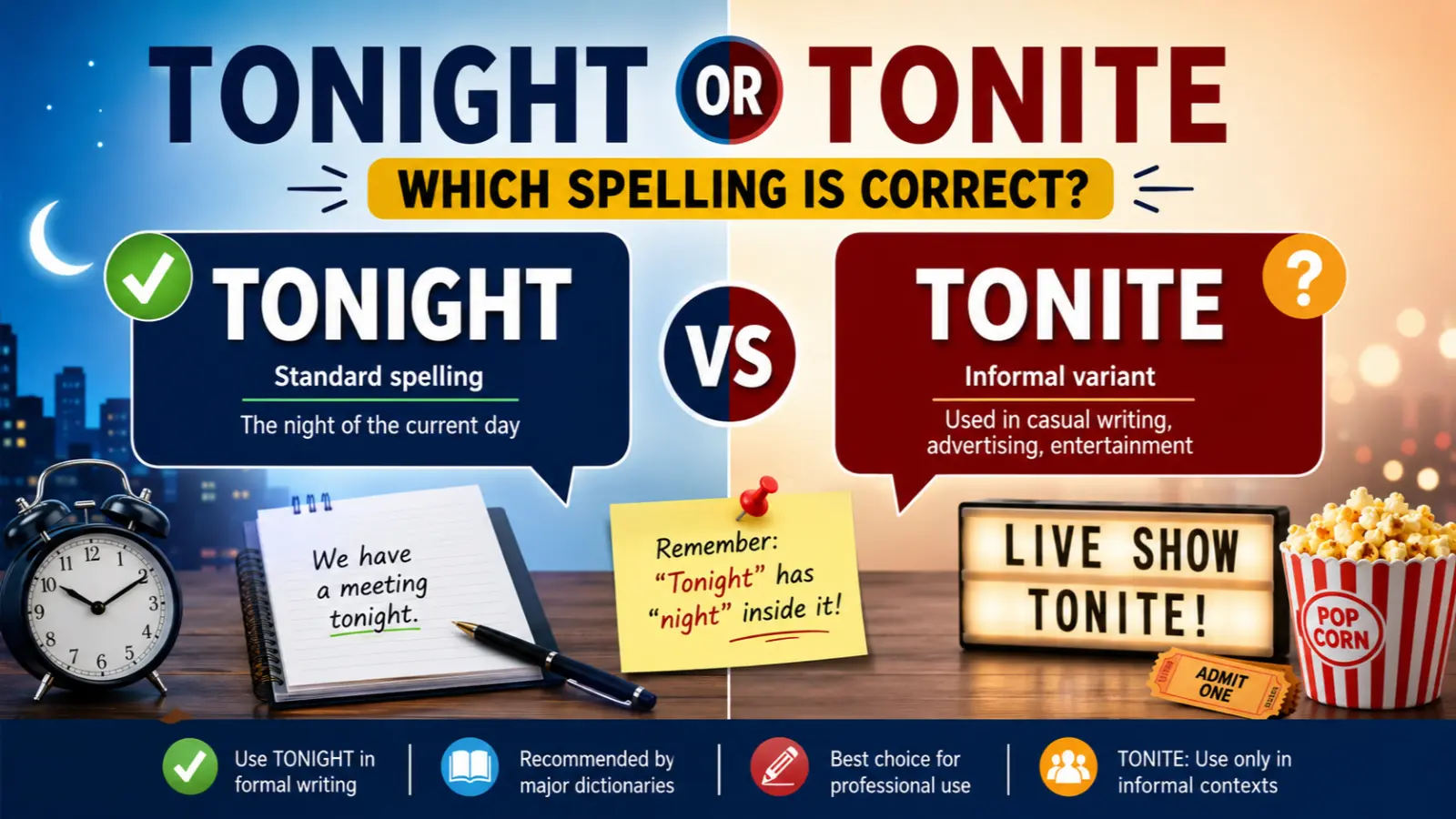
Tonight is the standard and preferred spelling for the evening or night of the current day. Tonite is an informal variant that appears mainly in casual writing, advertising, entertainment, and stylized text.
Tonight or Tonite are two forms you may see in casual English, but they do not have the same level of formality. Tonight is the standard and correct spelling used in formal and everyday writing. Tonite is an informal, nonstandard spelling often found in texts, social media, advertisements, and casual messages. Understanding the difference can help you choose the right word for each situation.
If you are writing an email, school assignment, article, or professional message, use tonight. For casual conversations, you may see tonite used for a relaxed style. This guide explains their meanings, differences, examples, and proper usage in simple English.
If you are writing an email, article, school assignment, business document, or professional message, choose tonight. The two forms have the same pronunciation and similar meaning when tonite is used as an informal spelling.
Quick Answer
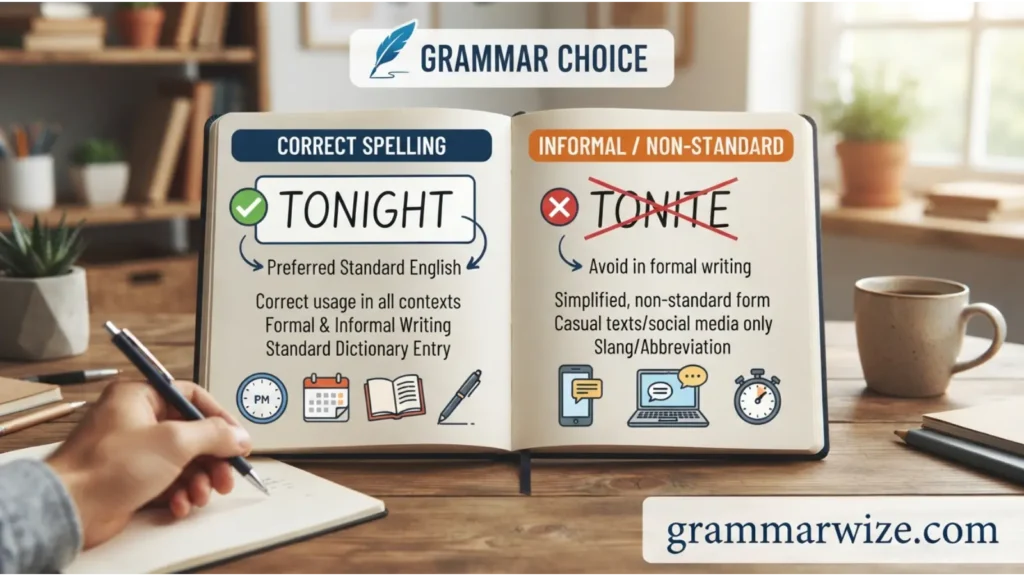
Tonight is the correct standard spelling.
Tonite can appear as an informal alternative, especially in American entertainment and advertising contexts. It should not normally replace tonight in formal or professional writing.
Cambridge Dictionary lists tonight as a standard English word meaning the night of the present day.

Meaning of Tonight
Tonight refers to the night or evening of the current day.
It can work as an adverb or noun.
As an adverb:
- We are going to dinner tonight.
- I will finish the report tonight.
- The concert starts tonight.
As a noun:
- Tonight is the perfect time to relax.
- I am looking forward to tonight.
- The event is scheduled for tonight.
Cambridge Dictionary identifies tonight as both a noun and an adverb.

Meaning of Tonite
Tonite is sometimes used as an informal spelling of tonight.
It keeps the same pronunciation and usually carries the same intended meaning when used this way.
For example:
- See you tonite.
- The show starts tonite.
- Movie night is tonite.
However, tonite has another dictionary meaning. Merriam Webster defines tonite as the name of an explosive compound.
Collins also lists tonite as an explosive used in quarrying.
So context matters when you encounter this spelling.
Tonight vs Tonite Comparison
| Feature | Tonight | Tonite |
|---|---|---|
| Standard spelling | Yes | No, when meaning tonight |
| Meaning | The current day’s night | Informal spelling of tonight |
| Pronunciation | /təˈnaɪt/ | Usually the same |
| Formal writing | Recommended | Avoid |
| Academic writing | Recommended | Avoid |
| Professional writing | Recommended | Avoid |
| Casual messages | Recommended | Possible |
| Advertising | Common | Sometimes used for style |
| Entertainment | Common | Sometimes used for a casual style |
The safest choice is tonight because it is the established standard spelling across ordinary English usage.
Why the Confusion Exists
The confusion mainly comes from pronunciation.
The ending of tonight sounds like nite, which is an informal spelling associated with night. This can make tonite look like a natural shortened form.
The spelling also appears in casual advertising and entertainment contexts. Linguistic references describe forms such as nite and tonite as informal American spellings that have been used in advertising.
Text messaging and casual online communication can also encourage shortened spellings.
That does not make tonite the best choice for standard writing.
Dictionary Recommendations
Major dictionaries clearly support tonight as the standard word for the current day’s night.
Cambridge Dictionary defines tonight as the night of the present day and gives examples such as “What are you doing tonight?”
Merriam Webster has a separate entry for tonite, but its main definition is the explosive compound rather than the ordinary meaning of tonight.
Wiktionary records the informal use of tonite as an alternative spelling of tonight, particularly in US entertainment contexts.
This evidence makes the writing recommendation straightforward. Use tonight when you need the standard English spelling.
Origin of Tonight
The word tonight has a long history in English.
Etymology sources trace it to Old English toniht, formed from elements related to to and night. It referred to the present or coming night.
The spelling changed over time. Historical forms included separate words and later to-night before the modern single-word form became established.
This history explains why today’s spelling may not look exactly like its older forms.
Real Life Examples
Standard Examples With Tonight
- I will call you tonight.
- Are you free tonight?
- We have a meeting tonight.
- The game starts tonight.
- She is flying home tonight.
- I need to study tonight.
- The restaurant is open tonight.
- They are hosting a party tonight.
Informal Examples With Tonite
- See you tonite.
- The show is on tonite.
- We are going out tonite.
- The concert starts tonite.
These examples may work in casual promotional or conversational settings, but tonight remains the better general choice.
Tonight in Professional Writing
Professional writing should use tonight.
Choose it for:
- Business emails.
- School assignments.
- College papers.
- News articles.
- Website content.
- Formal invitations.
- Reports.
- Resumes.
- Customer communications.
For example:
Professional:
The meeting will begin tonight at 7 p.m.
Informal:
The meeting starts tonite at 7.
The first version is clearer and follows standard spelling conventions.
When Tonite Can Be Used
Tonite can work when the unusual spelling is intentional.
It may appear in:
- Casual text messages.
- Informal social posts.
- Entertainment advertising.
- Posters.
- Headlines with a deliberately casual style.
- Brand names or creative campaigns.
The spelling can create a shorter or more relaxed visual style. Wiktionary specifically notes its use in US entertainment contexts.
Still, using it as a style choice is different from using it as the standard spelling.
Common Mistakes
One common mistake is assuming that tonite is the standard shortened form of tonight.
It is better to treat it as an informal variant rather than the normal spelling.
Another mistake is using tonite in formal documents because it sounds exactly like tonight.
Pronunciation does not determine standard spelling.
A third mistake involves the dictionary meaning of tonite. In some dictionaries, it refers to an explosive rather than an informal version of tonight.
Memory Trick
Use this simple rule:
Tonight has night inside it.
Think:
to + night = tonight
The word night helps you remember the standard spelling.
If you are unsure, choose tonight. It works in both casual and formal situations.
Professional Writing Recommendation
For almost every normal writing situation, use tonight.
It is the safest option for readers, editors, teachers, employers, and professional audiences.
Use tonite only when the informal style is deliberate and fits the context. If you are learning English or improving your standard writing, remember tonight as the preferred form.
FAQs:
Is tonight or tonite correct?
Tonight is the standard spelling. Tonite is an informal variant in some contexts.
Is tonite a real word?
Yes, but its uses vary. Some dictionaries list tonite as an explosive, while other references record its informal use as a spelling of tonight.
Can I use tonite in a text message?
You can use it in a casual message if the informal style is intentional. Tonight remains the safer spelling.
Should I use tonite in professional writing?
No. Use tonight in professional, academic, and formal writing.
Do tonight and tonite sound the same?
When tonite means the informal spelling of tonight, they are generally pronounced the same.
Is tonite an American spelling?
The informal spelling is particularly associated with US usage and entertainment contexts.
Which spelling should English learners use?
English learners should use tonight because it is the standard form used in ordinary English writing.
Conclusion
Tonight is the standard spelling for the current day’s night or evening. Tonite can appear as an informal or stylistic variant, especially in casual and entertainment contexts.
For clear and professional English, choose tonight. It is the reliable spelling for everyday communication, academic work, business writing, and published content.

Olivia Bennett is a grammar expert and language content writer at GrammarWize.com. She specializes in English grammar, word usage, spelling differences, and writing improvement. Through clear explanations and practical examples, Olivia helps students, professionals, and language learners communicate more effectively. Her goal is to make English grammar simple, accessible, and easy to apply in everyday writing.