Instable or unstable can confuse writers because both words are recognized in English dictionaries. The key difference is not basic correctness. It is frequency and natural usage. Cambridge lists instable as an adjective and gives unstable as its synonym.
Instable or Unstable can be confusing because both words look correct at first glance. Unstable is the standard and widely accepted word for describing something that is not steady, secure, or predictable.
Instable is much less common and is generally avoided in modern English. In this guide, you will learn the correct spelling, meaning, usage, and simple examples to help you choose the right word confidently.
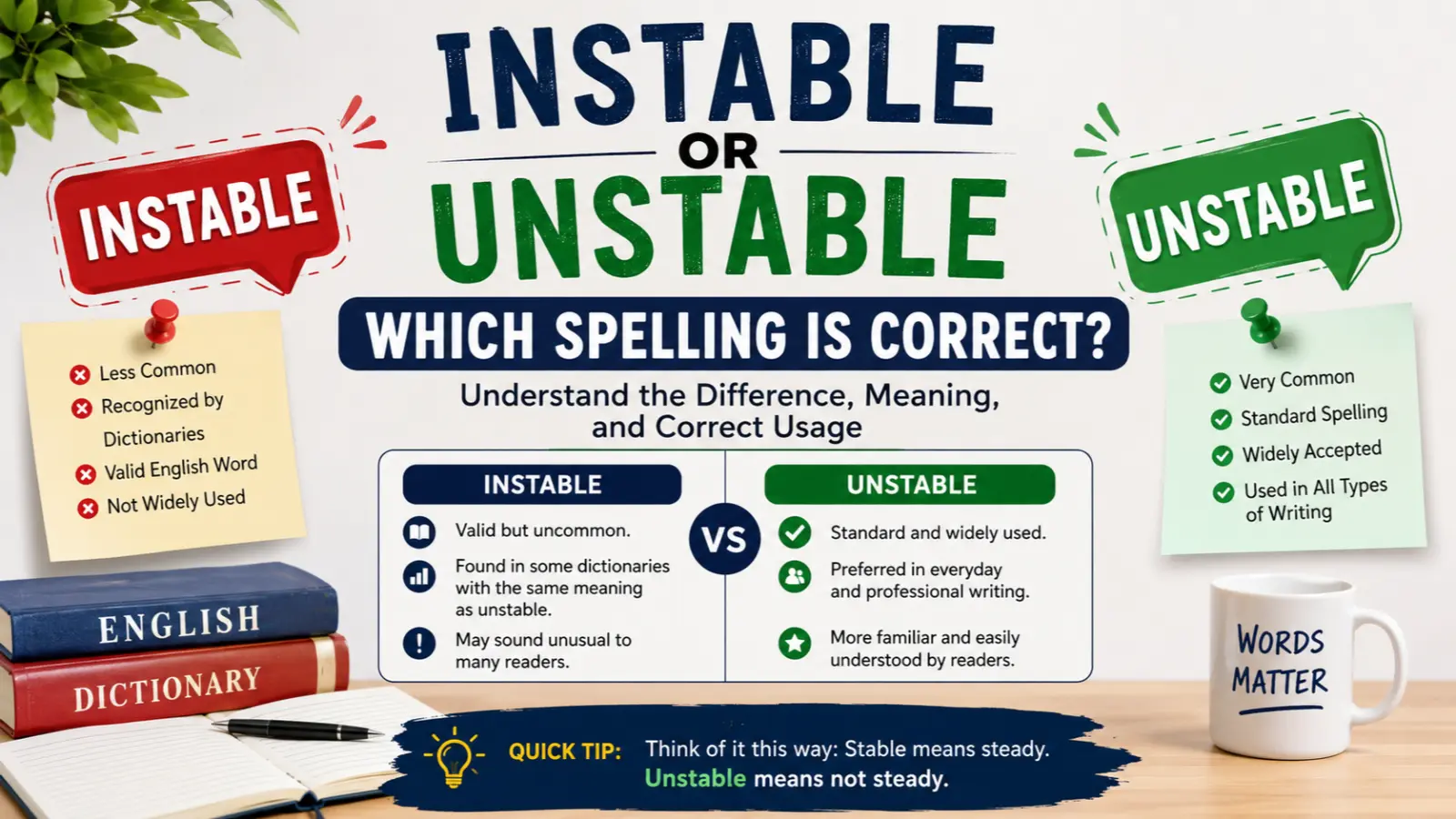
For most everyday and professional writing, unstable is the better choice. It is the standard and widely familiar form. Instable is valid, but it is much less common and can sound unusual to many readers.
Quick Answer
Unstable is the preferred choice in most English writing.
Instable is also a real English word, but it is uncommon. Cambridge defines it with the same basic sense as unstable.
Use unstable when you mean something that is not steady, secure, fixed, or likely to change suddenly.
- The table is unstable.
- The political situation is unstable.
- The chemical is unstable.
- His emotions seemed unstable.
Instable and Unstable Comparison
| Word | Correct? | Meaning | Common Usage |
|---|---|---|---|
| Instable | Yes | Not stable or secure | Less common |
| Unstable | Yes | Not stable, steady, secure, or predictable | Very common |
The important point is that instable is not simply a spelling mistake. Cambridge includes it as an adjective and identifies unstable as its synonym.

What Does Instable Mean?
Instable is an adjective meaning not firm, secure, strong, or likely to last. It can also describe a person whose emotional state changes suddenly. Cambridge provides examples involving political situations, technology, and emotional states.
Examples include:
- The political environment was instable.
- The machine became instable after the modification.
- The company entered an instable period.
These sentences are understandable, but many modern readers would naturally expect unstable instead.

What Does Unstable Mean?
Unstable is an adjective used for something that lacks stability or may change, move, fall, or fail unexpectedly.
Oxford lists several uses. It can describe changing political or economic conditions, people whose behavior and emotions change suddenly, objects that may move or fall, and substances that do not remain in the same chemical or atomic state.
Examples include:
- The ladder is unstable.
- The economy remains unstable.
- The building looks unstable.
- The chemical is unstable.
- The political situation is unstable.
Because unstable covers many common contexts, it is usually the safest word for general writing.
Why Does the Confusion Exist?
The confusion comes partly from the relationship between stable and its negative forms.
English uses several prefixes to create words with negative meanings. Unstable follows a familiar pattern:
stable → unstable
The word instable also exists, but it is less familiar to modern English readers. Cambridge recognizes it, yet directly gives unstable as its synonym.
This means writers may encounter both forms in dictionaries and wonder which one they should use.
The answer depends on context, but unstable is the normal choice for most modern English.
Dictionary Recommendations
Major learner dictionaries clearly support unstable as an established adjective.
Oxford defines unstable as something likely to change suddenly. It also covers physical objects that may move or fall and substances that do not remain in the same chemical or atomic state.
Cambridge also defines unstable as something that is not firm, strong, safe, or likely to last.
Cambridge separately lists instable and defines it with essentially the same core meaning, while identifying unstable as its synonym.
Therefore, both spellings have dictionary support, but unstable has the stronger recommendation for ordinary modern usage.
Real Life Examples
Physical objects
Use unstable when an object is unsafe or likely to move.
- The chair is unstable.
- The ladder became unstable.
- The tower looks unstable after the storm.
Instable is possible, but it sounds less natural in these sentences.
Politics and economics
Unstable is especially common when discussing changing or uncertain conditions.
- The region has an unstable political climate.
- The economy remains unstable.
- The currency became unstable during the crisis.
Oxford specifically uses unstable for political and economic situations.
Technology and science
Both forms can describe systems or substances that lack stability.
- The software became unstable after the update.
- The chemical compound is unstable.
- The system is unstable under heavy loads.
In technical and professional writing, unstable is usually the clearer choice.
Emotional behavior
Both words can describe sudden changes in emotional behavior.
- He appeared emotionally unstable.
- The patient showed emotional instability.
Cambridge records instable with this sense too, but unstable is the more familiar expression.

Common Mistakes
A common mistake is assuming that instable is always incorrect. That is not accurate.
Instable is a legitimate dictionary word. However, using it in everyday writing can make a sentence sound unusual because readers are much more accustomed to unstable. Cambridge explicitly recognizes both forms.
Another mistake is choosing instable simply because it appears to follow the prefix pattern of other words. English spelling patterns do not always determine which form is most natural.
For clear communication, choose unstable unless you have a specific reason to use instable.
Memory Trick
Think of the familiar pair:
stable → unstable
If you are unsure which word to use, remember that unstable is the form most readers expect.
A simple memory tip is:
Stable means steady. Unstable means not steady.
Professional Writing Recommendation
For emails, reports, academic writing, websites, business documents, and general communication, use unstable.
It is widely understood and supported by major dictionaries. Oxford and Cambridge both recognize it as an established adjective with several common meanings.
Use instable only when the context specifically calls for it or when you are discussing historical, specialized, or less common vocabulary.
If your goal is clear modern English, unstable is the better choice.
FAQs:
Is instable a correct word?
Yes. Instable is a valid English adjective listed by Cambridge. It means not stable and is given as a synonym of unstable.
Is unstable the correct spelling?
Yes. Unstable is the standard and widely used spelling for something that is not stable, secure, steady, or predictable.
Is instable wrong?
No. Instable is not wrong. It is simply much less common than unstable in modern general English.
Should I use instable or unstable in formal writing?
Use unstable in most formal writing. It is more familiar to readers and is the clearer choice.
Do instable and unstable mean the same thing?
They have essentially the same core meaning. Cambridge lists unstable as a synonym for instable.
Which word is more common?
Unstable is far more common in contemporary general English. It is the preferred choice for most everyday and professional contexts.
Conclusion
Instable and unstable are both legitimate English words, but unstable is the better choice for most modern writing. Major dictionaries recognize instable, yet Cambridge gives unstable as its synonym, while Oxford provides extensive modern usage for unstable.
If you want your writing to sound natural, clear, and familiar to a broad audience, choose unstable. Save instable for situations where its less common usage is appropriate.

Olivia Bennett is a grammar expert and language content writer at GrammarWize.com. She specializes in English grammar, word usage, spelling differences, and writing improvement. Through clear explanations and practical examples, Olivia helps students, professionals, and language learners communicate more effectively. Her goal is to make English grammar simple, accessible, and easy to apply in everyday writing.