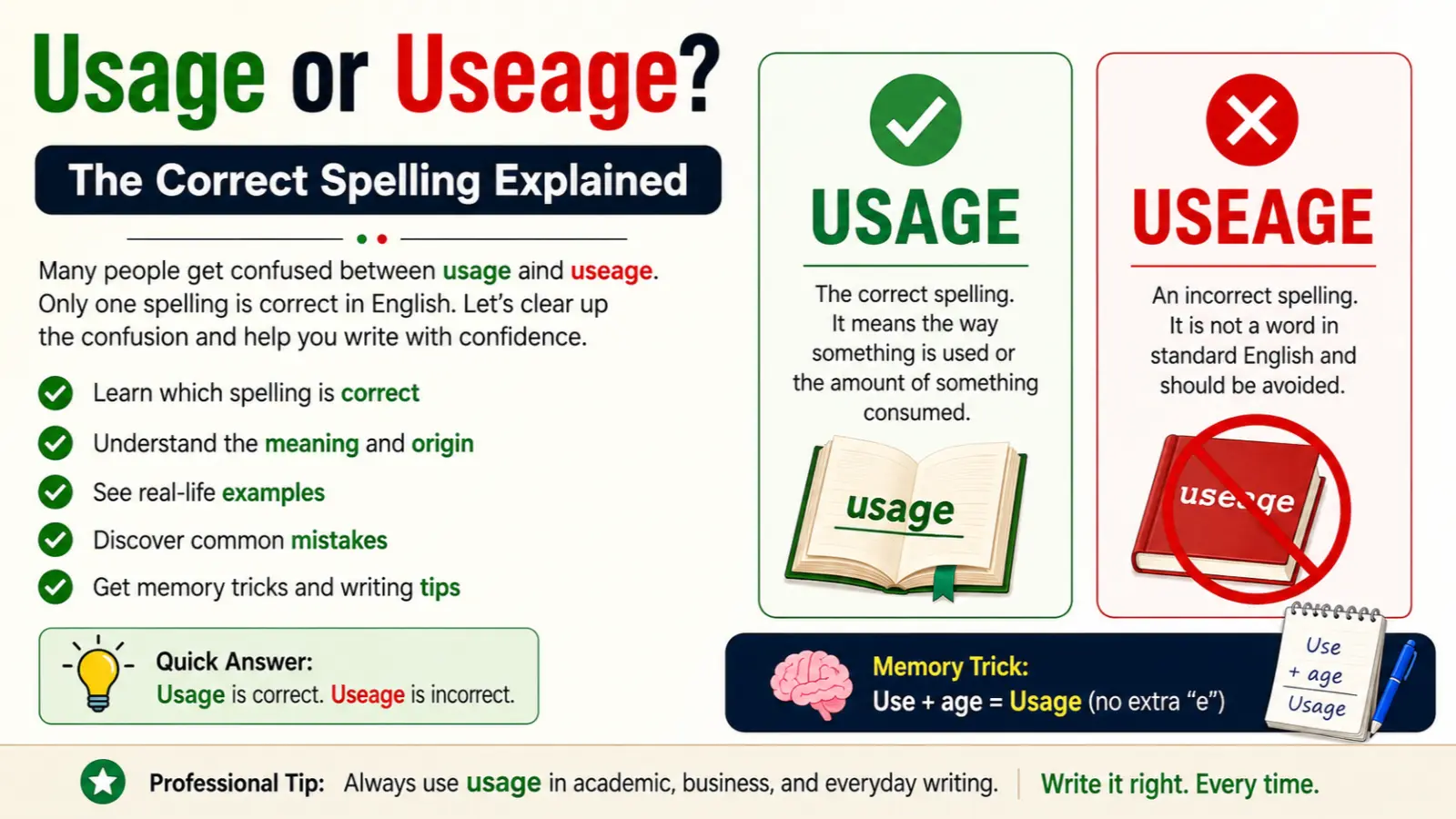
Usage or useage is a common spelling question for English learners, students, writers, and professionals. At first glance, both words seem possible because many English words ending in “age” follow similar spelling patterns.
Usage or Useage is a common spelling question that confuses many English learners and writers.Writers spell it as usage, while useage remains an incorrect spelling in both formal and informal writing. In this guide, you’ll learn the difference, correct meaning, pronunciation, examples, and simple tips to remember the right spelling.
Need a quick answer? Use the copy button to grab the correct spelling, examples, and explanations instantly for assignments, emails, blogs, or social media posts. By the end of this article, you’ll know exactly when and how to use usage with confidence and avoid this common spelling mistake.
The good news is that only one spelling is accepted in modern English. Understanding why the confusion happens will help you avoid mistakes and write with confidence in school, business, and everyday communication.
Quick Answer
Usage is the correct spelling.
Useage is an incorrect spelling and does not appear as a standard word in major English dictionaries. In professional, academic, and everyday writing, always use usage.
Meaning of Both Spellings
Usage
Usage is a noun that refers to the way a word, phrase, object, or resource is used. It can also describe accepted language practices or the amount of something that is consumed.
Examples:
- Correct grammar depends on proper word usage.
- Your monthly data usage increased.
- Dictionary usage changes over time.
Useage
Useage is simply a misspelling of usage. It has no accepted meaning in standard English and should not be used in formal or informal writing.

Comparison Table
| Feature | Usage | Useage |
|---|---|---|
| Correct spelling | ✔ Yes | ✘ No |
| Dictionary word | ✔ Yes | ✘ No |
| Standard English | ✔ Yes | ✘ No |
| Academic writing | ✔ Recommended | ✘ Incorrect |
| Business writing | ✔ Recommended | ✘ Incorrect |
| Everyday writing | ✔ Correct | ✘ Avoid |
Origin
The word usage comes from the Middle English and Old French word usage, which ultimately developed from the verb use. Over centuries, English kept the spelling usage, making it the accepted noun form.
Although many English words ending in age contain an extra “e” before the suffix, usage is one of the exceptions.
Why the Confusion Exists
Many people assume that because the base word is use, the noun should be spelled useage.
The mistake happens because English spelling is not always predictable. Words like marriage, package, and storage make some writers expect an extra e, but usage follows its own historical spelling.
Typing errors and incorrect online content also contribute to the confusion.
Dictionary Recommendations
Leading English dictionaries consistently recognize usage as the only correct spelling.
- Merriam-Webster: usage
- Oxford English Dictionary: usage
- Cambridge Dictionary: usage
- Collins Dictionary: usage
None of these dictionaries list useage as a standard English word.

Real Life Examples
Correct:
- Proper word usage improves your writing.
- Internet usage has increased worldwide.
- Teachers explain correct grammar usage.
- Water usage should be monitored carefully.
- The manual explains the correct usage of the equipment.
Incorrect:
- Proper word useage improves your writing.
- Internet useage has increased.
- Check the useage instructions.

Common Mistakes
Many writers make these errors:
- Adding an unnecessary e after use.
- Assuming every noun ending in age follows the same spelling pattern.
- Copying incorrect spellings from unofficial websites.
- Trusting spell check only after the mistake has become habitual.
Memory Trick
Think of this simple rule:
Use → Usage
There is no extra “e” before age.
A quick reminder:
Use + age = Usage
Not Use + e + age.
Professional Writing Recommendation
If you are writing emails, reports, research papers, articles, resumes, or website content, always choose usage.
Using useage may make your writing appear unprofessional because it is considered a spelling error by dictionaries, editors, and grammar checking tools.
Frequently Asked Questions
Is useage a real word?
No. Useage is a misspelling and is not accepted in standard English.
Which spelling should I use in academic writing?
Always use usage.
Why do people write useage?
People often assume the noun should keep the e from the verb use, but English spelling does not work that way in this case.
Is usage British or American English?
Usage is the correct spelling in both British and American English.
Can grammar checkers detect useage?
Yes. Most grammar and spell checking tools identify useage as a spelling mistake and recommend usage.
Conclusion
When comparing usage and useage, the answer is straightforward. Usage is the only correct spelling recognized by major dictionaries and style guides. Useage is a common misspelling caused by assumptions about English spelling patterns. For clear, accurate, and professional writing, always use usage. Understanding this small difference will help you write more confidently and avoid a mistake that editors quickly notice.

Olivia Bennett is a grammar expert and language content writer at GrammarWize.com. She specializes in English grammar, word usage, spelling differences, and writing improvement. Through clear explanations and practical examples, Olivia helps students, professionals, and language learners communicate more effectively. Her goal is to make English grammar simple, accessible, and easy to apply in everyday writing.